
The total weight of the crane is only the sum of the mass of the equipment and does not indicate how much reversible a particular leg has been at a given point in time. The load is redistributed to one side close to the cap, with a significant increase in the reversibility of some legs and a possible reduction of the other side, when the arm of the crane reaches out, the crane leaves the ground and turns around the side. The distribution results are altered by weight position, leg width, arm length, working radius and turn angles, so that the total weight is divided by an average of four, and the cushion is selected on this basis, which may seriously underestimate the most adverse legs.
Dynamics also need to be taken into account. Rises, brakes, swings, wind formations, small depositions on the ground and operational errors can have additional effects. The maximum reversibility may be transferred from one leg to the other when the crane passes through a different position; the initial calculation may also be invalid if the arm length, radius or leg pattern is changed during the operation. The project should be calculated using retrogressive leg data provided by the manufacturer, on-board system information, or an accredited suspension to cover the entire schedule, rather than choosing a total tonnage that appears conservative.
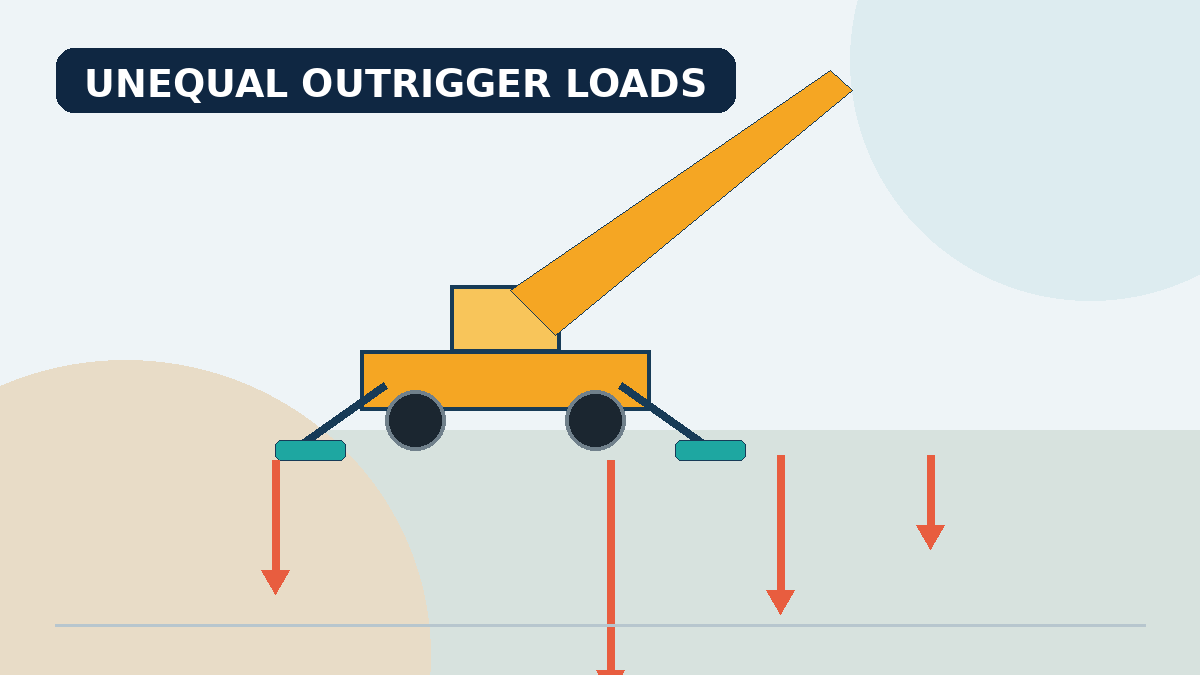
A map of the different retrogressive forces of the legs of the crane in different positions.
The ground is not entirely even. The asphalt surface layer may be loosely filled back and out, and there may be a cleavage next to the concrete, which will change the same site within hours. The leg pads need to pass the identified maximum reversibility to the grass-roots level with sufficient carrying capacity; if the pads cross a soft and hard line, slope or hole, the average area may also be tilted and edged. It is therefore necessary to check underground facilities, high ground marking, drainage and soft layer thickness.
The correct process is usually to confirm the equipment configuration and assembly plan and then obtain the retrogressive leg of each critical condition; then the ground assessment determines the permissible pressure, calculates the area of exposure required, and determines the thickness, rigidity and local pressure of the core pad. The footpad shall be placed in the middle and the mattress surface shall be kept clean and horizontal. Pre-pressure and deposition observations can be made prior to a formal suspension, which is monitored by a dedicated person, and any irregularity requires the cessation of operations.
The buyer should provide the maximum retrogressive force of the leg to the supplier of the leg mat, rather than a description of “80 tons crane” or “50 tons of equipment”. It is also indicated whether the scaffold diameter, mattress handling, minimum temperature, ground type and project need colour coding or numbering. The product recommendation can only be part of the suspension support system and cannot be a substitute for the manufacturer ' s payload table, ground-based evaluation and approved suspension programme.
Need for further evaluation of the actual project?
Applications, sizes, quantities, site photographs or drawings and delivery destinations are sent, on which we can identify more suitable products and processing programmes.







