
For a prior survey, the site should first determine whether the target is a continuous transport, a short-term suspension or a peak stop. Forklifts, tractors, distribution trucks, forklifts with scalding arms and forklifts and cleaning and maintenance vehicles are involved in warehouse swing areas, internal roads and open dumps at industrial parks, while control is required for narrow routes, multiple turnovers and mixed man-to-man carriages, shift of sides, detours and sight masks. When targets, vehicles and vulnerable positions are matched, the scope is not too large or missing critical points; the practical implementation principle is to complete the records of the route, load, ground and operational beats, and to determine the quantity and sequence of the plates.
The project team could complete a joint pedal before the vehicle enters the site, focusing on the transition between grassland and hard roads, low drainage points, ramps and available car space. The retroactivity of the legs of the vehicle ' s axial load, the exterior dimensions, the minimum convective radius and the equipment for the suspension was then collected. Moist salt mists may change the state of the grass-roots level, so measurements need to be date- and weather-specific. All parameters should be consolidated in the same version of the road map and equipment list.
Material parameters should serve the field rather than be propaganda figures. The pavements allow for a clear separation of the temporary driveway from the area of operations, and a leg pad stabilizes the support point for the lift and maintenance equipment. The project allows for a comparison of the 15 mm and the adjacent specifications of the single mass, rigidity, laying efficiency and number of containers, as well as a reconciliation of the links to the surface. 50-80 tonnes are only primary sifts; ground-based and support designs should be completed first when an underground hole, weak shoulder or hanger overload exists.
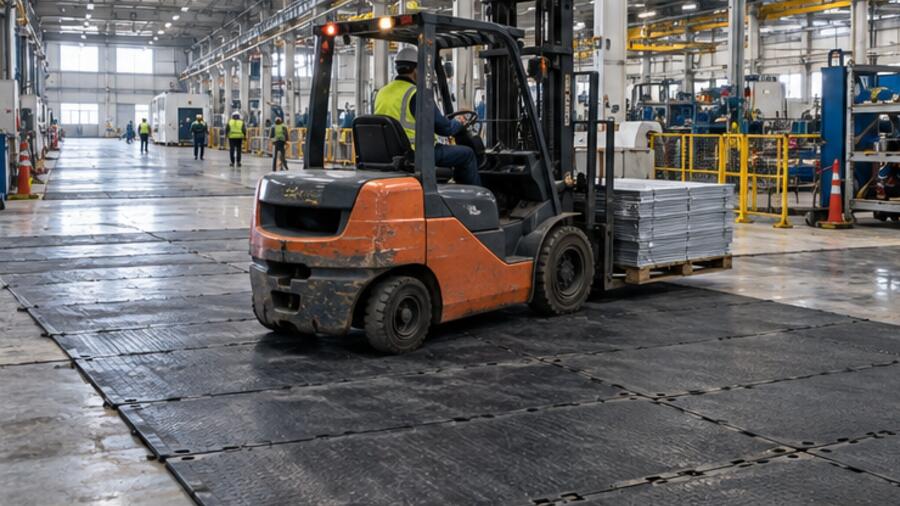
The construction staff should first seal the belts and confirm that no vehicles enter, then clear the floors and tablets. Do not leave the seams in the softest position, and do not let the edges remain open for long periods. Cleaning and installation of sandstones when the link is pierced, so that the connector is not fully in place. A low-speed test pass was completed and a “default move at the lower end of the ramp” was implemented before the next segment was opened.
Maintenance staff can divide the straight-line, turn-out, waiting areas and support points into different levels of inspection. The straight-line sections focus on the sutures and the tracks, turn around and look for lateral shifts, wait areas to see long-term static sinking, and support points to check whether the pads and the ground are sunk. Shorter check intervals after rain or when the traffic suddenly increases; any plate-side rise, loose connection or grass-roots plasma should trigger decommissioning.
In a simulation plan for a warehouse field retrofit project requiring the maintenance of routine incoming and outgoing shipments, the maintenance overhaul phase involves the zonal release of areas that have completed grass-roots processing and plate connectivity, with unaccepted areas remaining isolated. Each region designates a person responsible for the inspection and uses a number corresponding to the photograph. This example does not represent a specific project commitment, but allows the team to keep the load and load while the vehicle remains stable. If the records show repeated maintenance at the same location, they should be re-analysed back to the ground and transport organization.
Auxiliary equipment also affects the overall programme. A leg pad is required to accompany a vehicle, a forklift is required to focus on tyre contact, and a bulk vehicle may require a slab. The suitability of the UHMWPE liner depends on the work temperature, the chemical environment, the material impact and the car structure, and the manufacturer provides the installation requirements. Each product should be matched to specific equipment in the project form to avoid the use of the same parameter across uses.
In order to obtain a comparable offer, the purchaser should harmonize the request for quotations, at least specifying the project schedule and the plan, the route size, vehicle condition, ground condition and project time. Vendors are required to respond to material plates, sheeting, single weight, connection, packaging, containerization and quantity and quality documents. If the project is purchased on a containerized basis, the capability of the forklift or forklift on site or forklift is also confirmed. All safety-related selections are based on the equipment manual and the approval programme.
Need for further evaluation of the actual project?
Applications, sizes, quantities, site photographs or drawings and delivery destinations are sent, on which we can identify more suitable products and processing programmes.







