
The answer to how multi-equipment cross-operations between warehouses and industrial stations should be managed should start with the course of operation and not with a fixed specification. Forklifts, trucks and cranes should be divided into routes and waiting areas, and who has priority access. Forklifts, tractors, distribution trucks, scalding arm forklifts and cleaning and maintenance vehicles are usually present at the same time in the warehouse swing areas, in-house roads and open dumps, with different pressures on tyres, axles and diversions. The narrow route, the high number of turnovers and the mixing of man-cars, the shift of sides, the rise of edges and the protection of sight all require control. The project team shall first delineate the main corridor, the waiting areas, the loading and unloading points and the emergency export, and then the boundary shall be confirmed jointly by the construction, logistics and security authorities.
The survey forms can be completed by the four columns of ground, equipment, route and time. The surface column indicates the softened shoulder of the road near the drainage ditch and the adjacent drainage port; the equipment column lists the vehicle ' s own weight, cargo weight, number of axes and tyre specifications; the route column takes a clean width, slope and turn radius; and the time column describes short-term heavy rainfall and shift arrangements. If a crane is present, it should be based on the retroactivity of the leg in the manufacturer ' s worksheet, and it cannot be rated as a ground load.
Road-paving boards are responsible for spreading wheel pressure and leg mats for expanding static support areas, which cannot be replaced by one another. For this scenario, the pavement will allow for a clear separation of the temporary driveway from the area of operations, and the leg pads will stabilize the support point for the lift and maintenance equipment. 30 mm could be included as an option and compared with other thickness, subject to the simultaneous validation of plate sizes, connection structures, grass-roots stratification and number of passages. The labelling of 160 to 200 tons of products does not mean that all the same vehicles are available on the ground, and ground conditions remain the determining factor.
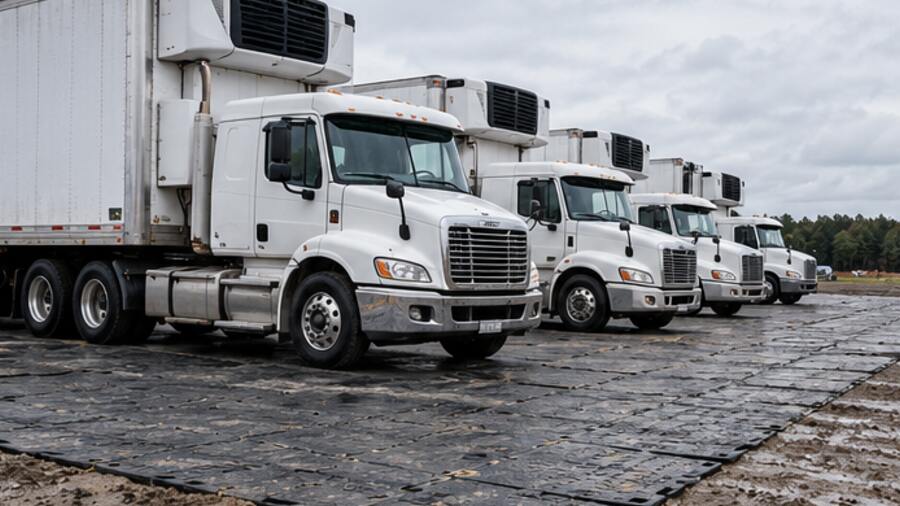
The sequence of laying would allow for the advance from the stable entrance to the area of operations. First, water and high differentials are processed, then the first plate is located; the subsequent plate is consistent in the direction of the texture and check if the seams form the steps. The ramp, turn and brake points shall increase the horizontal constraints or the width of the coverage. For this project, a “review of the original ground condition at the end of the project” could be used as a key action, with a dedicated person recording the time of completion and the results of the review.
Maintenance staff can divide the straight-line, turn-out, waiting areas and support points into different levels of inspection. The straight-line sections focus on the sutures and the tracks, turn around and look for lateral shifts, wait areas to see long-term static sinking, and support points to check whether the pads and the ground are sunk. Shorter check intervals after rain or when the traffic suddenly increases; any plate-side rise, loose connection or grass-roots plasma should trigger decommissioning.
In a simulation plan for a warehouse field retrofit project requiring the maintenance of routine incoming and outgoing shipments, the evacuation site recovery phase was released by zonal release: the area to be completed for grass-roots processing and plate connection was opened and the unaccepted area remained isolated. Each region designates a person responsible for the inspection and uses a number corresponding to the photograph. This example does not represent a specific project commitment, but allows the team to avoid sharing a fuzzy load assumption with different equipment. If the records show repeated maintenance at the same location, they should be re-analysed back to the ground and transport organization.
The bulk material project will also examine car car stickers, impact and wear. The UHMWPE car skateboard can improve offloading when materials, temperature and car structure are appropriate, but it is necessary to confirm fixation, thermal condensation, the end door gap and cleaning methods; it is not a substitute for the safe offloading procedure. If the project does not involve a self-loading vehicle, the budget should be focused on physical access and support points and not add irrelevant configurations to complete product portfolios.
It is best to complete small-scale technical confirmation before the next list. First, the total length of the route, the net width and turn radius and the complete field parameters were submitted to the supplier for specification, quantity and packing advice; then the sample trails, links, dimensions and material documentation were checked; and finally the container type, destination port, method of discharge and batch identification were confirmed. The supplier recommended that it be used only as an input and that the project party remain responsible for the stabilization of the ground load, traffic organization and lifting.
Need for further evaluation of the actual project?
Applications, sizes, quantities, site photographs or drawings and delivery destinations are sent, on which we can identify more suitable products and processing programmes.







