
In the case of night operations, the site should first determine whether the target is a continuous transport, short-term suspension or a temporary stop during peak periods. Forklifts, tractors, distribution trucks, forklifts with scalding arms and forklifts and cleaning and maintenance vehicles are involved in warehouse swing areas, internal roads and open dumps at industrial parks, while control is required for narrow routes, multiple turnovers and mixed man-to-man carriages, shift of sides, detours and sight masks. When targets, vehicles and vulnerable positions are matched, key points are not overstretched or missed; the practical implementation principle is to enhance border marking, lighting, suture visibility and command position at night.
The survey forms can be completed by the four columns of ground, equipment, route and time. The ground column indicates the boundary between old concrete and new backfills and the adjacent drainage vents; the equipment column lists the vehicle ' s own weight, cargo weight, number of axes and tyre specifications; the route column takes a clean width, slope and turn radius; and the time column describes the wet salt fog and the schedule. If a crane is present, it should be based on the retroactivity of the leg in the manufacturer ' s worksheet, and it cannot be rated as a ground load.
Product selection should be differentiated by stress. The pavements allow for a clear separation of the temporary driveway from the area of operations, and a leg pad stabilizes the support point for the lift and maintenance equipment. 15, 20, 25 and 30 mm are in the common thickness range and 25 mm can only serve as a starting point for comparison for this project; if there are holes or sediments at the grass-roots level, the increase in thickness is not a substitute for peace and reinforcement. The 120 to 160 tonnes in the product information should also be understood in conjunction with the test conditions, with the final specifications to be confirmed by the approved programme and field professionals.
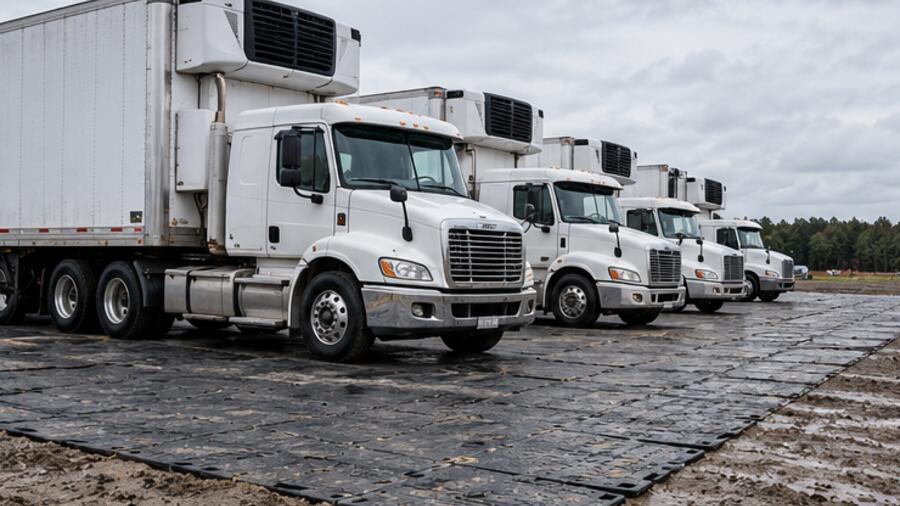
When the plates arrive at the site, the quantity, the connector and the crane are checked and the goods are discharged by route number. Upon completion of the grass-roots level, the vehicle entrance is prepared in sub-sections, and the level and edge support is checked at each stage of completion. The leg area of operation shall be separated from the area of passage. The inclusion in the installation programme of an “adjusting of the route ahead of schedule in accordance with weather forecasts” would allow field personnel to convert abstract requirements into detectable actions.
Following the opening of access, the focus of the inspection was on the continued support under the plate. The first heavy vehicle passes by to check for high seams, peripheries, mudslides and planks; the shift is repeated after weather changes. The pressure of contact of the forklift ' s solid-heart wheel differs significantly from the concentrated static of the crane ' s legs, and anomalies should be detected first in isolation before being drained, evened or replaced, and the subsequent flow of the vehicle cannot continue to magnify the damage.
Assuming that a warehouse site retrofit project requiring the maintenance of day-to-day incoming and outgoing shipments is subject to increased traffic during the maintenance overhaul phase, managers can first freeze route changes and then divide problems into four categories: ground, board, vehicle and movement control. Weak positions are reinforced, damage plates are replaced, vehicles are limited in speed, and one-way access is introduced for peak hours. The example does not correspond to the true customer, but shows how the supplier ' s offer is based on uniform parameters and how the on-site judgement is converted into a reusable list for the next project.
In the integrated site, different problems were solved by the pavement, leg mats and carboards. Vehicle traffic is supported by a continuous focus on the maximum retroactivity of the leg and the friction and adhesion of material from the surface of the vehicle. If MHMWPE skateboards are used, thermal stretches should be set aside and fixed systems checked; if relevant material is not available at the site, they should be removed from the list and the investment targeted.
The maximum reversibility of the crane leg must be present in the request for quotations, otherwise it is likely that the different suppliers will base their calculations on different assumptions. The procurement staff shall also require the description of the effective size, weight, number of attachments, packing units, container load and delivery cycle of each plate. The evaluation will be based on technical conformity, installation efficiency and turnover. Where key payloads or ground data have not been confirmed, the quotations should be marked as preliminary and the review retained.
Need for further evaluation of the actual project?
Applications, sizes, quantities, site photographs or drawings and delivery destinations are sent, on which we can identify more suitable products and processing programmes.







