
The answer to how vehicle traffic in warehouses and industrial sites arranges for installation and vehicle movement should start with the operational route rather than with a fixed specification. The installation area should be linked to the vehicle release plan to avoid connecting personnel to the plates in unseparated traffic. Forklifts, tractors, distribution trucks, scalding arm forklifts and cleaning and maintenance vehicles are usually present at the same time in the warehouse swing areas, in-house roads and open dumps, with different pressures on tyres, axles and diversions. The narrow route, the high number of turnovers and the mixing of man-cars, the shift of sides, the rise of edges and the protection of sight all require control. The project team shall first delineate the main corridor, the waiting areas, the loading and unloading points and the emergency export, and then the boundary shall be confirmed jointly by the construction, logistics and security authorities.
On-site measurements cover areas within the airport perimeter that are sensitive to the soil and record weak ranges, slopes, drainage directions and underground pipes. Changes in the water-bearing state and the car tracks should be observed before and after short and heavy rainfall. Mobile equipment will need to provide the whole vehicle with its own weight, full load weight, a single axle load, tyre size, turn radius and projected duration; the crane will also need to provide the maximum reversibility of the leg and leg extension. Data sources and measurement dates should also be recorded to avoid different versions.
Product selection should be differentiated by stress. The pavements allow for a clear separation of the temporary driveway from the area of operations, and a leg pad stabilizes the support point for the lift and maintenance equipment. 15, 20, 25 and 30 mm are in the common thickness range and 25 mm can only serve as a starting point for comparison for this project; if there are holes or sediments at the grass-roots level, the increase in thickness is not a substitute for peace and reinforcement. The 120 to 160 tonnes in the product information should also be understood in conjunction with the test conditions, with the final specifications to be confirmed by the approved programme and field professionals.
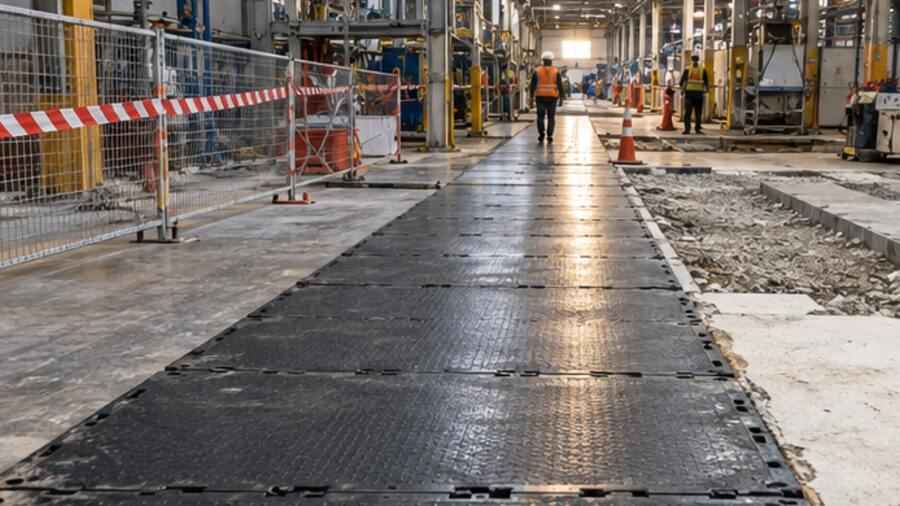
Pre-installation to remove sharp waste, loose rock and mobile mud, and to purge and level the ground. The plates were set up in the main direction and were sewd to avoid the deep path and to check the wells and legs. The turn and reverse areas are to be slightly wider and the connectors are to be locked as required. It should also be implemented at the site “to protect panel-lined roads using soft and clean tools”, and this requirement should be included at the end of the shift and in the traffic organization chart.
The day-to-day management will include vehicle behaviour in the inspection. Speed-limiting, prohibition of in-situ movement, fixed reverse routes and placement of commanders are often more effective than simply adding plates. The inspectors should touch or step on the suspicious seams, check the links and take photographs to locate them. Where there are repeated shifts, the width of the road, the turn radius and the grass-roots level should be re-evaluated, rather than the continuous consolidation of the same position.
For a warehouse site retrofit project that requires the maintenance of day-to-day deliveries and deliveries, the evacuation site recovery phase could be established as an independent inspection node. On-site identification of vehicle lists and weather is followed by a check of drainage, connections and borders; if any conditions change, release is suspended and the road map updated. This scenario was used only to illustrate the way the project was organized, with an emphasis on reducing the probability of the floor being directly crushed by tyres and legs. It should also record the number of inputs, the time of laying, the time of stoppage, the location of maintenance and the condition of the ground after the evacuation site.
If the transport chain contains coal, ore, wet soil or food, self-release efficiency may be assessed as an independent subject. Car skateboards help to reduce the adhesiveness of certain materials, but prior to installation, the lining thickness, scalables, bolts or presses and tail door motion space should be confirmed. If there is no need for bulk discharges, there is no need to add the subparagraph; the procurement programme should be consistent with the use.
In order to obtain a comparable offer, the purchaser should harmonize the request for quotations to at least specify the site manager and the security clearance process, route size, vehicle condition, ground condition and project time. Vendors are required to respond to material plates, sheeting, single weight, connection, packaging, containerization and quantity and quality documents. If the project is purchased on a containerized basis, the capability of the forklift or forklift on site or forklift is also confirmed. All safety-related selections are based on the equipment manual and the approval programme.
Need for further evaluation of the actual project?
Applications, sizes, quantities, site photographs or drawings and delivery destinations are sent, on which we can identify more suitable products and processing programmes.







