
For drainage protection, the site should first determine the target of access: whether it is a continuous transport, short-term suspension or a temporary stop during peak periods. Forklifts, tractors, distribution trucks, forklifts with scalding arms and forklifts and cleaning and maintenance vehicles are involved in warehouse swing areas, internal roads and open dumps at industrial parks, while control is required for narrow routes, multiple turnovers and mixed man-to-man carriages, shift of sides, detours and sight masks. When targets, vehicles and vulnerable positions are matched, they are laid in such a way that key points are not overstretched or missed; the practical implementation principle is that water under the plate weakens the grass-roots level and takes the finer, and the drainage direction must be preserved and the export can be cleared.
On-site measurements cover parking belts where long-term parked vehicles form part-sink, recording weak ranges, slopes, drainage directions and underground pipes. The wet salt fog should be followed by a change in the water-bearing state and the car trail, respectively. Mobile equipment will need to provide the whole vehicle with its own weight, full load weight, a single axle load, tyre size, turn radius and projected duration; the crane will also need to provide the maximum reversibility of the leg and leg extension. Data sources and measurement dates should also be recorded to avoid different versions.
Where the route has both a mobile device and a fixed support point, the choice should be made between the pavement and the leg pad, respectively. The pavements allow for a clear separation of the temporary driveway from the area of operations, and a leg pad stabilizes the support point for the lift and maintenance equipment. The thickness can be screened from commonly used specifications such as 15, 20, 25, 30 mm, and the 20 mm appearing in this article does not constitute a direct recommendation. For information on ranges of 80 to 120 tons, the purchaser should also request a test method and give priority to the equipment description, construction programme and on-site validation.
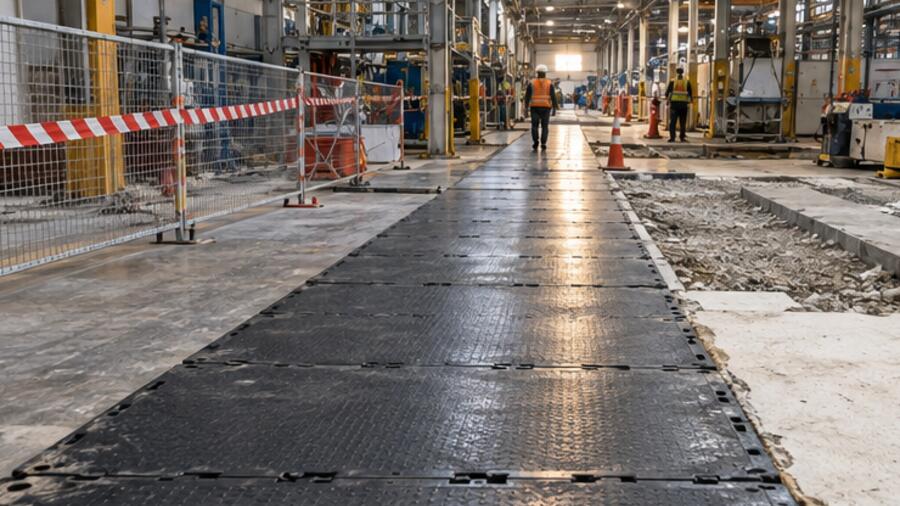
The fast-track installation still requires the retention of basic processes: drainage, debarment, peace-building, positioning, connection and trial passage. The plates remain continuous in line segments, leaving sufficient width at the intersections and outside areas; and they are to be removed from the rigid surface interface. The project leader should arrange for “the immediate decommissioning of the mud when it is discovered that it is coming out of the seams”, while specifying the conditions for its decommissioning, so as to prevent irregularity from being left to the next group during rush hours.
Temporary roads cannot be paved for long. Vehicle brakes, loading overloading and water stowing can gradually change the support under the plate, and surfaces may appear flat and may have created gaps. The site should be inspected before and after peak traffic, after damp salt fog and when the route is changed. In the event of a sinking, the ground and drainage should be checked before deciding whether to change or replace the panels, so as to avoid covering up the problem by filling the panels.
In the case of a warehouse site retrofit project that requires the maintenance of routine shipments and deliveries, the site could be divided into five areas, which would be located at the maintenance and overhaul stage. The entry point is responsible for vehicle reconciliation, maintaining continuous coverage of the straight-line segment, increasing the outer width of the turn-band, separate validation of the operating segment and completion of clean bundles in the recovery area. This simulation programme is used to illustrate the methodology and is not a client-specific performance; it can help the project team to recycle the panels to the next stage and keep a record of the number of maintenances and the length of breaks.
Three products may be used in this category at the same time, but the boundaries of the use are clear: road-painted service vehicle routes, leg-past services are centrally supported, and carboard services are applied to bulk discharges. In particular, UHMWPE skateboards need to check the material particle size, water content rate, temperature, impact and car shape. No product could compensate for the error, and the configuration list should be deleted from the field mission.
It is best to complete small-scale technical confirmation before the next list. First, the sample or small-scale trial shop needs and complete field parameters are submitted, allowing the supplier to give specifications, quantities and packaging advice; then the sample textures, connections, dimensions and material documents are checked; and finally the container type, destination port, discharge method and batch identification are identified. The supplier recommended that it be used only as an input and that the project party remain responsible for the stabilization of the ground load, traffic organization and lifting.
Need for further evaluation of the actual project?
Applications, sizes, quantities, site photographs or drawings and delivery destinations are sent, on which we can identify more suitable products and processing programmes.







