
Short-term construction at port repairs, logistics peaks, airport maintenance windows and industrial sites has a direct impact on the ability of vehicles to reach their operational areas as planned. Recycling equipment is commonly installed in field transport trucks, forklifts, engineering vehicles and plates, with different dynamic voltages, stationary loads and power. In the event that work is done in a manner that spares water, flattens, connects and inspects, the passageway will result in the wrong station or shift after the first heavy vehicle has been completed. The programme should, therefore, first target routes and time windows that must be kept open, before arranging for materials and personnel to avoid temporary changes in rules of passage on the construction side.
On-site measurements cover narrow slopes with insufficient convective radiuss for heavy vehicles, recording weak ranges, slopes, drainage directions and underground pipes. Changes in the water-bearing state and the car tracks should be observed before and after short and heavy rainfall. Mobile equipment will need to provide the whole vehicle with its own weight, full load weight, a single axle load, tyre size, turn radius and projected duration; the crane will also need to provide the maximum reversibility of the leg and leg extension. Data sources and measurement dates should also be recorded to avoid different versions.
The selection is based on the calculation of the local pressure and the examination of whether the plate remains continuous at the grass-roots level. The HDPE pavement with access holes and smooth-lined roads is suitable for modularization and can be moved to the next item after cleaning. The common thickness ranges from 15 mm to 30 mm, and this option can first assess 20 mm and then adjust it through trial preparation or project accounting. The so-called 80 to 120-ton carrier should have a clear test boundary and cannot be cited separately from the distance, temperature, payload distribution and safety factor.
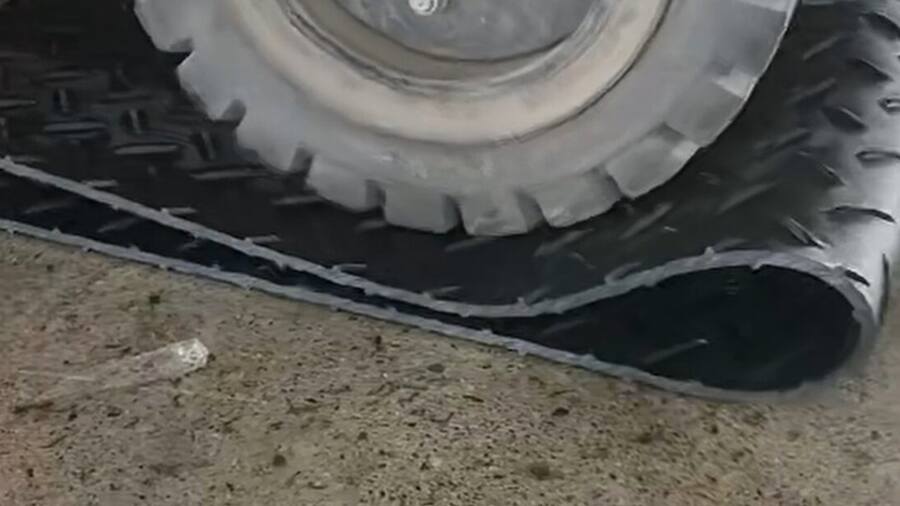
Pre-installation to remove sharp waste, loose rock and mobile mud, and to purge and level the ground. The plates were set up in the main direction and were sewd to avoid the deep path and to check the wells and legs. The turn and reverse areas are to be slightly wider and the connectors are to be locked as required. The site should also implement “drain and prepare cleaning tools before the rain” and include this requirement at the end of the shift and in the traffic organization chart.
Maintenance staff can divide the straight-line, turn-out, waiting areas and support points into different levels of inspection. The straight-line sections focus on the sutures and the tracks, turn around and look for lateral shifts, wait areas to see long-term static sinking, and support points to check whether the pads and the ground are sunk. Shorter check intervals after rain or when the traffic suddenly increases; any plate-side rise, loose connection or grass-roots plasma should trigger decommissioning.
In the case of a temporary mission requiring a site to be laid on the same day and to be vacated immediately after the completion of operations, the site could be divided into five areas for entry, straight march, turn, operation and recovery during the pre-entry phase. The entry point is responsible for vehicle reconciliation, maintaining continuous coverage of the straight-line segment, increasing the outer width of the turn-band, separate validation of the operating segment and completion of clean bundles in the recovery area. This simulation programme is used to illustrate the methodology and is not a client-specific performance; it helps project teams to synchronize the clean-up and classification of panels when they are evacuated and to keep records of the number of maintenances and the length of breaks.
The bulk material project will also examine car car stickers, impact and wear. The UHMWPE car skateboard can improve offloading when materials, temperature and car structure are appropriate, but it is necessary to confirm fixation, thermal condensation, the end door gap and cleaning methods; it is not a substitute for the safe offloading procedure. If the project does not involve a self-loading vehicle, the budget should be focused on physical access and support points and not add irrelevant configurations to complete product portfolios.
In order to obtain a comparable offer, the purchaser should harmonize the request for quotations to at least indicate the back-up ratio and the conditions for on-site maintenance, route size, vehicle condition, ground condition and project time. Vendors are required to respond to material plates, sheeting, single weight, connection, packaging, containerization and quantity and quality documents. If the project is purchased on a containerized basis, the capability of the forklift or forklift on site or forklift is also confirmed. All safety-related selections are based on the equipment manual and the approval programme.
Need for further evaluation of the actual project?
Applications, sizes, quantities, site photographs or drawings and delivery destinations are sent, on which we can identify more suitable products and processing programmes.







