
Case data have a direct impact on the ability of vehicles to access the operational surface as planned, with short-term construction at port repairs, logistics peaks, airport maintenance windows and industrial sites. Recycling equipment is commonly installed in field transport trucks, forklifts, engineering vehicles and plates, with different dynamic voltages, stationary loads and power. In the event that work is done in a manner that spares water, flattens, connects and inspects, the passageway will result in the wrong station or shift after the first heavy vehicle has been completed. The programme should, therefore, first target routes and time windows that must be kept open, before arranging for materials and personnel to avoid temporary changes in rules of passage on the construction side.
In order to determine whether the case data are enforceable, the site should be set up at a point rather than taking only a few photographs. In particular, soften shoulders close to drains should be reviewed, as dry surfaces do not represent a continuous carrying of the lower part. The project information shall also include the maximum daily traffic, the duration of the vehicle ' s stay, the direction of loading and unloading, and the drainage route during short and heavy rainfall. For troughs, inspection wells and underground facilities, the prohibited support or need to be reinforced should be indicated in the road map.
Where the route has both a mobile device and a fixed support point, the choice should be made between the pavement and the leg pad, respectively. The HDPE pavement with access holes and smooth-lined roads is suitable for modularization and can be moved to the next item after cleaning. The thickness can be screened from commonly used specifications such as 15, 20, 25 and 30 mm, and the 30 mm appearing in this section does not constitute a direct recommendation. For information ranging from 160 to 200 tons, the purchaser should also request the test method and give priority to the equipment description, construction programme and on-site validation.
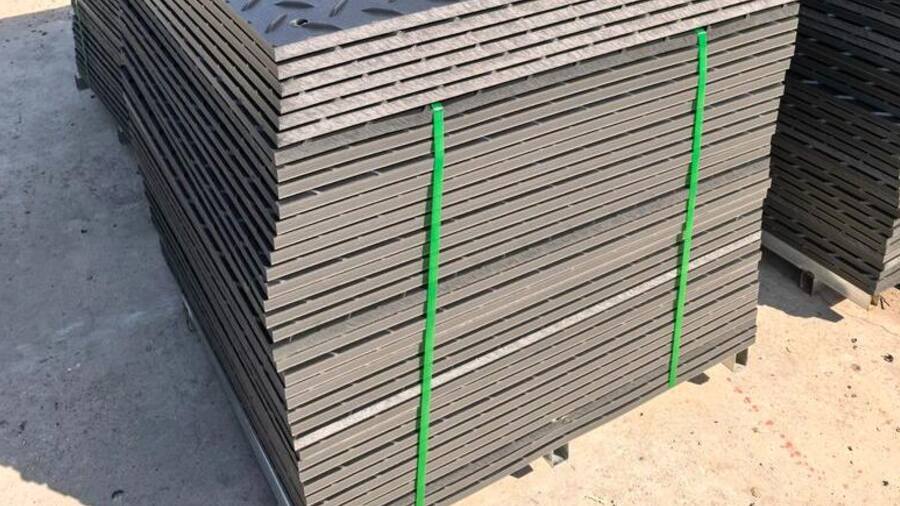
The construction staff should first seal the belts and confirm that no vehicles enter, then clear the floors and tablets. Do not leave the seams in the softest position, and do not let the edges remain open for long periods. Cleaning and installation of sandstones when the link is pierced, so that the connector is not fully in place. A low-speed test traffic was completed and the “dismantling of bulk and sharp material before being removed” was implemented before the next section was opened.
Following the opening of access, the focus of the inspection was on the continued support under the plate. The first heavy vehicle passes by to check for high seams, peripheries, mudslides and planks; the shift is repeated after weather changes. The pressure of contact of the forklift ' s solid-heart wheel differs significantly from the concentrated static of the crane ' s legs, and anomalies should be detected first in isolation before being drained, evened or replaced, and the subsequent flow of the vehicle cannot continue to magnify the damage.
A reference scenario is a temporary route mission that requires that the site be laid on the same day and evacuated immediately after the completion of operations. The project involves short-term trial preparation during the start-up phase, recording the relocation and deposition of the first vehicle after its adoption, and a gradual extension of the route. The turn areas, parking areas and pick-up points are inspected separately and no result is used to replace the full condition. This is an example of a methodology rather than a statement of performance, and the expected management effect is to make it possible for both laying and recycling to be carried over in shifts; after completion, a comparison between the original ground photographs, cleaning hours and the number of plates that can be used on a continuous basis is required.
Three products may be used in this category at the same time, but the boundaries of the use are clear: road-painted service vehicle routes, leg-past services are centrally supported, and carboard services are applied to bulk discharges. In particular, UHMWPE skateboards need to check the material particle size, water content rate, temperature, impact and car shape. No product could compensate for the error, and the configuration list should be deleted from the field mission.
The request for quotations must have a total length of route, net width and turn radius, otherwise it is likely that different suppliers would have based their calculations on different assumptions. The procurement staff shall also require the description of the effective size, weight, number of attachments, packing units, container load and delivery cycle of each plate. The evaluation will be based on technical conformity, installation efficiency and turnover. Where key payloads or ground data have not been confirmed, the quotations should be marked as preliminary and the review retained.
Need for further evaluation of the actual project?
Applications, sizes, quantities, site photographs or drawings and delivery destinations are sent, on which we can identify more suitable products and processing programmes.







