
The answer to how the rapid installation and recycling of temporary roads should design the demolition and recycling process should start with the operational route rather than with a fixed specification. Recovery should be carried out in reverse at the end of the portal, while cleaning, checking, sorting and binding should be completed. Port recovery, logistics peaks, airport maintenance windows and short-term construction of industrial sites usually combine transport trucks, forklifts, engineering vehicles and plates with recovery equipment, with different pressures on tyres, axles and shifting patterns. In the event that work is done in a manner that spares water, flattens, connects and inspects, the passageway will result in the wrong station or shift after the first heavy vehicle has been completed. The project team shall first delineate the main corridor, the waiting areas, the loading and unloading points and the emergency export, and then the boundary shall be confirmed jointly by the construction, logistics and security authorities.
The survey forms can be completed by the four columns of ground, equipment, route and time. The surface column indicates the interior floor and the adjacent drainage vents that require the protection of epoxy coating; the equipment column lists vehicle self-heaviness, cargo weight, axle numbers and tyre specifications; the route column takes a clean width, slope and turn radius; and the time bar indicates cryogenic freezing and shift arrangements. If a crane is present, it should be based on the retroactivity of the leg in the manufacturer ' s worksheet, and it cannot be rated as a ground load.
Road-paving boards are responsible for spreading wheel pressure and leg mats for expanding static support areas, which cannot be replaced by one another. For this scenario, the HDPE pavement board with a connection to the hole and a smooth-lined road is suitable for modularization and can be moved to the next item after cleaning. 15 mm could be included as an option and compared with other thickness, provided that the size of the plate, the connection structure, the base level and the number of passages were verified. The labelling of 50 to 80 tons of products does not mean that all the same vehicles are available on the ground, and ground conditions remain the determining factor.
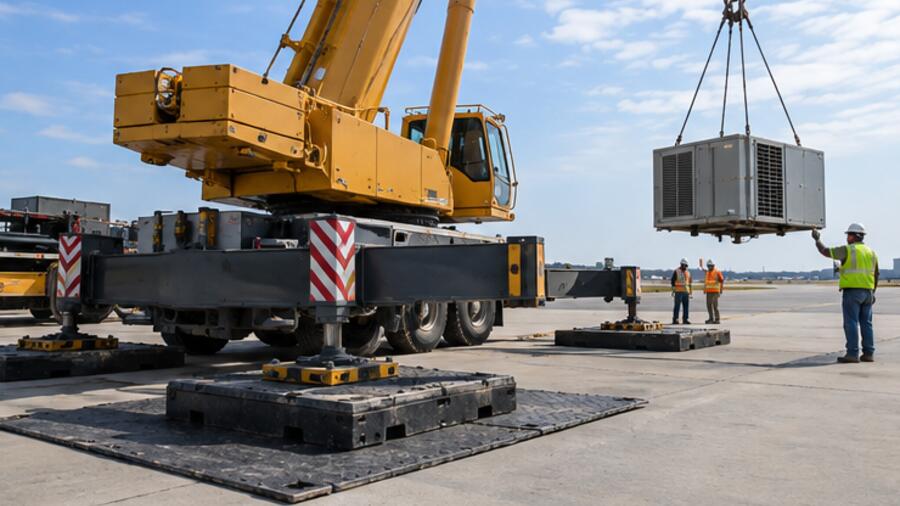
The construction staff should first seal the belts and confirm that no vehicles enter, then clear the floors and tablets. Do not leave the seams in the softest position, and do not let the edges remain open for long periods. Cleaning and installation of sandstones when the link is pierced, so that the connector is not fully in place. A low-speed test pass was completed and a “default move at the lower end of the ramp” was implemented before the next segment was opened.
Maintenance staff can divide the straight-line, turn-out, waiting areas and support points into different levels of inspection. The straight-line sections focus on the sutures and the tracks, turn around and look for lateral shifts, wait areas to see long-term static sinking, and support points to check whether the pads and the ground are sunk. Shorter check intervals after rain or when the traffic suddenly increases; any plate-side rise, loose connection or grass-roots plasma should trigger decommissioning.
In the case of a temporary access task requiring that the site be paved on the same day and evacuated immediately after the completion of operations, the site could be divided into five areas for entry, straight march, turn, operation and recovery during the maintenance and repair phase. The entry point is responsible for vehicle reconciliation, maintaining continuous coverage of the straight-line segment, increasing the outer width of the turn-band, separate validation of the operating segment and completion of clean bundles in the recovery area. This simulation programme is used to illustrate the methodology and is not a client-specific performance; it can help the project team to separate the main wheel tracks of heavy vehicles from the people ' s lanes and leave a record of the number of maintenances and the length of breaks.
Three products may be used in this category at the same time, but the boundaries of the use are clear: road-painted service vehicle routes, leg-past services are centrally supported, and carboard services are applied to bulk discharges. In particular, UHMWPE skateboards need to check the material particle size, water content rate, temperature, impact and car shape. No product could compensate for the error, and the configuration list should be deleted from the field mission.
In addition to the total area, requests for quotations should include quality documentation, batch retroactive and acceptance methods, as well as a description of the country, the duration, the conditions of handling, the manner of packing and the port of destination. Compared suppliers can check the documentation, size difference, surface routing, connector, piece weight, effective area coverage, cabinet list and batch retroactive. The whole container shall be purchased in advance to confirm the discharge equipment. The final programme, which involves the safety of the ground, assembly or operation of the airport, must be approved by the project professional.
Need for further evaluation of the actual project?
Applications, sizes, quantities, site photographs or drawings and delivery destinations are sent, on which we can identify more suitable products and processing programmes.







