
Which of the most common questions for temporary road rapid installation and recycling sites cannot be answered with single product parameters. Project leaders need to view both traffic organization, ground support and maintenance capabilities; most of the problems are concentrated on inadequate drainage, discontinuity at the grass-roots level, loose connectivity, upsliding and the wrong turn. When transport trucks, forklifts, engineering vehicles and slabs are recycled into ports for repairs, logistics peaks, airport maintenance windows and short-term construction at industrial sites, problems with turnovers, ramps, seams and waiting positions on routes may arise earlier than normal straight-line segments and should be individually marked on drawings.
In order to determine whether common problems could be implemented, a spot should be set up, rather than just a few photographs. In particular, a review of the temporary intersection shared between construction and production is to be undertaken, as the surface is dry and does not represent a continuous carrying of the lower part. Information on the project should also include the maximum daily traffic, the length of vehicle stay, the direction of handling and the drainage route during high-temperature tan. For troughs, inspection wells and underground facilities, the prohibited support or need to be reinforced should be indicated in the road map.
Product selection should be differentiated by stress. The HDPE pavement with access holes and smooth-lined roads is suitable for modularization and can be moved to the next item after cleaning. 15, 20, 25 and 30 mm are in the common thickness range and 30 mm can only serve as a starting point for comparison for this project; if there are holes or sediments at the grass-roots level, the increase in thickness is not a substitute for peace and reinforcement. The 160 to 200 tonnes in the product information should also be understood in conjunction with the test conditions, with the final specifications to be confirmed by the approved programme and field professionals.
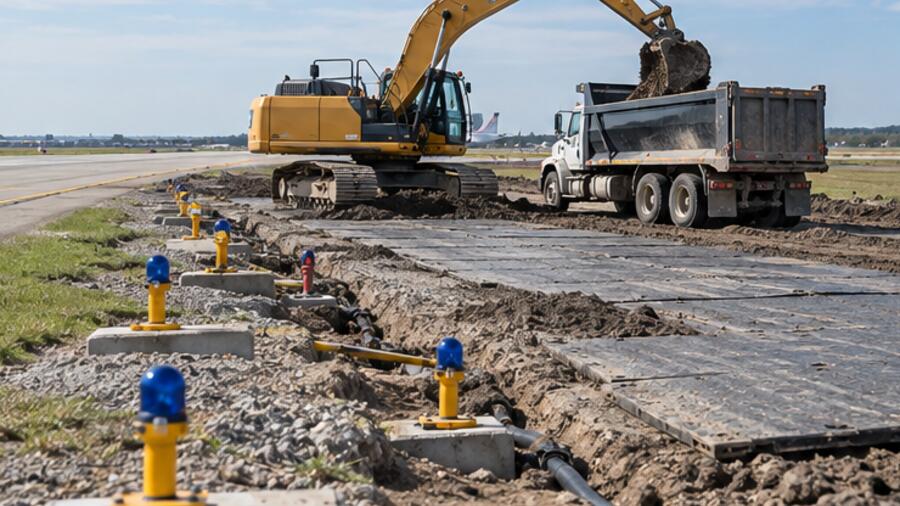
When the plates arrive at the site, the quantity, the connector and the crane are checked and the goods are discharged by route number. Upon completion of the grass-roots level, the vehicle entrance is prepared in sub-sections, and the level and edge support is checked at each stage of completion. The leg area of operation shall be separated from the area of passage. The inclusion in the installation programme of “place the back-up sheet near a weak section” would allow field personnel to convert abstract requirements into actionable.
Maintenance staff can divide the straight-line, turn-out, waiting areas and support points into different levels of inspection. The straight-line sections focus on the sutures and the tracks, turn around and look for lateral shifts, wait areas to see long-term static sinking, and support points to check whether the pads and the ground are sunk. Shorter check intervals after rain or when the traffic suddenly increases; any plate-side rise, loose connection or grass-roots plasma should trigger decommissioning.
In the case of a temporary route mission requiring that the site be laid on the same day and vacated immediately after completion of operations, the site could be divided into five areas during the peak transport phase, straight, turning, operating and recycling. The entry point is responsible for vehicle reconciliation, maintaining continuous coverage of the straight-line segment, increasing the outer width of the turn-band, separate validation of the operating segment and completion of clean bundles in the recovery area. The simulation programme is used to illustrate the methodology and is not a client-specific performance; it can help the project team to reduce vehicle mud into the hardened area and leave a record of the number of maintenances and the length of breaks.
If the transport chain contains coal, ore, wet soil or food, self-release efficiency may be assessed as an independent subject. Car skateboards help to reduce the adhesiveness of certain materials, but prior to installation, the lining thickness, scalables, bolts or presses and tail door motion space should be confirmed. If there is no need for bulk discharges, there is no need to add the subparagraph; the procurement programme should be consistent with the use.
It is best to complete small-scale technical confirmation before the next list. First, the expected delivery period and arrival sequence and complete field parameters are submitted, allowing the supplier to give specifications, quantities and packing suggestions; then the sample trail, connection holes, size differences and material documents are checked; and finally, the container type, destination port, discharge method and batch identification are identified. The supplier recommended that it be used only as an input and that the project party remain responsible for the stabilization of the ground load, traffic organization and lifting.
Need for further evaluation of the actual project?
Applications, sizes, quantities, site photographs or drawings and delivery destinations are sent, on which we can identify more suitable products and processing programmes.







