
In processing the acceptance criteria, “where to go, what to go, how many times a day” is written as a verifiable on-site condition. Port repairs, logistics peaks, airport maintenance windows and short-term construction of industrial sites often include transport trucks, forklifts, engineering vehicles and the installation of recovery equipment on board, with only full tonnage neglecting the impact of tyre exposure and low-speed turns. The more reliable conclusion is that the acceptance and inspection is to check the continuity of the route, the high seams, the stability of the surface, the clarity of the border and the obstruction of drainage, and then determine the combination of pavement, leg mats or local grass-roots treatment.
In order to determine whether or not the acceptance criteria are being implemented, a spot should be set up, rather than just a few photographs. In particular, the boundary between old concrete and new landfills is to be reviewed, as drying of the surface does not mean continuous carrying of the lower part. The project information should also include the maximum daily traffic, the length of vehicle stay, the direction of handling and the drainage route during the wet salt fog. For troughs, inspection wells and underground facilities, the prohibited support or need to be reinforced should be indicated in the road map.
Material parameters should serve the field rather than be propaganda figures. The HDPE pavement with access holes and smooth-lined roads is suitable for modularization and can be moved to the next item after cleaning. The project allows for a comparison of the 25 mm and the adjacent specifications of the single mass, rigidity, laying efficiency and number of containers, as well as a reconciliation of the links to the surface. Between 120 and 160 tonnes are initial sifts only; ground-based and support designs should be completed first when an underground hole, weak shoulder or hanger overload exists.
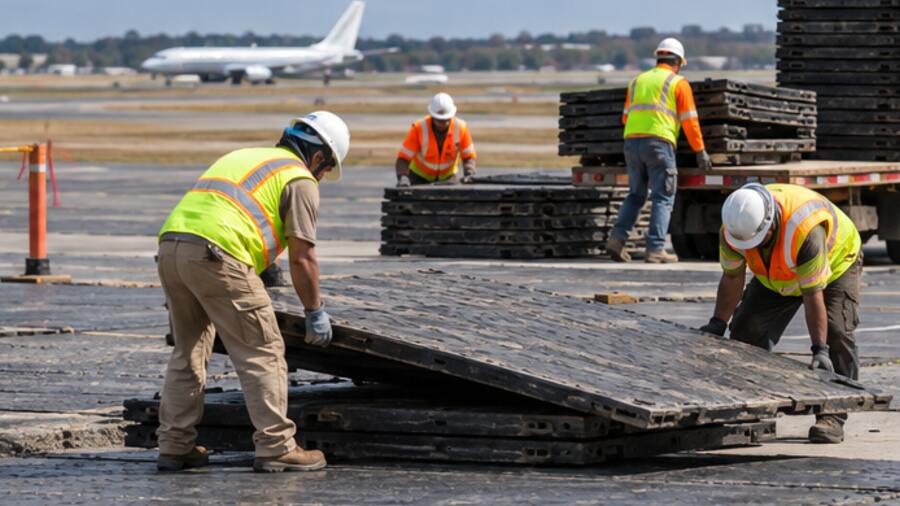
Pre-installation to remove sharp waste, loose rock and mobile mud, and to purge and level the ground. The plates were set up in the main direction and were sewd to avoid the deep path and to check the wells and legs. The turn and reverse areas are to be slightly wider and the connectors are to be locked as required. It should also be implemented at the site “to protect panel-lined roads using soft and clean tools”, and this requirement should be included at the end of the shift and in the traffic organization chart.
The day-to-day management will include vehicle behaviour in the inspection. Speed-limiting, prohibition of in-situ movement, fixed reverse routes and placement of commanders are often more effective than simply adding plates. The inspectors should touch or step on the suspicious seams, check the links and take photographs to locate them. Where there are repeated shifts, the width of the road, the turn radius and the grass-roots level should be re-evaluated, rather than the continuous consolidation of the same position.
In a simulation plan for a temporary route mission that requires a site to be laid on the same day and to be evacuated immediately after the completion of the operation, the evacuation site recovery phase involves the zonal release of the area that has completed the grass-roots process and the plate link, while the unaccepted area remains isolated. Each region designates a person responsible for the inspection and uses a number corresponding to the photograph. This example does not represent a specific project commitment, but allows the team to separate the temporary post from the main traffic route. If the records show repeated maintenance at the same location, they should be re-analysed back to the ground and transport organization.
The bulk material project will also examine car car stickers, impact and wear. The UHMWPE car skateboard can improve offloading when materials, temperature and car structure are appropriate, but it is necessary to confirm fixation, thermal condensation, the end door gap and cleaning methods; it is not a substitute for the safe offloading procedure. If the project does not involve a self-loading vehicle, the budget should be focused on physical access and support points and not add irrelevant configurations to complete product portfolios.
The request for quotations shall, in addition to the total area, provide the maximum resonance of the legs of the crane, indicating the country, the duration, the conditions of handling, the manner of packing and the port of destination. Compared suppliers can check the documentation, size difference, surface routing, connector, piece weight, effective area coverage, cabinet list and batch retroactive. The whole container shall be purchased in advance to confirm the discharge equipment. The final programme, which involves the safety of the ground, assembly or operation of the airport, must be approved by the project professional.
Need for further evaluation of the actual project?
Applications, sizes, quantities, site photographs or drawings and delivery destinations are sent, on which we can identify more suitable products and processing programmes.







