
The answer to the configuration of the spare pavement for the rapid installation and recycling of temporary roads should start with the operational route and not with a fixed specification. The back-up should be in the vicinity of the weak segment, the turning area and the recovery point, and a fast-tracked connection should be reserved. Port recovery, logistics peaks, airport maintenance windows and short-term construction of industrial sites usually combine transport trucks, forklifts, engineering vehicles and plates with recovery equipment, with different pressures on tyres, axles and shifting patterns. In the event that work is done in a manner that spares water, flattens, connects and inspects, the passageway will result in the wrong station or shift after the first heavy vehicle has been completed. The project team shall first delineate the main corridor, the waiting areas, the loading and unloading points and the emergency export, and then the boundary shall be confirmed jointly by the construction, logistics and security authorities.
In order to determine whether the back-up configuration is operational or not, a spot should be installed rather than just a few photographs. In particular, there is a need to review the sculpture base, which is uneven, since the drying of the surface does not represent a continuous carrying of the next. The project information shall also include the maximum daily traffic, the length of vehicle stay, the direction of handling and the drainage route during the cryogenic thaw. For troughs, inspection wells and underground facilities, the prohibited support or need to be reinforced should be indicated in the road map.
The selection is based on the calculation of the local pressure and the examination of whether the plate remains continuous at the grass-roots level. The HDPE pavement with access holes and smooth-lined roads is suitable for modularization and can be moved to the next item after cleaning. The common thickness ranges from 15 mm to 30 mm, and this option can first assess 20 mm and then adjust it through trial preparation or project accounting. The so-called 80 to 120-ton carrier should have a clear test boundary and cannot be cited separately from the distance, temperature, payload distribution and safety factor.
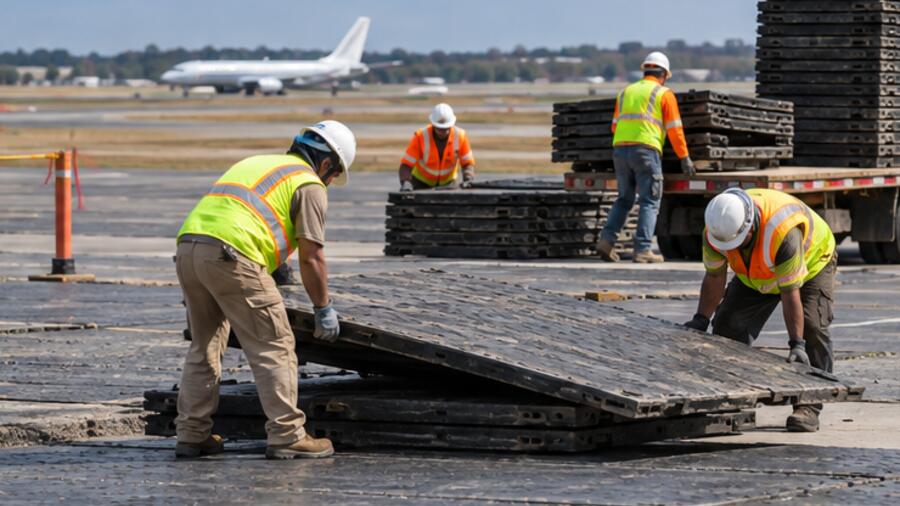
The fast-track installation still requires the retention of basic processes: drainage, debarment, peace-building, positioning, connection and trial passage. The plates remain continuous in line segments, leaving sufficient width at the intersections and outside areas; and they are to be removed from the rigid surface interface. The project leader should arrange for “the immediate decommissioning of the mud when it is discovered that it is coming out of the seams”, while specifying the conditions for its decommissioning, so as to prevent irregularity from being left to the next group during rush hours.
Temporary roads cannot be paved for long. Vehicle brakes, loading overloading and water stowing can gradually change the support under the plate, and surfaces may appear flat and may have created gaps. The site should be checked before and after peak traffic, after cryogenic freezing and when the route changes. In the event of a sinking, the ground and drainage should be checked before deciding whether to change or replace the panels, so as to avoid covering up the problem by filling the panels.
Assuming an increase in traffic during the maintenance and repair phase of a temporary access task requiring a site to be laid on the same day and to be vacated immediately after the completion of operations, managers could first freeze the change of route and then classify the problems into four categories: ground, plank, vehicle and movement control. Weak positions are reinforced, damage plates are replaced, vehicles are limited in speed, and one-way access is introduced for peak hours. The example does not correspond to the true customer but shows how to retain a clear exit route for night maintenance and how to convert the site judgement into a reusable list for the next project.
In the integrated site, different problems were solved by the pavement, leg mats and carboards. Vehicle traffic is supported by a continuous focus on the maximum retroactivity of the leg and the friction and adhesion of material from the surface of the vehicle. If MHMWPE skateboards are used, thermal stretches should be set aside and fixed systems checked; if relevant material is not available at the site, they should be removed from the list and the investment targeted.
The procurement list should provide suppliers with a real picture of the work, in which the sizes and quantities of tyres or belts are data that need to be highlighted in this section. The remaining information includes vehicle and leg loads, ground photographs and sizes, projected number of vehicles, number of days of use, colour trails, destination port and desired period. A comparison of the quotations should be converted to a valid area coverage and complete connection system and not only a single block price; the acceptance and inspection criteria should also be included in the document before the next list.
Need for further evaluation of the actual project?
Applications, sizes, quantities, site photographs or drawings and delivery destinations are sent, on which we can identify more suitable products and processing programmes.







