
The answer to how the temporary route for heavy vehicles at the port is to establish an advance survey list should start with the operational route and not with a fixed specification. First, the route, load, ground and operational metronic records are complete, and then the number and order of panels are determined. Container terminals, bulk berths and port area expansion areas are usually accompanied by a combination of set cards, tractors, front-hand hangings, piles of high machines and maintenance vehicles, with different pressures on tyres, axles and shifting patterns. High axle loads, frequent turnovers, brakes and traffic crosses the seams, the shoulder of the road and the water vents are the first to sink. The project team shall first delineate the main corridor, the waiting areas, the loading and unloading points and the emergency export, and then the boundary shall be confirmed jointly by the construction, logistics and security authorities.
On-site measurements cover powders with higher water content after the rain and record weak ranges, slopes, drainage directions and underground pipes. Changes in the water-bearing state and the car tracks should be observed before and after consecutive rainfalls. Mobile equipment will need to provide the whole vehicle with its own weight, full load weight, a single axle load, tyre size, turn radius and projected duration; the crane will also need to provide the maximum reversibility of the leg and leg extension. Data sources and measurement dates should also be recorded to avoid different versions.
Product selection should be differentiated by stress. The HDPE pavement board provides smoothing and partitioning for the continuous passage, and the crane leg pad is used for port machine overhaul or temporary suspension. 15, 20, 25 and 30 mm are in the common thickness range and 15 mm can only serve as a starting point for comparison for the project; if there are holes or sediments at the grass-roots level, the increase in thickness is not a substitute for the search for peace and reinforcement. The 50-80 tonnes in the product information should also be understood in conjunction with the test conditions, with the final specifications to be confirmed by the approved programme and field professionals.
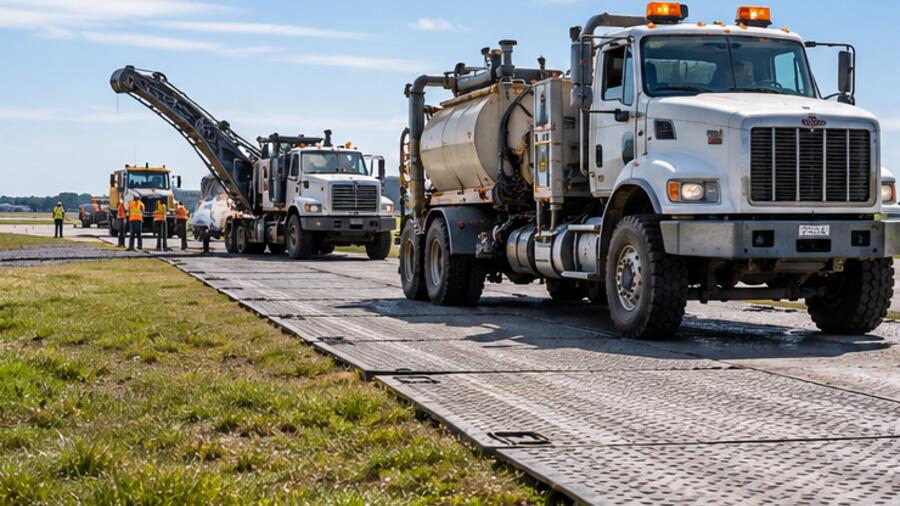
Pre-installation to remove sharp waste, loose rock and mobile mud, and to purge and level the ground. The plates were set up in the main direction and were sewd to avoid the deep path and to check the wells and legs. The turn and reverse areas are to be slightly wider and the connectors are to be locked as required. The site should also “set one-way access and check the total vehicle weight at the entrance” and include this requirement at the end of the shift and in the traffic organization chart.
Following the opening of access, the focus of the inspection was on the continued support under the plate. The first heavy vehicle passes by to check for high seams, peripheries, mudslides and planks; the shift is repeated after weather changes. The pressure of contact of the forklift ' s solid-heart wheel differs significantly from the concentrated static of the crane ' s legs, and anomalies should be detected first in isolation before being drained, evened or replaced, and the subsequent flow of the vehicle cannot continue to magnify the damage.
In the case of a temporary port corridor connecting a stacking site to a maintenance area, the site can be divided into five areas during the pre-entry phase, straight, turning, operation and recovery. The entry point is responsible for vehicle reconciliation, maintaining continuous coverage of the straight-line segment, increasing the outer width of the turn-band, separate validation of the operating segment and completion of clean bundles in the recovery area. This simulation programme is used to illustrate the methodology and is not a client-specific performance; it can help the project team to separate the main wheel tracks of heavy vehicles from the people ' s lanes and leave a record of the number of maintenances and the length of breaks.
The bulk material project will also examine car car stickers, impact and wear. The UHMWPE car skateboard can improve offloading when materials, temperature and car structure are appropriate, but it is necessary to confirm fixation, thermal condensation, the end door gap and cleaning methods; it is not a substitute for the safe offloading procedure. If the project does not involve a self-loading vehicle, the budget should be focused on physical access and support points and not add irrelevant configurations to complete product portfolios.
The request for quotations shall, in addition to the total area, provide the maximum gross vehicle weight and single axle load, indicating the country, duration, conditions of handling, packing and port of destination. Compared suppliers can check the documentation, size difference, surface routing, connector, piece weight, effective area coverage, cabinet list and batch retroactive. The whole container shall be purchased in advance to confirm the discharge equipment. The final programme, which involves the safety of the ground, assembly or operation of the airport, must be approved by the project professional.
Need for further evaluation of the actual project?
Applications, sizes, quantities, site photographs or drawings and delivery destinations are sent, on which we can identify more suitable products and processing programmes.







