
The daily inspection frequency of the temporary route for heavy vehicles at the port cannot be answered using single-product parameters. The project manager needs to look at the flow organization, ground support and maintenance capacity at the same time; the stitches, sunk and contaminated should be checked after the first car, before the shift and after heavy rainfall. When collectors, tractors, front-hand hangers, piles and maintenance vehicles enter container terminals, bulk berths and port area expansion areas, problems with turnovers, ramps, seams and waiting positions on routes may arise earlier than normal straight-line segments and should be individually marked on drawings.
The survey forms can be completed by the four columns of ground, equipment, route and time. Ground bars indicate ramps and adjacent drains that are permanently flushed by water at the entrance to the warehouse; equipment columns show vehicle self-heaviness, cargo weight, number of axes and tyre specifications; route bars take a clean width, slope and turn radius; and timebars describe short-term heavy rainfall and shift arrangements. If a crane is present, it should be based on the retroactivity of the leg in the manufacturer ' s worksheet, and it cannot be rated as a ground load.
Where the route has both a mobile device and a fixed support point, the choice should be made between the pavement and the leg pad, respectively. The HDPE pavement board provides smoothing and partitioning for the continuous passage, and the crane leg pad is used for port machine overhaul or temporary suspension. The thickness can be screened from commonly used specifications such as 15, 20, 25, 30 mm, and the 15 mm appearing in this section does not constitute a direct recommendation. For information ranging from 50 to 80 tons, the purchaser should also request the test method and give priority to the equipment description, construction programme and on-site validation.
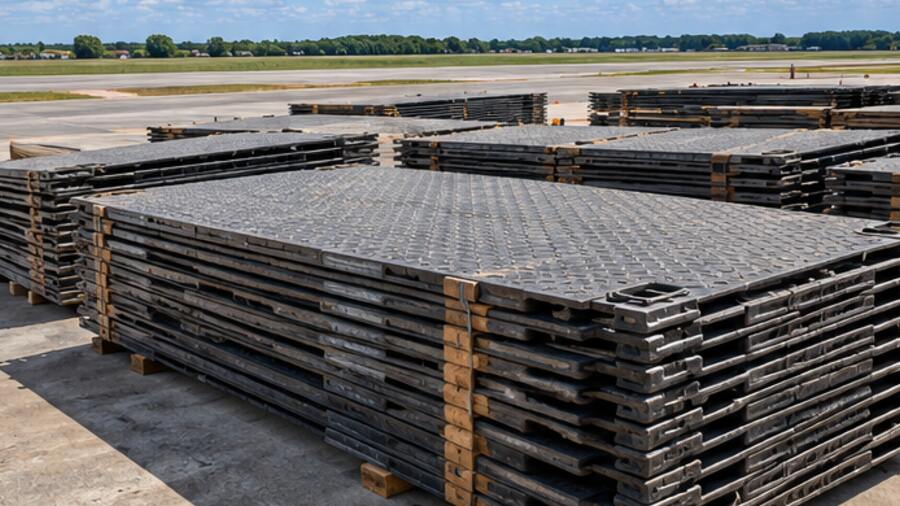
The construction staff should first seal the belts and confirm that no vehicles enter, then clear the floors and tablets. Do not leave the seams in the softest position, and do not let the edges remain open for long periods. Cleaning and installation of sandstones when the link is pierced, so that the connector is not fully in place. A low-speed test pass was completed and a “default move at the lower end of the ramp” was implemented before the next segment was opened.
Following the opening of access, the focus of the inspection was on the continued support under the plate. The first heavy vehicle passes by to check for high seams, peripheries, mudslides and planks; the shift is repeated after weather changes. The pressure of contact of the forklift ' s solid-heart wheel differs significantly from the concentrated static of the crane ' s legs, and anomalies should be detected first in isolation before being drained, evened or replaced, and the subsequent flow of the vehicle cannot continue to magnify the damage.
In the case of a temporary port corridor connecting a stacking site with a maintenance area, the site could be divided into five areas, which could be moved straight, turned, operated and recovered during maintenance repairs. The entry point is responsible for vehicle reconciliation, maintaining continuous coverage of the straight-line segment, increasing the outer width of the turn-band, separate validation of the operating segment and completion of clean bundles in the recovery area. This simulation programme is used to describe the methodology and is not a client-specific performance; it can help the project team to maintain access without expanding permanent hardened areas and leave a record of the number of maintenances and the length of breaks.
Three products may be used in this category at the same time, but the boundaries of the use are clear: road-painted service vehicle routes, leg-past services are centrally supported, and carboard services are applied to bulk discharges. In particular, UHMWPE skateboards need to check the material particle size, water content rate, temperature, impact and car shape. No product could compensate for the error, and the configuration list should be deleted from the field mission.
It is best to complete small-scale technical confirmation before the next list. First, the method of connection and the need to lay tools and complete on-site parameters for suppliers to give specifications, quantities and packaging advice; then to check sample trails, connections, dimensions and material documents; and finally to confirm container type, destination port, discharge method and batch identification. The supplier recommended that it be used only as an input and that the project party remain responsible for the stabilization of the ground load, traffic organization and lifting.
Need for further evaluation of the actual project?
Applications, sizes, quantities, site photographs or drawings and delivery destinations are sent, on which we can identify more suitable products and processing programmes.







