
For case data, the site should first determine the target for access: whether it is a continuous transport, short-term suspension or a temporary stop during peak periods. Container terminals, bulk berths and port area expansion areas involve pick-ups, tractors, front-hand hangings, stackings and maintenance vehicles, while high axle loads, frequent turnovers, brakes and traffic traffic cross-crossings lead to sunk seams, shoulders and drains. When targets, vehicles and vulnerable locations are matched, the scope is not too large or missing; the specific implementation principle is that cases should record pre-input, time of laying, vehicle type, number of maintenance, recovery and ground restoration results.
The degree of completeness of the input conditions determines the quality of the subsequent selection. First, the length and width of the temporary intersection, which is shared between construction and production, is measured, and then the maximum work of the collection cards, tractors, front hangings, piles and maintenance vehicles is checked. In addition to the weight, the pressure of the tyre, the form of the belt, the position of the brake, the possibility of in situ transfer and the frequency of passage shall be recorded. In case of high temperatures, a ground review should be carried out; if data cannot be confirmed, unknown items should be listed as a restriction rather than being replaced by empirical values.
The selection is based on the calculation of the local pressure and the examination of whether the plate remains continuous at the grass-roots level. The HDPE pavement board provides smoothing and partitioning for the continuous passage, and the crane leg pad is used for port machine overhaul or temporary suspension. The common thickness ranges from 15 mm to 30 mm, and this option can first assess 30 mm and then adjust it through trial preparation or project accounting. The so-called 160 to 200-ton carrier should have a clear test boundary and cannot be cited separately from the distance, temperature, payload distribution and safety factor.
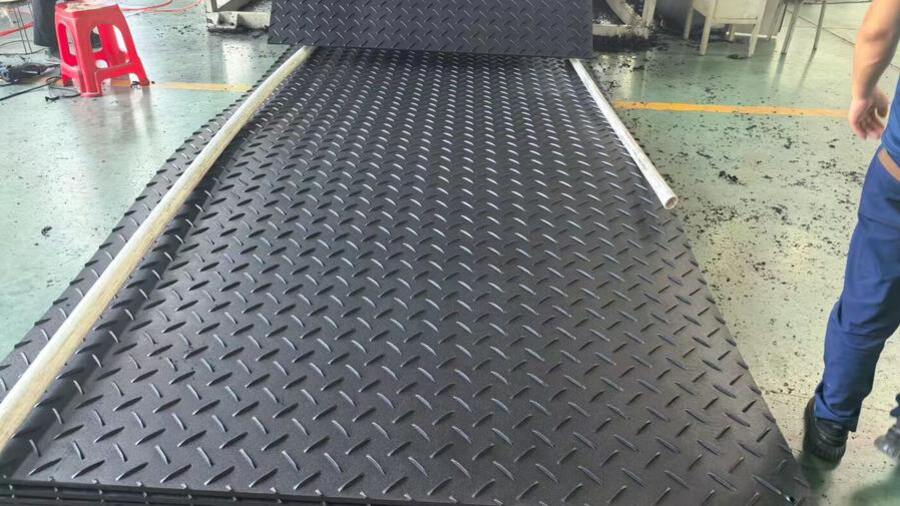
The sequence of laying would allow for the advance from the stable entrance to the area of operations. First, water and high differentials are processed, then the first plate is located; the subsequent plate is consistent in the direction of the texture and check if the seams form the steps. The ramp, turn and brake points shall increase the horizontal constraints or the width of the coverage. For this project, a “review of the original ground condition at the end of the project” could be used as a key action, with a dedicated person recording the time of completion and the results of the review.
Following the opening of access, the focus of the inspection was on the continued support under the plate. The first heavy vehicle passes by to check for high seams, peripheries, mudslides and planks; the shift is repeated after weather changes. The pressure of contact of the forklift ' s solid-heart wheel differs significantly from the concentrated static of the crane ' s legs, and anomalies should be detected first in isolation before being drained, evened or replaced, and the subsequent flow of the vehicle cannot continue to magnify the damage.
In the case of a temporary port route connecting a stacking site to a maintenance area, the site could be divided into five areas during the recovery phase of the evacuation site, straight, turning, operating and recycling. The entry point is responsible for vehicle reconciliation, maintaining continuous coverage of the straight-line segment, increasing the outer width of the turn-band, separate validation of the operating segment and completion of clean bundles in the recovery area. This simulation programme is used to describe the methodology and is not a client-specific performance; it can help the project team to make the receipt and inspection records match the site photographs and location maps and leave a record of the number of maintenances and the length of breaks.
Auxiliary equipment also affects the overall programme. A leg pad is required to accompany a vehicle, a forklift is required to focus on tyre contact, and a bulk vehicle may require a slab. The suitability of the UHMWPE liner depends on the work temperature, the chemical environment, the material impact and the car structure, and the manufacturer provides the installation requirements. Each product should be matched to specific equipment in the project form to avoid the use of the same parameter across uses.
The expected delivery and arrival sequences must be present in the request for quotations, otherwise it is likely that different suppliers will calculate on different assumptions. The procurement staff shall also require the description of the effective size, weight, number of attachments, packing units, container load and delivery cycle of each plate. The evaluation will be based on technical conformity, installation efficiency and turnover. Where key payloads or ground data have not been confirmed, the quotations should be marked as preliminary and the review retained.
Need for further evaluation of the actual project?
Applications, sizes, quantities, site photographs or drawings and delivery destinations are sent, on which we can identify more suitable products and processing programmes.







