
When handling cross-cutting operations, “where to go, what to go, how many times a day” is written as a verifiable on-site condition. The traffic of container terminals, bulk berths and port area expansion areas often consists of pick-up cards, tractors, front-hand hangings, high-altitude piles and maintenance vehicles, with the impact of tyre exposures and low-speed rotations being ignored by the whole tonnage. The more reliable conclusion is that forklifts, trucks and cranes should be routed and in waiting areas, and who should be given priority access, and then decide on a combination of pavements, leg mats or local grass-roots treatment.
In order to determine whether cross-cutting operations could be carried out, the site should be set up at a point rather than taking only a few photographs. In particular, there is a need to review the spill-off areas resulting from the contamination of the bulk, as the drying of the surface does not represent a continuous carrying of the lower part. The project information shall also include the maximum daily traffic, the length of vehicle stay, the direction of handling and the drainage route during the cryogenic thaw. For troughs, inspection wells and underground facilities, the prohibited support or need to be reinforced should be indicated in the road map.
Material parameters should serve the field rather than be propaganda figures. The HDPE pavement board provides smoothing and partitioning for the continuous passage, and the crane leg pad is used for port machine overhaul or temporary suspension. The project compares 30 mm and the number of block weights, rigidity, laying efficiency and containers with the adjacent specifications, and cross-checks the links to the surface. 160 to 200 tonnes is only a primary sift; ground-based and support designs should be completed first when an underground hole, weak shoulder or hanger overload exists.
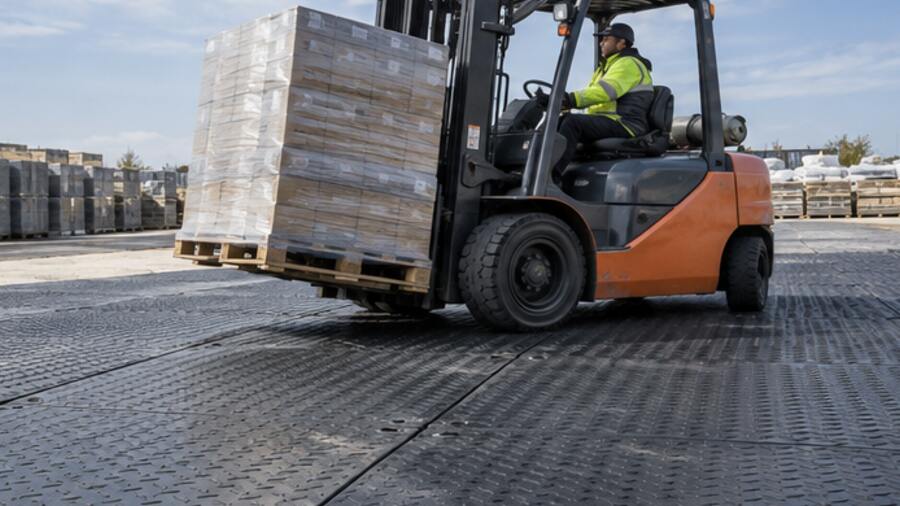
When the plates arrive at the site, the quantity, the connector and the crane are checked and the goods are discharged by route number. Upon completion of the grass-roots level, the vehicle entrance is prepared in sub-sections, and the level and edge support is checked at each stage of completion. The leg area of operation shall be separated from the area of passage. The inclusion in the installation programme of “place the back-up sheet near a weak section” would allow field personnel to convert abstract requirements into actionable.
Following the opening of access, the focus of the inspection was on the continued support under the plate. The first heavy vehicle passes by to check for high seams, peripheries, mudslides and planks; the shift is repeated after weather changes. The pressure of contact of the forklift ' s solid-heart wheel differs significantly from the concentrated static of the crane ' s legs, and anomalies should be detected first in isolation before being drained, evened or replaced, and the subsequent flow of the vehicle cannot continue to magnify the damage.
In the case of a temporary port corridor connecting a stacking site to a maintenance area, the site could be divided into five areas at the peak transport stage, straight, turning, operating and recycling. The entry point is responsible for vehicle reconciliation, maintaining continuous coverage of the straight-line segment, increasing the outer width of the turn-band, separate validation of the operating segment and completion of clean bundles in the recovery area. This simulation programme is used to describe the methodology and is not a client-specific performance; it can help the project team to position the problem sheets by number and leave a record of the number of maintenances and interruptions.
If the transport chain contains coal, ore, wet soil or food, self-release efficiency may be assessed as an independent subject. Car skateboards help to reduce the adhesiveness of certain materials, but prior to installation, the lining thickness, scalables, bolts or presses and tail door motion space should be confirmed. If there is no need for bulk discharges, there is no need to add the subparagraph; the procurement programme should be consistent with the use.
The procurement list should allow suppliers to see the real situation, in which the size of the car, the type of material and the temperature of the work are data that need to be highlighted. The remaining information includes vehicle and leg loads, ground photographs and sizes, projected number of vehicles, number of days of use, colour trails, destination port and desired period. A comparison of the quotations should be converted to a valid area coverage and complete connection system and not only a single block price; the acceptance and inspection criteria should also be included in the document before the next list.
Need for further evaluation of the actual project?
Applications, sizes, quantities, site photographs or drawings and delivery destinations are sent, on which we can identify more suitable products and processing programmes.







