
The answer to the most common questions at the site of temporary access for heavy vehicles in ports should start with the operational route rather than with a fixed specification. Most of the problems are concentrated on inadequate drainage, discontinuity at the grass-roots level, loose connectivity, upsliding on the edges and the wrong turn. Container terminals, bulk berths and port area expansion areas are usually accompanied by a combination of set cards, tractors, front-hand hangings, piles of high machines and maintenance vehicles, with different pressures on tyres, axles and shifting patterns. High axle loads, frequent turnovers, brakes and traffic crosses the seams, the shoulder of the road and the water vents are the first to sink. The project team shall first delineate the main corridor, the waiting areas, the loading and unloading points and the emergency export, and then the boundary shall be confirmed jointly by the construction, logistics and security authorities.
The degree of completeness of the input conditions determines the quality of the subsequent selection. First, the length and width of the refilled areas close to the building base are measured, and then the maximum performance of the collection cards, tractors, front hangings, piles and maintenance vehicles is checked. In addition to the weight, the pressure of the tyre, the form of the belt, the position of the brake, the possibility of in situ transfer and the frequency of passage shall be recorded. In case of continuous rainfall, a ground review should be carried out; if the data cannot be confirmed, the unknown item should be included as a restriction rather than replaced by an empirical value.
Material parameters should serve the field rather than be propaganda figures. The HDPE pavement board provides smoothing and partitioning for the continuous passage, and the crane leg pad is used for port machine overhaul or temporary suspension. The project compares 30 mm and the number of block weights, rigidity, laying efficiency and containers with the adjacent specifications, and cross-checks the links to the surface. 160 to 200 tonnes is only a primary sift; ground-based and support designs should be completed first when an underground hole, weak shoulder or hanger overload exists.
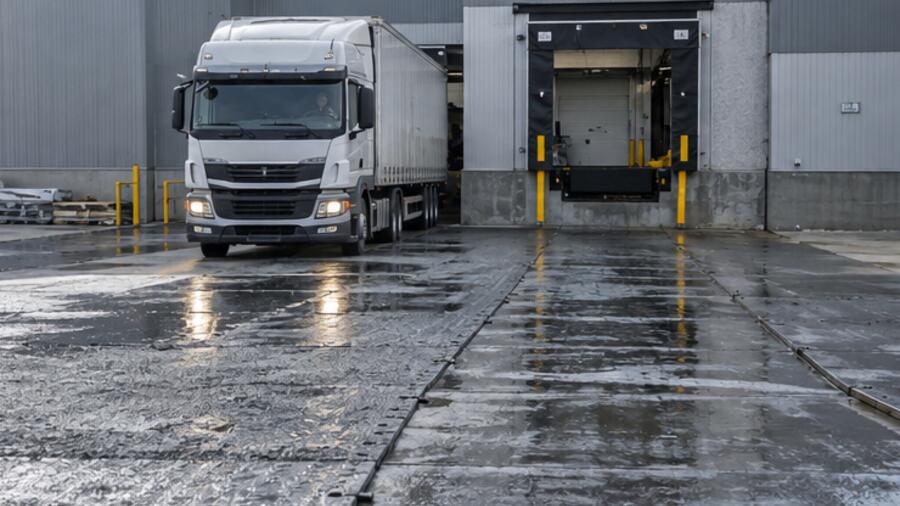
The fast-track installation still requires the retention of basic processes: drainage, debarment, peace-building, positioning, connection and trial passage. The plates remain continuous in line segments, leaving sufficient width at the intersections and outside areas; and they are to be removed from the rigid surface interface. The project leader should arrange for “dismantling the bulk and sharpness before removal”, while specifying the conditions for decommissioning to prevent irregularity from being left to the next group during rush hours.
Maintenance staff can divide the straight-line, turn-out, waiting areas and support points into different levels of inspection. The straight-line sections focus on the sutures and the tracks, turn around and look for lateral shifts, wait areas to see long-term static sinking, and support points to check whether the pads and the ground are sunk. Shorter check intervals after rain or when the traffic suddenly increases; any plate-side rise, loose connection or grass-roots plasma should trigger decommissioning.
For a temporary port route connecting a stacking site to a maintenance area, the entry preparation phase could be established as an independent inspection node. On-site identification of vehicle lists and weather is followed by a check of drainage, connections and borders; if any conditions change, release is suspended and the road map updated. This scenario is used only to illustrate how the project is organized, with a focus on avoiding the sharing of a vague load assumption among different equipment. It should also record the number of inputs, the time of laying, the time of stoppage, the location of maintenance and the condition of the ground after the evacuation site.
In the integrated site, different problems were solved by the pavement, leg mats and carboards. Vehicle traffic is supported by a continuous focus on the maximum retroactivity of the leg and the friction and adhesion of material from the surface of the vehicle. If MHMWPE skateboards are used, thermal stretches should be set aside and fixed systems checked; if relevant material is not available at the site, they should be removed from the list and the investment targeted.
It is best to complete small-scale technical confirmation before the next list. First, the container type and destination port and complete field parameters are submitted to the supplier for specification, quantity and packaging advice; then the sample trails, connections, dimensions and material documents are checked; and finally, the container type, destination port, discharge method and batch identification are identified. The supplier recommended that it be used only as an input and that the project party remain responsible for the stabilization of the ground load, traffic organization and lifting.
Need for further evaluation of the actual project?
Applications, sizes, quantities, site photographs or drawings and delivery destinations are sent, on which we can identify more suitable products and processing programmes.







