
The development of acceptance criteria for temporary access to port heavy vehicles cannot be answered with single-product parameters. Project leaders need to check both traffic organization, ground support and maintenance capabilities; receiving and inspection check the continuity of routes, high seams, panel stability, clear borders and obstruction of drainage. When collectors, tractors, front-hand hangers, piles and maintenance vehicles enter container terminals, bulk berths and port area expansion areas, problems with turnovers, ramps, seams and waiting positions on routes may arise earlier than normal straight-line segments and should be individually marked on drawings.
The degree of completeness of the input conditions determines the quality of the subsequent selection. First, the length and width of areas that are sensitive to the soil within the boundaries of the airport are measured, and then the maximum of the work performed on the collection cards, tractors, front hangings, piles and maintenance vehicles are checked. In addition to the weight, the pressure of the tyre, the form of the belt, the position of the brake, the possibility of in situ transfer and the frequency of passage shall be recorded. Short and heavy rainfall should be supplemented by a ground review; if data cannot be confirmed, unknown items should be included as a limitation rather than replaced by empirical values.
Road-paving boards are responsible for spreading wheel pressure and leg mats for expanding static support areas, which cannot be replaced by one another. For this scenario, the HDPE pavement board provides smoothing and partitioning for the continuous passage, and crane leg mats are used for port machine overhaul or temporary suspension. An alternative 25 mm could be included and compared with other thickness, subject to the simultaneous validation of plate sizes, connection structures, grass-roots stratification and number of passages. The labelling of 120 to 160 tons of products does not mean that all the same vehicles are available on the ground, and ground conditions remain the determining factor.
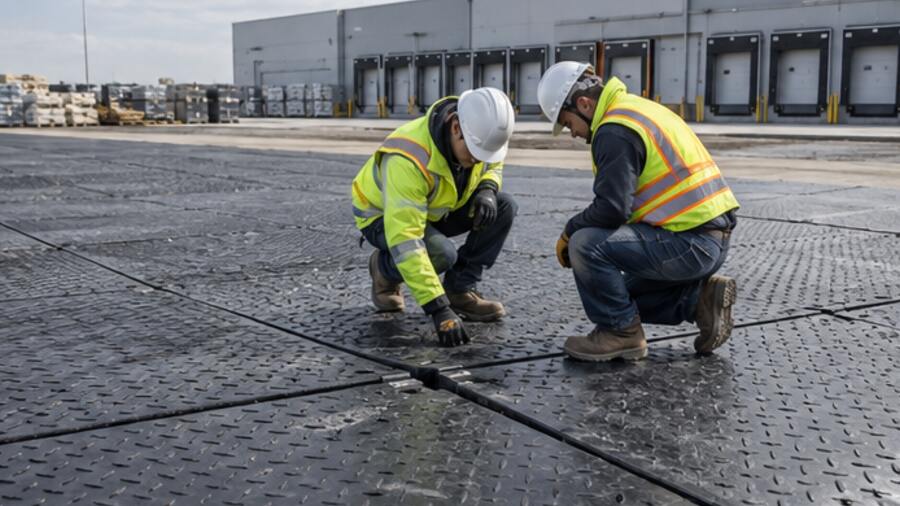
When the plates arrive at the site, the quantity, the connector and the crane are checked and the goods are discharged by route number. Upon completion of the grass-roots level, the vehicle entrance is prepared in sub-sections, and the level and edge support is checked at each stage of completion. The leg area of operation shall be separated from the area of passage. The inclusion in the installation programme of an “adjusting of the route ahead of schedule in accordance with weather forecasts” would allow field personnel to convert abstract requirements into detectable actions.
The day-to-day management will include vehicle behaviour in the inspection. Speed-limiting, prohibition of in-situ movement, fixed reverse routes and placement of commanders are often more effective than simply adding plates. The inspectors should touch or step on the suspicious seams, check the links and take photographs to locate them. Where there are repeated shifts, the width of the road, the turn radius and the grass-roots level should be re-evaluated, rather than the continuous consolidation of the same position.
A reference scenario is a temporary port passage connecting the stacks to the maintenance area. During the maintenance and repair phase, the project will make short-term trial preparation to record the relocation and deposition of the first vehicle and then gradually extend the route. The turn areas, parking areas and pick-up points are inspected separately and no result is used to replace the full condition. This is an example of methodology rather than a statement of performance, and the intended management effect is to accumulate comparable data for subsequent projects; after completion, it is necessary to compare the original ground photographs, cleaning hours and the number of boards that can be used.
If the transport chain contains coal, ore, wet soil or food, self-release efficiency may be assessed as an independent subject. Car skateboards help to reduce the adhesiveness of certain materials, but prior to installation, the lining thickness, scalables, bolts or presses and tail door motion space should be confirmed. If there is no need for bulk discharges, there is no need to add the subparagraph; the procurement programme should be consistent with the use.
In addition to the total area, the request for quotations should provide the person in charge of the site and the security clearance process, with an indication of the country, duration, conditions of handling, packing and port of destination. Compared suppliers can check the documentation, size difference, surface routing, connector, piece weight, effective area coverage, cabinet list and batch retroactive. The whole container shall be purchased in advance to confirm the discharge equipment. The final programme, which involves the safety of the ground, assembly or operation of the airport, must be approved by the project professional.
Need for further evaluation of the actual project?
Applications, sizes, quantities, site photographs or drawings and delivery destinations are sent, on which we can identify more suitable products and processing programmes.







