
When handling installation movements, “where to go, what to go, how many times a day” is written as a verifiable on-site condition. The traffic of container terminals, bulk berths and port area expansion areas often consists of pick-up cards, tractors, front-hand hangings, high-altitude piles and maintenance vehicles, with the impact of tyre exposures and low-speed rotations being ignored by the whole tonnage. The more reliable conclusion is that the area of installation is to be linked to the vehicle release plan to avoid connecting personnel to the plates in unseparated traffic, and then to decide on the combination of pavement, leg pads or local grass-roots treatment.
The survey forms can be completed by the four columns of ground, equipment, route and time. The surface column shows loose grass-roots and adjacent drainage points following the winter freeze; the equipment column lists vehicle weight, cargo weight, number of axes and tyre specifications; the route column takes a net width, slope and turn radius; and the time bar indicates cryogenic freezing and shift arrangements. If a crane is present, it should be based on the retroactivity of the leg in the manufacturer ' s worksheet, and it cannot be rated as a ground load.
The selection is based on the calculation of the local pressure and the examination of whether the plate remains continuous at the grass-roots level. The HDPE pavement board provides smoothing and partitioning for the continuous passage, and the crane leg pad is used for port machine overhaul or temporary suspension. The common thickness ranges from 15 mm to 30 mm, and this option can first assess 25 mm and then adjust it through trial preparation or project accounting. The so-called 120-160-ton carrier should have a clear test boundary and cannot be cited separately from the distance, temperature, payload distribution and safety factor.
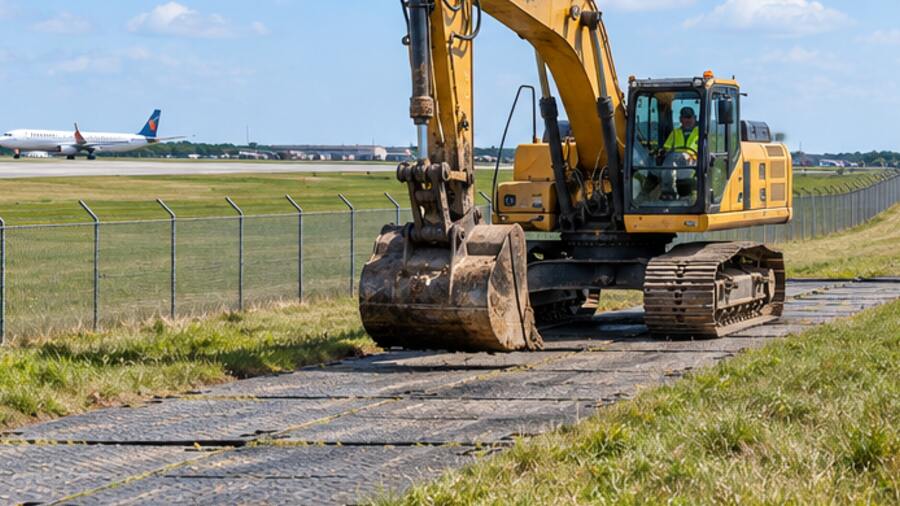
The fast-track installation still requires the retention of basic processes: drainage, debarment, peace-building, positioning, connection and trial passage. The plates remain continuous in line segments, leaving sufficient width at the intersections and outside areas; and they are to be removed from the rigid surface interface. Project leaders should arrange for “low-speed test and re-checking of the first heavy vehicle”, while specifying the conditions for decommissioning to prevent irregularity from being left to the next group during rush hours.
Temporary roads cannot be paved for long. Vehicle brakes, loading overloading and water stowing can gradually change the support under the plate, and surfaces may appear flat and may have created gaps. The site should be checked before and after peak traffic, after cryogenic freezing and when the route changes. In the event of a sinking, the ground and drainage should be checked before deciding whether to change or replace the panels, so as to avoid covering up the problem by filling the panels.
In a simulation plan for a temporary port route connecting the stacking site to the maintenance area, a zonal release was used during the peak transport phase: the area that had completed the grass-roots treatment and plate connection was opened and the unaccepted area remained isolated. Each region designates a person responsible for the inspection and uses a number corresponding to the photograph. This example does not represent a specific project commitment, but allows the team to separate the temporary post from the main traffic route. If the records show repeated maintenance at the same location, they should be re-analysed back to the ground and transport organization.
In the integrated site, different problems were solved by the pavement, leg mats and carboards. Vehicle traffic is supported by a continuous focus on the maximum retroactivity of the leg and the friction and adhesion of material from the surface of the vehicle. If MHMWPE skateboards are used, thermal stretches should be set aside and fixed systems checked; if relevant material is not available at the site, they should be removed from the list and the investment targeted.
In addition to the total area, the request shall provide a maximum slope and drainage direction, indicating the country, duration, conditions of handling, mode of packaging and port of destination. Compared suppliers can check the documentation, size difference, surface routing, connector, piece weight, effective area coverage, cabinet list and batch retroactive. The whole container shall be purchased in advance to confirm the discharge equipment. The final programme, which involves the safety of the ground, assembly or operation of the airport, must be approved by the project professional.
Need for further evaluation of the actual project?
Applications, sizes, quantities, site photographs or drawings and delivery destinations are sent, on which we can identify more suitable products and processing programmes.







