
In container terminals, bulk berths and port area expansion areas, standby configurations have a direct impact on the ability of vehicles to reach their operational areas as planned. Common on-site collection cards, tractors, front-hand hangings, heaps and maintenance vehicles with different dynamic wheel pressure, static de-loading and power. High axle loads, frequent turnovers, brakes and traffic crosses the seams, the shoulder of the road and the water vents are the first to sink. The programme should, therefore, first target routes and time windows that must be kept open, before arranging for materials and personnel to avoid temporary changes in rules of passage on the construction side.
The degree of completeness of the input conditions determines the quality of the subsequent selection. First, measuring the length and width of the long-term parked vehicle to form a partially insulated parking belt, then checking the maximum performance of the collection cards, tractors, front hangings, piles and maintenance vehicles. In addition to the weight, the pressure of the tyre, the form of the belt, the position of the brake, the possibility of in situ transfer and the frequency of passage shall be recorded. In case of damp salt fog, a ground review should be carried out; if the data cannot be confirmed, the unknown item should be classified as a restriction and not replaced by an empirical value.
Product selection should be differentiated by stress. The HDPE pavement board provides smoothing and partitioning for the continuous passage, and the crane leg pad is used for port machine overhaul or temporary suspension. 15, 20, 25 and 30 mm are within the common thickness range and 20 mm can only serve as a starting point for comparison for this project; if there are holes or sediments at the grass-roots level, the increase in thickness will not be a substitute for peace and reinforcement. The 80 to 120 tonnes in the product information should also be understood in conjunction with the test conditions, with the final specifications to be confirmed by the approved programme and field professionals.
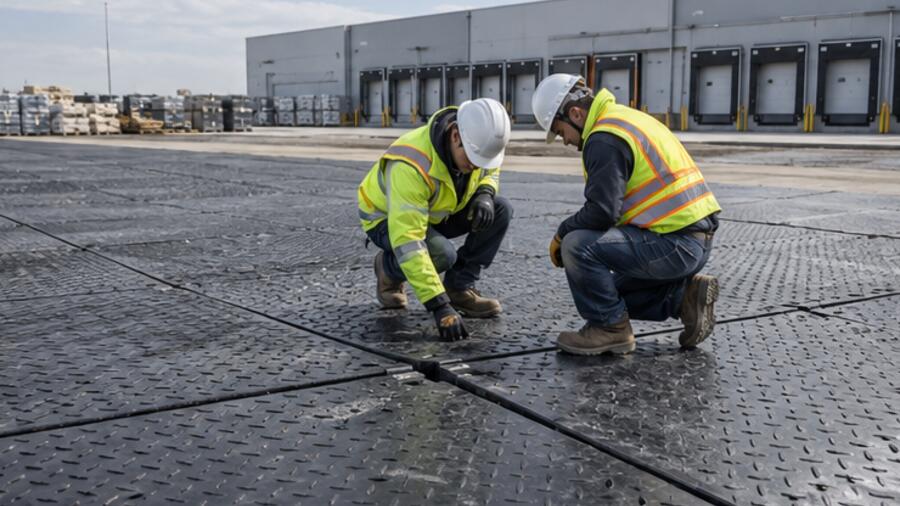
The construction staff should first seal the belts and confirm that no vehicles enter, then clear the floors and tablets. Do not leave the seams in the softest position, and do not let the edges remain open for long periods. Cleaning and installation of sandstones when the link is pierced, so that the connector is not fully in place. A low-speed test pass after a period has been completed and the following section will be opened only after it has been “marked with a numbered chart of the location of each plate”.
Temporary roads cannot be paved for long. Vehicle brakes, loading overloading and water stowing can gradually change the support under the plate, and surfaces may appear flat and may have created gaps. The site should be inspected before and after peak traffic, after damp salt fog and when the route is changed. In the event of a sinking, the ground and drainage should be checked before deciding whether to change or replace the panels, so as to avoid covering up the problem by filling the panels.
In a simulation plan for a temporary port route connecting the stacking site to the maintenance area, the equipment installation phase was to be released in a zoning area: the area that had completed grass-roots processing and the plate connection had been opened and the unaccepted area had remained isolated. Each region designates a person responsible for the inspection and uses a number corresponding to the photograph. This example does not represent a specific project commitment, but allows the team to synchronize the clean-up and classification of the plates at the exit site. If the records show repeated maintenance at the same location, they should be re-analysed back to the ground and transport organization.
Three products may be used in this category at the same time, but the boundaries of the use are clear: road-painted service vehicle routes, leg-past services are centrally supported, and carboard services are applied to bulk discharges. In particular, UHMWPE skateboards need to check the material particle size, water content rate, temperature, impact and car shape. No product could compensate for the error, and the configuration list should be deleted from the field mission.
The procurement list should allow suppliers to see the real situation, in which the need for samples or small-scale trials is the data that needs to be highlighted and supplemented. The remaining information includes vehicle and leg loads, ground photographs and sizes, projected number of vehicles, number of days of use, colour trails, destination port and desired period. A comparison of the quotations should be converted to a valid area coverage and complete connection system and not only a single block price; the acceptance and inspection criteria should also be included in the document before the next list.
Need for further evaluation of the actual project?
Applications, sizes, quantities, site photographs or drawings and delivery destinations are sent, on which we can identify more suitable products and processing programmes.







