
For comparison with suppliers, the site should first determine whether the goal of access is continuous transport, short-term suspension, or temporary parking during peak periods. Container terminals, bulk berths and port area expansion areas involve pick-ups, tractors, front-hand hangings, stackings and maintenance vehicles, while high axle loads, frequent turnovers, brakes and traffic traffic cross-crossings lead to sunk seams, shoulders and drains. When targets, vehicles and vulnerable locations are matched, key points will not be overstretched or left out; the practical implementation principle is that materials, structures, connections, effective coverage, containerization and quality documents should be more covered.
In order to judge whether the supplier compares to whether it is possible to implement, the site should be set up, rather than taking only a few photographs. In particular, old sites with visible ups and downs will be reviewed, as dry surfaces do not represent a continuous carrying of the lower part. Information on the project should also include the maximum daily traffic, the length of vehicle stay, the direction of handling and the drainage route during high-temperature tan. For troughs, inspection wells and underground facilities, the prohibited support or need to be reinforced should be indicated in the road map.
Road-paving boards are responsible for spreading wheel pressure and leg mats for expanding static support areas, which cannot be replaced by one another. For this scenario, the HDPE pavement board provides smoothing and partitioning for the continuous passage, and crane leg mats are used for port machine overhaul or temporary suspension. An alternative 25 mm could be included and compared with other thickness, subject to the simultaneous validation of plate sizes, connection structures, grass-roots stratification and number of passages. The labelling of 120 to 160 tons of products does not mean that all the same vehicles are available on the ground, and ground conditions remain the determining factor.
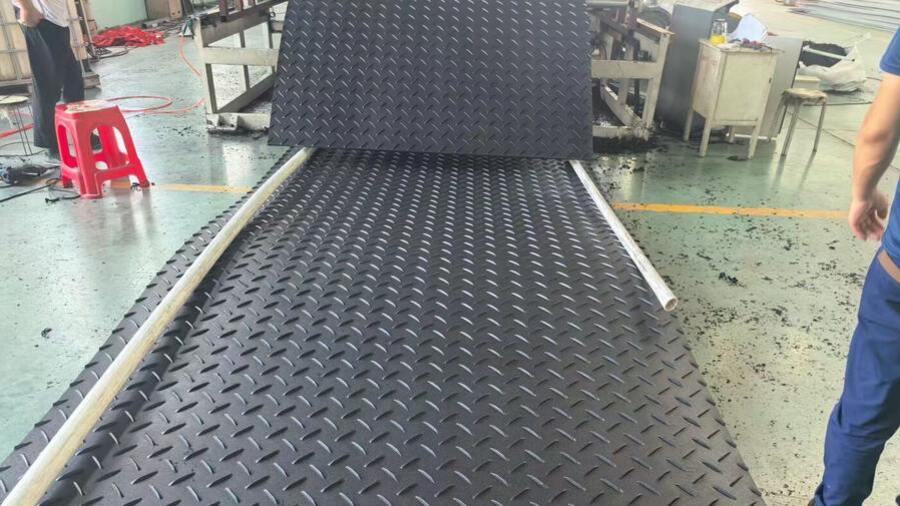
Pre-installation to remove sharp waste, loose rock and mobile mud, and to purge and level the ground. The plates were set up in the main direction and were sewd to avoid the deep path and to check the wells and legs. The turn and reverse areas are to be slightly wider and the connectors are to be locked as required. It should also be implemented at the site “to protect panel-lined roads using soft and clean tools”, and this requirement should be included at the end of the shift and in the traffic organization chart.
Temporary roads cannot be paved for long. Vehicle brakes, loading overloading and water stowing can gradually change the support under the plate, and surfaces may appear flat and may have created gaps. The site should be inspected before and after peak traffic, after high temperatures and when the route changes. In the event of a sinking, the ground and drainage should be checked before deciding whether to change or replace the panels, so as to avoid covering up the problem by filling the panels.
In a simulation plan for a temporary port route connecting the stacking site to the maintenance area, the evacuation site recovery phase was to be released by zonalization: the area that had completed the ground treatment and the plate link was to be opened and the unaccepted area remained isolated. Each region designates a person responsible for the inspection and uses a number corresponding to the photograph. This example does not represent a specific project commitment, but allows the team to base the vendor ' s offer on uniform parameters. If the records show repeated maintenance at the same location, they should be re-analysed back to the ground and transport organization.
The bulk material project will also examine car car stickers, impact and wear. The UHMWPE car skateboard can improve offloading when materials, temperature and car structure are appropriate, but it is necessary to confirm fixation, thermal condensation, the end door gap and cleaning methods; it is not a substitute for the safe offloading procedure. If the project does not involve a self-loading vehicle, the budget should be focused on physical access and support points and not add irrelevant configurations to complete product portfolios.
It is best to complete small-scale technical confirmation before the next list. First, the packing form and handling equipment and complete field parameters are submitted, allowing the supplier to give specifications, quantities and packing recommendations; then the sample trail, connection holes, size and material documents are checked; and finally the container type, destination port, method of discharge and batch identification are identified. The supplier recommended that it be used only as an input and that the project party remain responsible for the stabilization of the ground load, traffic organization and lifting.
Need for further evaluation of the actual project?
Applications, sizes, quantities, site photographs or drawings and delivery destinations are sent, on which we can identify more suitable products and processing programmes.







