
In container terminals, bulk berths and port area extension areas, accounting for quantities has a direct impact on the ability of vehicles to reach their operational areas as planned. Common on-site collection cards, tractors, front-hand hangings, heaps and maintenance vehicles with different dynamic wheel pressure, static de-loading and power. High axle loads, frequent turnovers, brakes and traffic crosses the seams, the shoulder of the road and the water vents are the first to sink. The programme should, therefore, first target routes and time windows that must be kept open, before arranging for materials and personnel to avoid temporary changes in rules of passage on the construction side.
The survey forms can be completed by the four columns of ground, equipment, route and time. The surface column indicates the mixed ground and adjacent drainage vents in a wet salt mist environment in the port area; the equipment column lists the vehicle ' s own weight, cargo weight, axle numbers and tyre specifications; the route column takes a clean width, slope and turn radius; and the time column describes the wet salt fog and the shift schedule. If a crane is present, it should be based on the retroactivity of the leg in the manufacturer ' s worksheet, and it cannot be rated as a ground load.
Material parameters should serve the field rather than be propaganda figures. The HDPE pavement board provides smoothing and partitioning for the continuous passage, and the crane leg pad is used for port machine overhaul or temporary suspension. The project compares 30 mm and the number of block weights, rigidity, laying efficiency and containers with the adjacent specifications, and cross-checks the links to the surface. 160 to 200 tonnes is only a primary sift; ground-based and support designs should be completed first when an underground hole, weak shoulder or hanger overload exists.
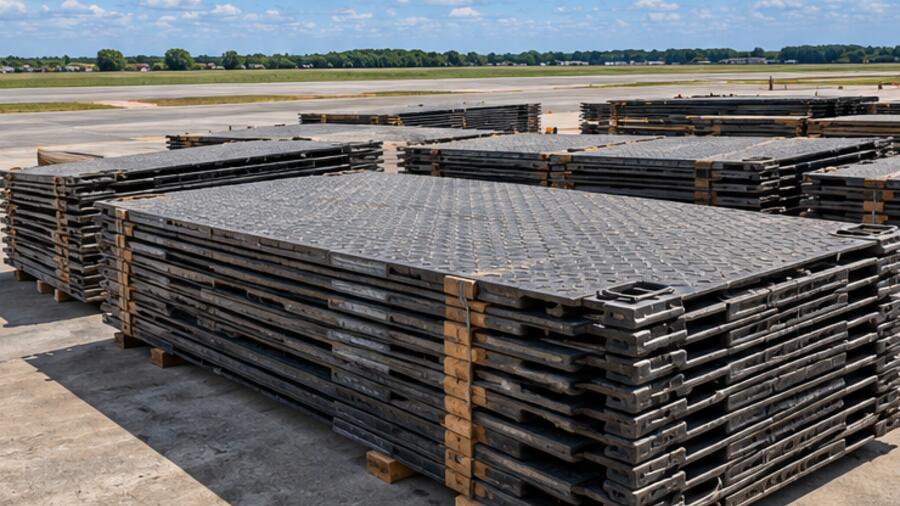
Pre-installation to remove sharp waste, loose rock and mobile mud, and to purge and level the ground. The plates were set up in the main direction and were sewd to avoid the deep path and to check the wells and legs. The turn and reverse areas are to be slightly wider and the connectors are to be locked as required. The site should also implement “pre-class confirmation of seams and connectors” and include this requirement at the end of the shift and in the traffic organization chart.
The day-to-day management will include vehicle behaviour in the inspection. Speed-limiting, prohibition of in-situ movement, fixed reverse routes and placement of commanders are often more effective than simply adding plates. The inspectors should touch or step on the suspicious seams, check the links and take photographs to locate them. Where there are repeated shifts, the width of the road, the turn radius and the grass-roots level should be re-evaluated, rather than the continuous consolidation of the same position.
A reference scenario is a temporary port passage connecting the stacks to the maintenance area. During the installation phase of the project, a short-range test lay was made to record the relocation and deposition of the first vehicle after its adoption, and the route was gradually extended. The turn areas, parking areas and pick-up points are inspected separately and no result is used to replace the full condition. This is an example of a methodology rather than a statement of performance, and the expected management effect is to make it possible for both laying and recycling to be carried over in shifts; after completion, a comparison between the original ground photographs, cleaning hours and the number of plates that can be used on a continuous basis is required.
The bulk material project will also examine car car stickers, impact and wear. The UHMWPE car skateboard can improve offloading when materials, temperature and car structure are appropriate, but it is necessary to confirm fixation, thermal condensation, the end door gap and cleaning methods; it is not a substitute for the safe offloading procedure. If the project does not involve a self-loading vehicle, the budget should be focused on physical access and support points and not add irrelevant configurations to complete product portfolios.
Indoor and outdoor temperatures and chemical contamination must be present in the request for quotations, otherwise different suppliers are likely to calculate on different assumptions. The procurement staff shall also require the description of the effective size, weight, number of attachments, packing units, container load and delivery cycle of each plate. The evaluation will be based on technical conformity, installation efficiency and turnover. Where key payloads or ground data have not been confirmed, the quotations should be marked as preliminary and the review retained.
Need for further evaluation of the actual project?
Applications, sizes, quantities, site photographs or drawings and delivery destinations are sent, on which we can identify more suitable products and processing programmes.







