
The answer to how temporary access to port heavy vehicles balances drainage with ground protection should start with the operational route rather than with a fixed specification. Underground water would weaken the grass-roots level and take the finer, and it was important to keep the drainage course and clean up the exit. Container terminals, bulk berths and port area expansion areas are usually accompanied by a combination of set cards, tractors, front-hand hangings, piles of high machines and maintenance vehicles, with different pressures on tyres, axles and shifting patterns. High axle loads, frequent turnovers, brakes and traffic crosses the seams, the shoulder of the road and the water vents are the first to sink. The project team shall first delineate the main corridor, the waiting areas, the loading and unloading points and the emergency export, and then the boundary shall be confirmed jointly by the construction, logistics and security authorities.
The survey forms can be completed by the four columns of ground, equipment, route and time. Ground bars mark restricted loads above underground ditches and adjacent drains; equipment columns specify vehicle weights, cargo weights, axle numbers and tyre specifications; route bars take a clean width, slope and turn radius; timebar indicates continuous rainfall and shift arrangements. If a crane is present, it should be based on the retroactivity of the leg in the manufacturer ' s worksheet, and it cannot be rated as a ground load.
Road-paving boards are responsible for spreading wheel pressure and leg mats for expanding static support areas, which cannot be replaced by one another. For this scenario, the HDPE pavement board provides smoothing and partitioning for the continuous passage, and crane leg mats are used for port machine overhaul or temporary suspension. 20 mm could be included as an option and compared with other thickness, subject to the simultaneous verification of plate size, connection structure, grass-roots rigidity and number of passages. The labelling of 80 to 120 tons of products does not mean that all the same vehicles are available on the ground, and ground conditions remain the determining factor.
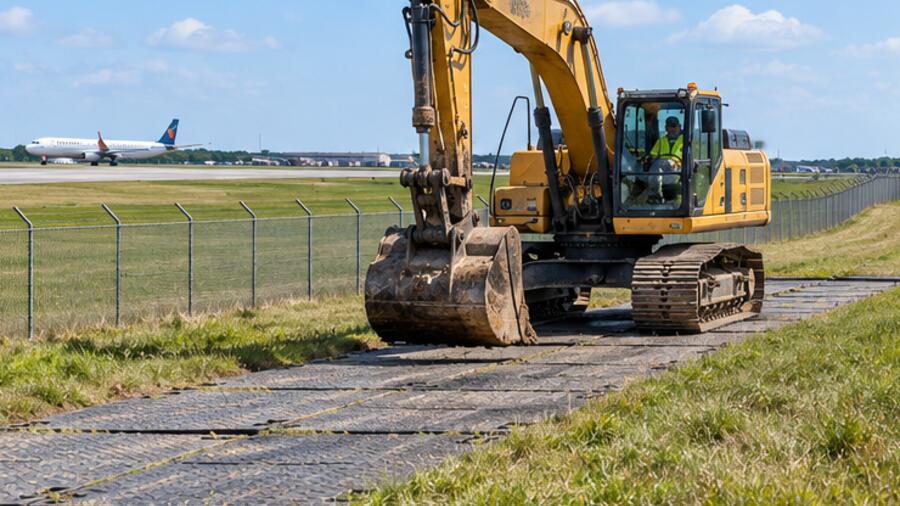
The sequence of laying would allow for the advance from the stable entrance to the area of operations. First, water and high differentials are processed, then the first plate is located; the subsequent plate is consistent in the direction of the texture and check if the seams form the steps. The ramp, turn and brake points shall increase the horizontal constraints or the width of the coverage. For this project, “Drain drainage and clean-up tools before rain” can be used as a key action, with dedicated time and results recorded.
Operating records include at least open hours, traffic through vehicles, unusual locations and disposal results. The first group of vehicles shall travel at a low speed to observe whether the plates are moving with the tyres; the second class shall then adjust the speed limits and frequency of the inspection to the records. Forklifts with frequent and rapid turnovers should check for surface wear and, if the crane changes the condition, re-check the retroactivity of the leg. Once maintenance is completed, access will be restored to the designated person.
Assuming an increase in traffic during the pre-entry phase of a temporary port route connecting the stacking and maintenance areas, managers could freeze the change of route before classifying problems into four categories: ground, board, vehicle and movement control. Weak positions are reinforced, damage plates are replaced, vehicles are limited in speed, and one-way access is introduced for peak hours. The example does not correspond to the true customer but shows how to retain a clear exit route for night maintenance and how to convert the site judgement into a reusable list for the next project.
Auxiliary equipment also affects the overall programme. A leg pad is required to accompany a vehicle, a forklift is required to focus on tyre contact, and a bulk vehicle may require a slab. The suitability of the UHMWPE liner depends on the work temperature, the chemical environment, the material impact and the car structure, and the manufacturer provides the installation requirements. Each product should be matched to specific equipment in the project form to avoid the use of the same parameter across uses.
The procurement list should provide suppliers with a real picture of the work, with the number of trips per day and the number of days spent projected to be the data to be highlighted for the current section. The remaining information includes vehicle and leg loads, ground photographs and sizes, projected number of vehicles, number of days of use, colour trails, destination port and desired period. A comparison of the quotations should be converted to a valid area coverage and complete connection system and not only a single block price; the acceptance and inspection criteria should also be included in the document before the next list.
Need for further evaluation of the actual project?
Applications, sizes, quantities, site photographs or drawings and delivery destinations are sent, on which we can identify more suitable products and processing programmes.







