
When handling night operations, “where to go, what to go, how many times a day” is written as a verifiable on-site condition. Flows in bulk-handling areas such as ore, coal, gravel, food and wet soil often include dumps, shovels, in-port troughs and silo-service vehicles, with only full tonnage to ignore the effects of tyre exposure and low-speed turns. The more reliable conclusion is that at night, border markings, lighting, seam visibility and the location of command officers are to be enhanced, followed by a decision on the combination of pavements, leg mats or local ground handling.
The project team could complete a joint pedal before the vehicle enters the site, focusing on ramps, drains, ramps and available car space that are permanently flushed at the warehouse entrance. The retroactivity of the legs of the vehicle ' s axial load, the exterior dimensions, the minimum convective radius and the equipment for the suspension was then collected. Short and heavy rainfall can change the state of the grass-roots level, so measurements need to be date- and weather-specific. All parameters should be consolidated in the same version of the road map and equipment list.
Product selection should be differentiated by stress. The route may be made on a HDPE paved board, which may be equipped with MHMWPE car skateboards to improve the discharge material, subject to applicable conditions. 15, 20, 25 and 30 mm are in the common thickness range and 15 mm can only serve as a starting point for comparison for the project; if there are holes or sediments at the grass-roots level, the increase in thickness is not a substitute for the search for peace and reinforcement. The 120 to 160 tonnes in the product information should also be understood in conjunction with the test conditions, with the final specifications to be confirmed by the approved programme and field professionals.
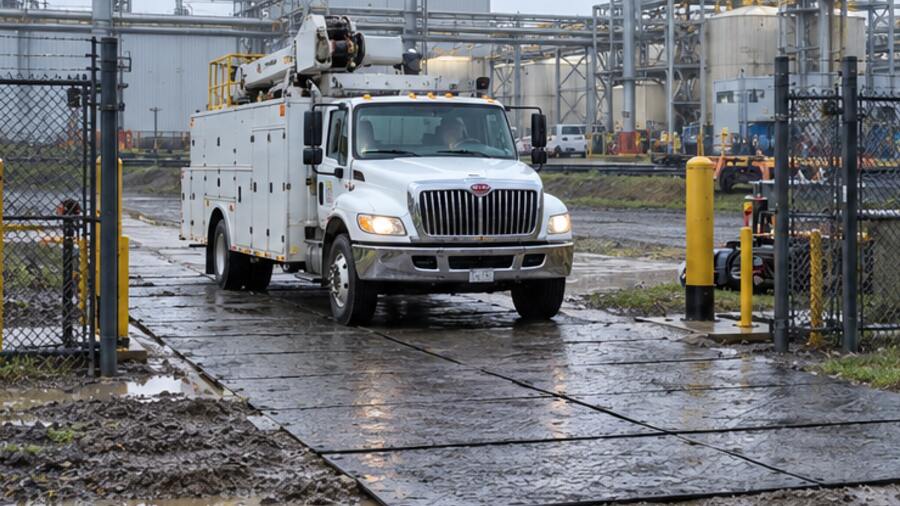
The construction staff should first seal the belts and confirm that no vehicles enter, then clear the floors and tablets. Do not leave the seams in the softest position, and do not let the edges remain open for long periods. Cleaning and installation of sandstones when the link is pierced, so that the connector is not fully in place. A low-speed test of access after a period of completion and implementation of “recording of the number of passing vehicles per shift” will be completed before the next segment becomes operational.
Maintenance staff can divide the straight-line, turn-out, waiting areas and support points into different levels of inspection. The straight-line sections focus on the sutures and the tracks, turn around and look for lateral shifts, wait areas to see long-term static sinking, and support points to check whether the pads and the ground are sunk. Shorter check intervals after rain or when the traffic suddenly increases; any plate-side rise, loose connection or grass-roots plasma should trigger decommissioning.
A reference scenario is a short barrage route for bulk material from the port stack to the discharge point. During the installation phase of the project, a short-range test lay was made to record the relocation and deposition of the first vehicle after its adoption, and the route was gradually extended. The turn areas, parking areas and pick-up points are inspected separately and no result is used to replace the full condition. This is an example of a methodology rather than a statement of performance, and the expected management effect is to focus the inspection on turnovers, ramps and seams; after completion, a comparison of the original ground photographs, cleaning hours and the number of plates that can be used for use.
The bulk material project will also examine car car stickers, impact and wear. The UHMWPE car skateboard can improve offloading when materials, temperature and car structure are appropriate, but it is necessary to confirm fixation, thermal condensation, the end door gap and cleaning methods; it is not a substitute for the safe offloading procedure. If the project does not involve a self-loading vehicle, the budget should be focused on physical access and support points and not add irrelevant configurations to complete product portfolios.
The procurement list should provide suppliers with a real picture of the work, in which the means of connection and the need for a tool to be laid are data that need to be added to this section. The remaining information includes vehicle and leg loads, ground photographs and sizes, projected number of vehicles, number of days of use, colour trails, destination port and desired period. A comparison of the quotations should be converted to a valid area coverage and complete connection system and not only a single block price; the acceptance and inspection criteria should also be included in the document before the next list.
Need for further evaluation of the actual project?
Applications, sizes, quantities, site photographs or drawings and delivery destinations are sent, on which we can identify more suitable products and processing programmes.







