
For receiving and inspection standards, the site should first determine whether the target is a continuous transport, short-term suspension or a temporary stop during peak periods. Mass handling areas, such as ores, coal, sandstone, food and wet soil, involve dumps, shovels, short-barriers and silo service vehicles, while glue increases backloads and clean-up times, and frequent shocks increase wear and tear and site contamination. When targets, vehicles and vulnerable positions are matched, the scope is not too large or missing key points; the practical implementation principle is to check the continuity of the route, the high seams, the stability of the surface, the clarity of the border and the obstruction of drainage.
On-site measurements cover indoor floors that require protection of epoxy coatings and record weak ranges, slopes, drainage directions and underground pipes. The water-bearing state and changes in the car tracks should be observed before and after the cryogenic freeze. Mobile equipment will need to provide the whole vehicle with its own weight, full load weight, a single axle load, tyre size, turn radius and projected duration; the crane will also need to provide the maximum reversibility of the leg and leg extension. Data sources and measurement dates should also be recorded to avoid different versions.
Where the route has both a mobile device and a fixed support point, the choice should be made between the pavement and the leg pad, respectively. The route may be made on a HDPE paved board, which may be equipped with MHMWPE car skateboards to improve the discharge material, subject to applicable conditions. The thickness can be screened from commonly used specifications such as 15, 20, 25, 30 mm, and the 15 mm appearing in this section does not constitute a direct recommendation. For information ranging from 120 to 160 tons, the purchaser should also request a test method and give priority to the equipment description, construction programme and on-site validation.
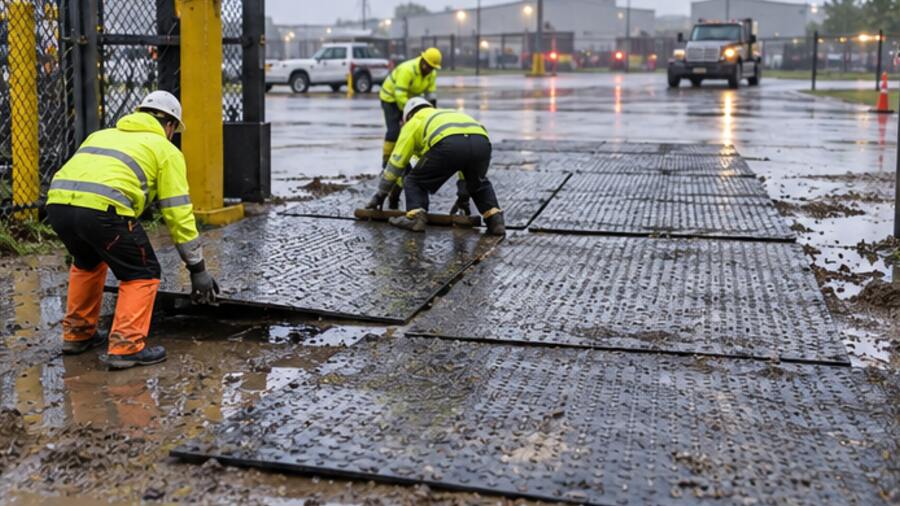
When the plates arrive at the site, the quantity, the connector and the crane are checked and the goods are discharged by route number. Upon completion of the grass-roots level, the vehicle entrance is prepared in sub-sections, and the level and edge support is checked at each stage of completion. The leg area of operation shall be separated from the area of passage. The inclusion in the installation programme of the words “set a one-way pass and check the total weight of the vehicle at the entrance” would allow the field personnel to convert abstract requirements into actionable.
Maintenance staff can divide the straight-line, turn-out, waiting areas and support points into different levels of inspection. The straight-line sections focus on the sutures and the tracks, turn around and look for lateral shifts, wait areas to see long-term static sinking, and support points to check whether the pads and the ground are sunk. Shorter check intervals after rain or when the traffic suddenly increases; any plate-side rise, loose connection or grass-roots plasma should trigger decommissioning.
A reference scenario is a short barrage route for bulk material from the port stack to the discharge point. The project involves short-term trial preparation during the start-up phase, recording the relocation and deposition of the first vehicle after its adoption, and a gradual extension of the route. The turn areas, parking areas and pick-up points are inspected separately and no result is used to replace the full condition. This is an example of a methodology rather than a statement of performance, and the expected management effect is to keep the load and load waiting for a steady parking of the vehicle; after completion, a comparison between the original ground photographs, cleaning hours and the number of plates that can continue to be used is required.
Three products may be used in this category at the same time, but the boundaries of the use are clear: road-painted service vehicle routes, leg-past services are centrally supported, and carboard services are applied to bulk discharges. In particular, UHMWPE skateboards need to check the material particle size, water content rate, temperature, impact and car shape. No product could compensate for the error, and the configuration list should be deleted from the field mission.
Quality documents, batch retroactives and acceptance methods must be present in the request for quotations, otherwise it is likely that different suppliers will base their calculations on different assumptions. The procurement staff shall also require the description of the effective size, weight, number of attachments, packing units, container load and delivery cycle of each plate. The evaluation will be based on technical conformity, installation efficiency and turnover. Where key payloads or ground data have not been confirmed, the quotations should be marked as preliminary and the review retained.
Need for further evaluation of the actual project?
Applications, sizes, quantities, site photographs or drawings and delivery destinations are sent, on which we can identify more suitable products and processing programmes.







