
Installation of movement control in bulk handling areas such as ore, coal, gravel, food and wet soil has a direct impact on the ability of vehicles to access the operational surface as planned. In-situ self-loading, forklifts, short-barriers and silo service vehicles, with different dynamic wheel pressure, stationary load and power. The adhesive increases backloads and clean-up times, and frequent shocks exacerbate car wear and contamination. The programme should, therefore, first target routes and time windows that must be kept open, before arranging for materials and personnel to avoid temporary changes in rules of passage on the construction side.
The degree of completeness of the input conditions determines the quality of the subsequent selection. After measuring the length and width of the arctics that are formed as a result of repeated crushing, the maximum performance of the self-loading, shoveling, short-barriers and silo service vehicles is checked. In addition to the weight, the pressure of the tyre, the form of the belt, the position of the brake, the possibility of in situ transfer and the frequency of passage shall be recorded. In case of high temperatures, a ground review should be carried out; if data cannot be confirmed, unknown items should be listed as a restriction rather than being replaced by empirical values.
Product selection should be differentiated by stress. The route may be made on a HDPE paved board, which may be equipped with MHMWPE car skateboards to improve the discharge material, subject to applicable conditions. 15, 20, 25 and 30 mm are in the common thickness range and 15 mm can only serve as a starting point for comparison for the project; if there are holes or sediments at the grass-roots level, the increase in thickness is not a substitute for the search for peace and reinforcement. The 120 to 160 tonnes in the product information should also be understood in conjunction with the test conditions, with the final specifications to be confirmed by the approved programme and field professionals.
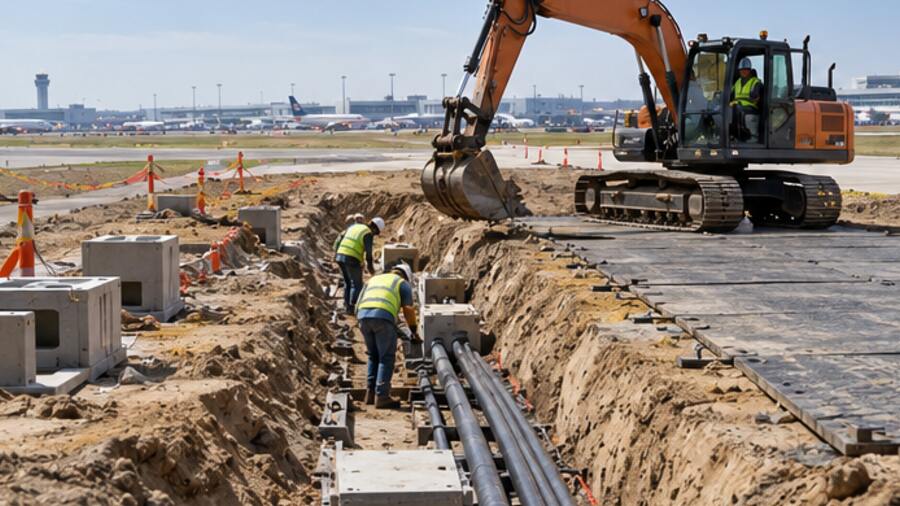
The fast-track installation still requires the retention of basic processes: drainage, debarment, peace-building, positioning, connection and trial passage. The plates remain continuous in line segments, leaving sufficient width at the intersections and outside areas; and they are to be removed from the rigid surface interface. The project manager shall arrange for “set-down measures at the lower end of the ramp” and at the same time specify the conditions for decommissioning, so as to prevent irregularity from being left to the next group when work is due.
Following the opening of access, the focus of the inspection was on the continued support under the plate. The first heavy vehicle passes by to check for high seams, peripheries, mudslides and planks; the shift is repeated after weather changes. The pressure of contact of the forklift ' s solid-heart wheel differs significantly from the concentrated static of the crane ' s legs, and anomalies should be detected first in isolation before being drained, evened or replaced, and the subsequent flow of the vehicle cannot continue to magnify the damage.
In a simulation plan for a short-barrel line of bulk material from the dock to the discharge point, the maintenance and overhaul phase involves the zonal release of areas that have completed grass-roots treatment and plate connections, with unaccepted areas remaining isolated. Each region designates a person responsible for the inspection and uses a number corresponding to the photograph. This example does not represent a specific project commitment, but allows the team to move from ad hoc decision-making to a pre-set process for post-rainfall repairs. If the records show repeated maintenance at the same location, they should be re-analysed back to the ground and transport organization.
Auxiliary equipment also affects the overall programme. A leg pad is required to accompany a vehicle, a forklift is required to focus on tyre contact, and a bulk vehicle may require a slab. The suitability of the UHMWPE liner depends on the work temperature, the chemical environment, the material impact and the car structure, and the manufacturer provides the installation requirements. Each product should be matched to specific equipment in the project form to avoid the use of the same parameter across uses.
The demand for quotations must be based on ground type, water-bearing status and permitted loads, otherwise it is likely that the different suppliers will calculate on different assumptions. The procurement staff shall also require the description of the effective size, weight, number of attachments, packing units, container load and delivery cycle of each plate. The evaluation will be based on technical conformity, installation efficiency and turnover. Where key payloads or ground data have not been confirmed, the quotations should be marked as preliminary and the review retained.
Need for further evaluation of the actual project?
Applications, sizes, quantities, site photographs or drawings and delivery destinations are sent, on which we can identify more suitable products and processing programmes.







