
The configuration of alternative pavements for bulk material transport and discharge in ports cannot be answered with single-product parameters. Project leaders need to view both traffic organization, ground support and maintenance capabilities; the back-up should be close to weak sections, turn areas and recovery points, and preserve fast-tracked connections. When dumps, shovels, short barges and silo service vehicles enter bulk loading areas such as ore, coal, gravel, food and wet soil, problems will arise earlier on the route, ramps, seams and waiting positions, which should be individually marked on drawings.
In situ measurements cover backfill areas close to the building base and record weak ranges, slopes, drainage directions and underground pipes. Changes in the water-bearing state and the car tracks should be observed before and after consecutive rainfalls. Mobile equipment will need to provide the whole vehicle with its own weight, full load weight, a single axle load, tyre size, turn radius and projected duration; the crane will also need to provide the maximum reversibility of the leg and leg extension. Data sources and measurement dates should also be recorded to avoid different versions.
Material parameters should serve the field rather than be propaganda figures. The route may be made on a HDPE paved board, which may be equipped with MHMWPE car skateboards to improve the discharge material, subject to applicable conditions. The project compares 30 mm and the number of block weights, rigidity, laying efficiency and containers with the adjacent specifications, and cross-checks the links to the surface. Between 80 and 120 tonnes are only primary sifts; ground-based and support designs should be completed when underground holes, weak shoulder or suspension loads are overloaded.
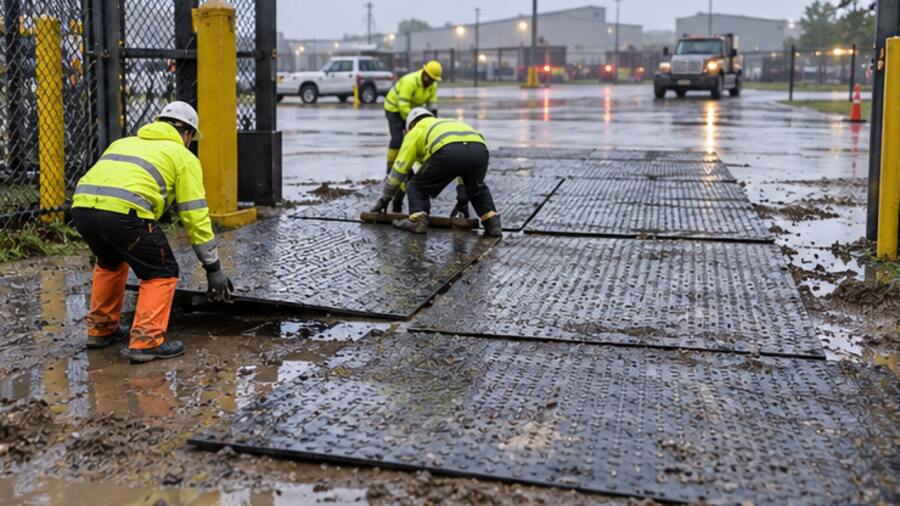
The construction staff should first seal the belts and confirm that no vehicles enter, then clear the floors and tablets. Do not leave the seams in the softest position, and do not let the edges remain open for long periods. Cleaning and installation of sandstones when the link is pierced, so that the connector is not fully in place. A low-speed test pass after completion of a period and the implementation of a “review of the original ground condition after completion of the project” before the opening of the next section.
Following the opening of access, the focus of the inspection was on the continued support under the plate. The first heavy vehicle passes by to check for high seams, peripheries, mudslides and planks; the shift is repeated after weather changes. The pressure of contact of the forklift ' s solid-heart wheel differs significantly from the concentrated static of the crane ' s legs, and anomalies should be detected first in isolation before being drained, evened or replaced, and the subsequent flow of the vehicle cannot continue to magnify the damage.
In a simulation plan for a short-barrel line of bulk material from the port yard to the discharge point, the evacuation site recovery phase involves the zonal release of areas that have completed the ground-based treatment and plate connection, while unaccepted areas remain isolated. Each region designates a person responsible for the inspection and uses a number corresponding to the photograph. This example does not represent a specific project commitment, but allows the team to reduce vehicle mud to the hardened area. If the records show repeated maintenance at the same location, they should be re-analysed back to the ground and transport organization.
The bulk material project will also examine car car stickers, impact and wear. The UHMWPE car skateboard can improve offloading when materials, temperature and car structure are appropriate, but it is necessary to confirm fixation, thermal condensation, the end door gap and cleaning methods; it is not a substitute for the safe offloading procedure. If the project does not involve a self-loading vehicle, the budget should be focused on physical access and support points and not add irrelevant configurations to complete product portfolios.
In addition to the total area, the request for quotations should provide the type of container and the port of destination, indicating the country, the period of work, the conditions of handling, the manner of packing and the port of destination. Compared suppliers can check the documentation, size difference, surface routing, connector, piece weight, effective area coverage, cabinet list and batch retroactive. The whole container shall be purchased in advance to confirm the discharge equipment. The final programme, which involves the safety of the ground, assembly or operation of the airport, must be approved by the project professional.
Need for further evaluation of the actual project?
Applications, sizes, quantities, site photographs or drawings and delivery destinations are sent, on which we can identify more suitable products and processing programmes.







