
The answer to which data should be recorded in the case of the Logistics Park Temporary Parking and Handling Area Project should start with the operational route rather than with a fixed specification. The case should record the pre-input, the time of laying, the type of vehicle, the number of maintenance, the recovery and the results of the ground restoration. The logistics park expansion area, the outside of the warehouse platform and the waiting areas for peak vehicles are usually accompanied by semi-mounted vehicles, cold-chain vehicles, vans, forklifts and loading platform equipment, with different pressures on tyres, axle loads and shifts. Vehicle parking, low-speed driving and overloading can easily result in road tracks, local downfalls and perimeter damage. The project team shall first delineate the main corridor, the waiting areas, the loading and unloading points and the emergency export, and then the boundary shall be confirmed jointly by the construction, logistics and security authorities.
The project team could complete a joint pedal before the vehicle enters the site, focusing on the boundary between old concrete and new backfills, low drainage points, ramps and available car space. The retroactivity of the legs of the vehicle ' s axial load, the exterior dimensions, the minimum convective radius and the equipment for the suspension was then collected. Moist salt mists may change the state of the grass-roots level, so measurements need to be date- and weather-specific. All parameters should be consolidated in the same version of the road map and equipment list.
Where the route has both a mobile device and a fixed support point, the choice should be made between the pavement and the leg pad, respectively. Road panels are suitable for making up the driveway, parking spaces and loading and unloading links, and can be accompanied, as necessary, by leg mats for the handling of the vehicle support points. The thickness can be screened from commonly used specifications such as 15, 20, 25, 30 mm, and the 15 mm appearing in this section does not constitute a direct recommendation. For information on ranges of 80 to 120 tons, the purchaser should also request a test method and give priority to the equipment description, construction programme and on-site validation.
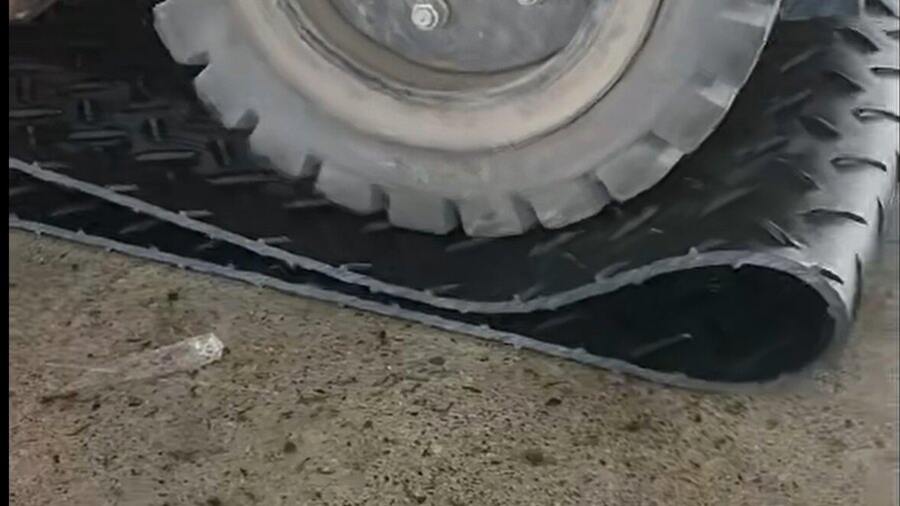
When the plates arrive at the site, the quantity, the connector and the crane are checked and the goods are discharged by route number. Upon completion of the grass-roots level, the vehicle entrance is prepared in sub-sections, and the level and edge support is checked at each stage of completion. The leg area of operation shall be separated from the area of passage. The inclusion in the installation programme of the phrase “first low-speed test and post-pass check” would allow the field personnel to convert abstract requirements into actionable.
The day-to-day management will include vehicle behaviour in the inspection. Speed-limiting, prohibition of in-situ movement, fixed reverse routes and placement of commanders are often more effective than simply adding plates. The inspectors should touch or step on the suspicious seams, check the links and take photographs to locate them. Where there are repeated shifts, the width of the road, the turn radius and the grass-roots level should be re-evaluated, rather than the continuous consolidation of the same position.
Assuming that a temporary parking area at a logistics park that would still need to be maintained during the construction of the warehouse experienced an increase in traffic during the peak transport phase, managers could first freeze the change of route and then divide the problems into four categories: ground, board, vehicle and movement control. Weak positions are reinforced, damage plates are replaced, vehicles are limited in speed, and one-way access is introduced for peak hours. The example does not correspond to the true customer, but it shows how to reduce the probability of the floor being directly crushed by tyres and legs, and how to convert the site judgement into a reusable list for the next project.
The bulk material project will also examine car car stickers, impact and wear. The UHMWPE car skateboard can improve offloading when materials, temperature and car structure are appropriate, but it is necessary to confirm fixation, thermal condensation, the end door gap and cleaning methods; it is not a substitute for the safe offloading procedure. If the project does not involve a self-loading vehicle, the budget should be focused on physical access and support points and not add irrelevant configurations to complete product portfolios.
In order to obtain a comparable offer, the purchaser should harmonize the request for quotations, at least specifying the project schedule and the plan, the route size, vehicle condition, ground condition and project time. Vendors are required to respond to material plates, sheeting, single weight, connection, packaging, containerization and quantity and quality documents. If the project is purchased on a containerized basis, the capability of the forklift or forklift on site or forklift is also confirmed. All safety-related selections are based on the equipment manual and the approval programme.
Need for further evaluation of the actual project?
Applications, sizes, quantities, site photographs or drawings and delivery destinations are sent, on which we can identify more suitable products and processing programmes.







