
In response to the request for quotation parameters, the site should first determine whether the target is a continuous transport, a short-term suspension or a temporary stop during peak periods. The logistics park expansion area, the outer side of the warehouse platform and the waiting areas for peak vehicles involve semi-mounted vehicles, cold-chain vehicles, vans, forklifts and loading platform equipment, while vehicle parking, low-speed driving and overloading can easily result in staves, local downfalls and marginal damage. When targets, vehicles and vulnerable locations are matched, key points will not be overstretched or left out; the practical implementation principle is that valid request for quotations requires at least vehicle, payload, ground, route size, quantity and destination port information.
The degree of completeness of the input conditions determines the quality of the subsequent selection. Measuring the length and width of the interior floors epoxy coatings, then checking the maximum performance of semi-mounted vehicles, cold-chain vehicles, vans, forklifts and loading platform equipment. In addition to the weight, the pressure of the tyre, the form of the belt, the position of the brake, the possibility of in situ transfer and the frequency of passage shall be recorded. In case of cryogenic freezing, a ground review should be carried out; if the data cannot be confirmed, the unknown item should be classified as a restriction and not replaced by an empirical value.
The selection is based on the calculation of the local pressure and the examination of whether the plate remains continuous at the grass-roots level. Road panels are suitable for making up the driveway, parking spaces and loading and unloading links, and can be accompanied, as necessary, by leg mats for the handling of the vehicle support points. The common thickness ranges from 15 mm to 30 mm, and this option can first assess 25 mm and then adjust it through trial preparation or project accounting. The so-called 160 to 200-ton carrier should have a clear test boundary and cannot be cited separately from the distance, temperature, payload distribution and safety factor.
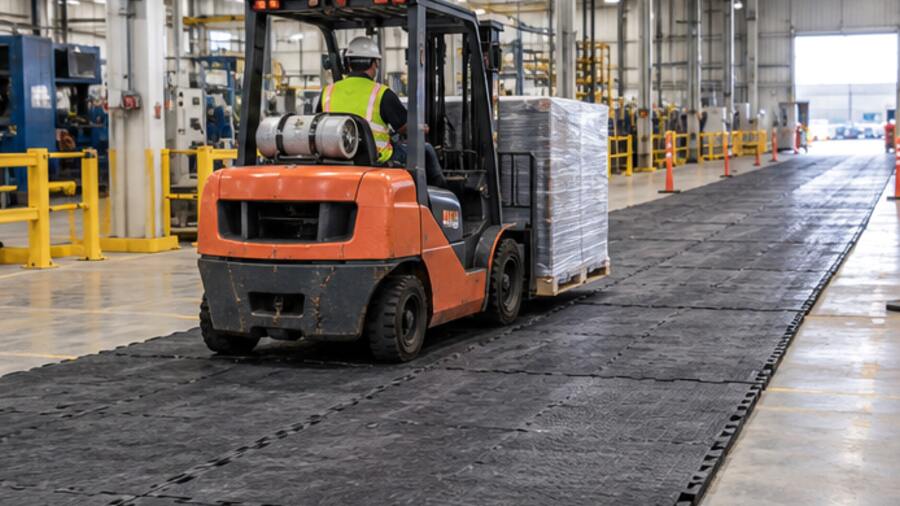
The sequence of laying would allow for the advance from the stable entrance to the area of operations. First, water and high differentials are processed, then the first plate is located; the subsequent plate is consistent in the direction of the texture and check if the seams form the steps. The ramp, turn and brake points shall increase the horizontal constraints or the width of the coverage. For this item, “one-way access and checking of the total vehicle mass at the entrance” can be used as a key action, with a dedicated person recording the completion time and the results of the review.
Maintenance staff can divide the straight-line, turn-out, waiting areas and support points into different levels of inspection. The straight-line sections focus on the sutures and the tracks, turn around and look for lateral shifts, wait areas to see long-term static sinking, and support points to check whether the pads and the ground are sunk. Shorter check intervals after rain or when the traffic suddenly increases; any plate-side rise, loose connection or grass-roots plasma should trigger decommissioning.
A reference scenario is a temporary parking area of a logistics park that still needs to be maintained during the construction of the warehouse. The project involves short-term trial preparation during the start-up phase, recording the relocation and deposition of the first vehicle after its adoption, and a gradual extension of the route. The turn areas, parking areas and pick-up points are inspected separately and no result is used to replace the full condition. This is an example of a methodology rather than a statement of performance, and the expected management effect is to keep the load and load waiting for a steady parking of the vehicle; after completion, a comparison between the original ground photographs, cleaning hours and the number of plates that can continue to be used is required.
Three products may be used in this category at the same time, but the boundaries of the use are clear: road-painted service vehicle routes, leg-past services are centrally supported, and carboard services are applied to bulk discharges. In particular, UHMWPE skateboards need to check the material particle size, water content rate, temperature, impact and car shape. No product could compensate for the error, and the configuration list should be deleted from the field mission.
In order to obtain a comparable offer, the purchaser should harmonize the request for quotations to at least indicate maximum slope and drainage direction, route size, vehicle condition, ground condition and project time. Vendors are required to respond to material plates, sheeting, single weight, connection, packaging, containerization and quantity and quality documents. If the project is purchased on a containerized basis, the capability of the forklift or forklift on site or forklift is also confirmed. All safety-related selections are based on the equipment manual and the approval programme.
Need for further evaluation of the actual project?
Applications, sizes, quantities, site photographs or drawings and delivery destinations are sent, on which we can identify more suitable products and processing programmes.







