
The design of the removal and recycling process in the temporary parking and loading areas of the logistics park cannot be answered with a single product parameter. Project leaders need to view the flow organization, ground support and maintenance capacity at the same time; recovery should be carried out in reverse from the end to the entrance, while cleaning, checking, sorting and binding is completed. When semi-mounted vehicles, cold-chained vehicles, vans, forklifts and loading platform equipment enter the logistics park extension area, the outer side of the warehouse platform and the waiting area for peak vehicles, problems will arise earlier on the route, ramps, seams and waiting positions and should be separately marked on the drawings.
The degree of completeness of the input conditions determines the quality of the subsequent selection. First, the length and width of the refilled areas close to the building base are measured, and then the maximum performance of the semi-mounted, cold-chain, van, forklift and loading platform equipment is checked. In addition to the weight, the pressure of the tyre, the form of the belt, the position of the brake, the possibility of in situ transfer and the frequency of passage shall be recorded. In case of continuous rainfall, a ground review should be carried out; if the data cannot be confirmed, the unknown item should be included as a restriction rather than replaced by an empirical value.
Road-paving boards are responsible for spreading wheel pressure and leg mats for expanding static support areas, which cannot be replaced by one another. For this scenario, the pavement is suitable for making up the drive, parking spaces and loading and unloading links, and can be accompanied by a leg pad to handle the slinging points. 20 mm could be included as an option and compared with other thickness, subject to the simultaneous verification of plate size, connection structure, grass-roots rigidity and number of passages. The labelling of 120 to 160 tons of products does not mean that all the same vehicles are available on the ground, and ground conditions remain the determining factor.
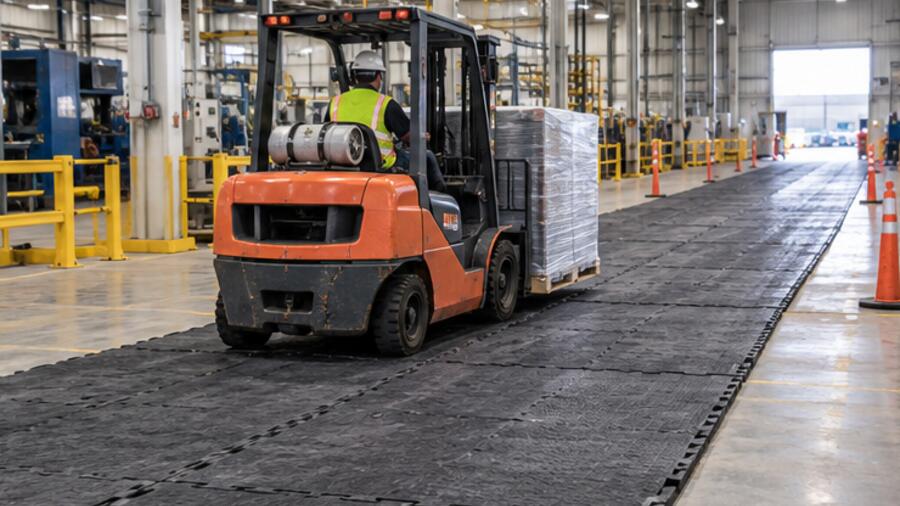
When the plates arrive at the site, the quantity, the connector and the crane are checked and the goods are discharged by route number. Upon completion of the grass-roots level, the vehicle entrance is prepared in sub-sections, and the level and edge support is checked at each stage of completion. The leg area of operation shall be separated from the area of passage. The inclusion in the installation programme of a “review of the original ground state at the end of the project” would allow field personnel to convert abstract requirements into actionable.
Following the opening of access, the focus of the inspection was on the continued support under the plate. The first heavy vehicle passes by to check for high seams, peripheries, mudslides and planks; the shift is repeated after weather changes. The pressure of contact of the forklift ' s solid-heart wheel differs significantly from the concentrated static of the crane ' s legs, and anomalies should be detected first in isolation before being drained, evened or replaced, and the subsequent flow of the vehicle cannot continue to magnify the damage.
In a simulation plan for a temporary parking area at a logistics park that still needs to be maintained during the construction of the warehouse, area release is used for the evacuation site recovery phase: the area to complete the ground handling and plate connection is open and the unaccepted area remains isolated. Each region designates a person responsible for the inspection and uses a number corresponding to the photograph. This example does not represent a specific project commitment, but allows the team to reduce vehicle mud to the hardened area. If the records show repeated maintenance at the same location, they should be re-analysed back to the ground and transport organization.
The bulk material project will also examine car car stickers, impact and wear. The UHMWPE car skateboard can improve offloading when materials, temperature and car structure are appropriate, but it is necessary to confirm fixation, thermal condensation, the end door gap and cleaning methods; it is not a substitute for the safe offloading procedure. If the project does not involve a self-loading vehicle, the budget should be focused on physical access and support points and not add irrelevant configurations to complete product portfolios.
It is best to complete small-scale technical confirmation before the next list. First, the expected daily number and number of days of use and complete field parameters were submitted to the supplier for specification, quantity and packaging advice; then the sample trails, links, dimensions and material documentation were checked; and finally, the container type, destination port, discharge method and batch identification were confirmed. The supplier recommended that it be used only as an input and that the project party remain responsible for the stabilization of the ground load, traffic organization and lifting.
Need for further evaluation of the actual project?
Applications, sizes, quantities, site photographs or drawings and delivery destinations are sent, on which we can identify more suitable products and processing programmes.







