
How the temporary parking and handling area of the logistics park determines the width of the temporary road cannot be answered with a single product parameter. Project leaders need to view both the flow organization, ground support and maintenance capabilities; the width should cover both the wheel, the rotation, car demand and side safety balances. When semi-mounted vehicles, cold-chained vehicles, vans, forklifts and loading platform equipment enter the logistics park extension area, the outer side of the warehouse platform and the waiting area for peak vehicles, problems will arise earlier on the route, ramps, seams and waiting positions and should be separately marked on the drawings.
The survey forms can be completed by the four columns of ground, equipment, route and time. Ground bars mark restricted loads above underground ditches and adjacent drains; equipment columns specify vehicle weights, cargo weights, axle numbers and tyre specifications; route bars take a clean width, slope and turn radius; timebar indicates continuous rainfall and shift arrangements. If a crane is present, it should be based on the retroactivity of the leg in the manufacturer ' s worksheet, and it cannot be rated as a ground load.
Where the route has both a mobile device and a fixed support point, the choice should be made between the pavement and the leg pad, respectively. Road panels are suitable for making up the driveway, parking spaces and loading and unloading links, and can be accompanied, as necessary, by leg mats for the handling of the vehicle support points. The thickness can be screened from commonly used specifications such as 15, 20, 25 and 30 mm, and the 30 mm appearing in this section does not constitute a direct recommendation. For information ranging from 50 to 80 tons, the purchaser should also request the test method and give priority to the equipment description, construction programme and on-site validation.
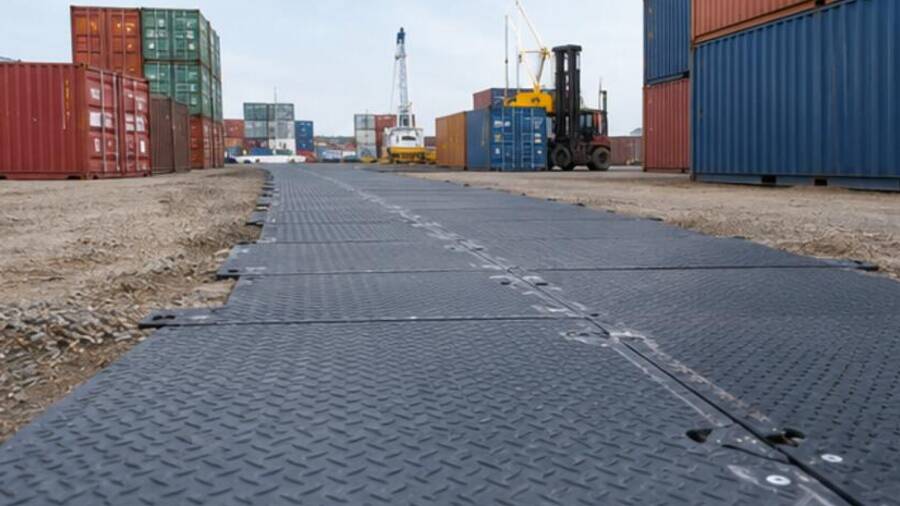
The construction staff should first seal the belts and confirm that no vehicles enter, then clear the floors and tablets. Do not leave the seams in the softest position, and do not let the edges remain open for long periods. Cleaning and installation of sandstones when the link is pierced, so that the connector is not fully in place. Following the completion of a period of low-speed trial traffic and the implementation of the “management of the hanger area separately from the continuous driveway”, the next section will be opened only after eligibility.
Maintenance staff can divide the straight-line, turn-out, waiting areas and support points into different levels of inspection. The straight-line sections focus on the sutures and the tracks, turn around and look for lateral shifts, wait areas to see long-term static sinking, and support points to check whether the pads and the ground are sunk. Shorter check intervals after rain or when the traffic suddenly increases; any plate-side rise, loose connection or grass-roots plasma should trigger decommissioning.
A reference scenario is a temporary parking area of a logistics park that still needs to be maintained during the construction of the warehouse. The project involves short-term trial preparation during the recovery phase of the evacuation site, recording the relocation and deposition of the first vehicle after its adoption, and a gradual extension of the route. The turn areas, parking areas and pick-up points are inspected separately and no result is used to replace the full condition. This is an example of a method rather than a statement of performance, and the expected management effect is to reduce the amount of time spent on cleaning car stickers; after completion, a comparison between the original ground photographs, cleaning hours and the number of plates that can be continued.
In the integrated site, different problems were solved by the pavement, leg mats and carboards. Vehicle traffic is supported by a continuous focus on the maximum retroactivity of the leg and the friction and adhesion of material from the surface of the vehicle. If MHMWPE skateboards are used, thermal stretches should be set aside and fixed systems checked; if relevant material is not available at the site, they should be removed from the list and the investment targeted.
The procurement list should provide suppliers with a real picture of the situation, in which the type of container and the port of destination are data that need to be highlighted and supplemented. The remaining information includes vehicle and leg loads, ground photographs and sizes, projected number of vehicles, number of days of use, colour trails, destination port and desired period. A comparison of the quotations should be converted to a valid area coverage and complete connection system and not only a single block price; the acceptance and inspection criteria should also be included in the document before the next list.
Need for further evaluation of the actual project?
Applications, sizes, quantities, site photographs or drawings and delivery destinations are sent, on which we can identify more suitable products and processing programmes.







