
For receiving and inspection standards, the site should first determine whether the target is a continuous transport, short-term suspension or a temporary stop during peak periods. The logistics park expansion area, the outer side of the warehouse platform and the waiting areas for peak vehicles involve semi-mounted vehicles, cold-chain vehicles, vans, forklifts and loading platform equipment, while vehicle parking, low-speed driving and overloading can easily result in staves, local downfalls and marginal damage. When targets, vehicles and vulnerable positions are matched, the scope is not too large or missing key points; the practical implementation principle is to check the continuity of the route, the high seams, the stability of the surface, the clarity of the border and the obstruction of drainage.
The project team could complete a joint pedal survey before the vehicle enters the site, focusing on the ground floors, low-water drainage, ramps and available car space, with uneven pressure. The retroactivity of the legs of the vehicle ' s axial load, the exterior dimensions, the minimum convective radius and the equipment for the suspension was then collected. Low-temperature freezing may change the state at the grass-roots level, so measurement results need to be date- and weather-specific. All parameters should be consolidated in the same version of the road map and equipment list.
Material parameters should serve the field rather than be propaganda figures. Road panels are suitable for making up the driveway, parking spaces and loading and unloading links, and can be accompanied, as necessary, by leg mats for the handling of the vehicle support points. The project compares 30 mm and the number of block weights, rigidity, laying efficiency and containers with the adjacent specifications, and cross-checks the links to the surface. 50-80 tonnes are only primary sifts; ground-based and support designs should be completed first when an underground hole, weak shoulder or hanger overload exists.
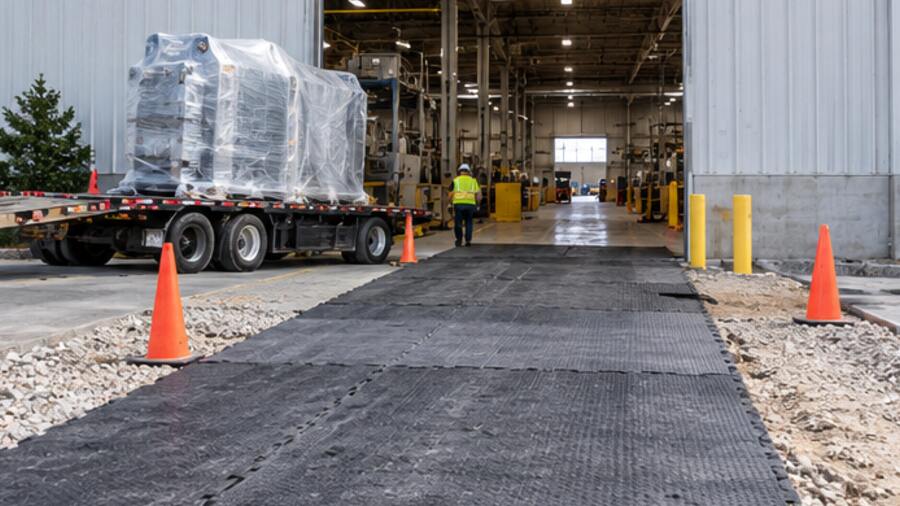
The construction staff should first seal the belts and confirm that no vehicles enter, then clear the floors and tablets. Do not leave the seams in the softest position, and do not let the edges remain open for long periods. Cleaning and installation of sandstones when the link is pierced, so that the connector is not fully in place. A low-speed test of access after a period of completion and the implementation of the “drain before drainage and preparation of cleaning tools” were completed before the next section was opened.
Temporary roads cannot be paved for long. Vehicle brakes, loading overloading and water stowing can gradually change the support under the plate, and surfaces may appear flat and may have created gaps. The site should be checked before and after peak traffic, after cryogenic freezing and when the route changes. In the event of a sinking, the ground and drainage should be checked before deciding whether to change or replace the panels, so as to avoid covering up the problem by filling the panels.
In the case of a temporary parking area at a logistics park, which would still need to be maintained during the construction of the warehouse, the pre-entry phase could be established as an independent inspection node. On-site identification of vehicle lists and weather is followed by a check of drainage, connections and borders; if any conditions change, release is suspended and the road map updated. This scenario is used only to illustrate the way in which the project is organized, with a focus on revolving the sheeting to the next stage. It should also record the number of inputs, the time of laying, the time of stoppage, the location of maintenance and the condition of the ground after the evacuation site.
In the integrated site, different problems were solved by the pavement, leg mats and carboards. Vehicle traffic is supported by a continuous focus on the maximum retroactivity of the leg and the friction and adhesion of material from the surface of the vehicle. If MHMWPE skateboards are used, thermal stretches should be set aside and fixed systems checked; if relevant material is not available at the site, they should be removed from the list and the investment targeted.
It is best to complete small-scale technical confirmation before the next list. First, the size of the vehicle, the type of material and the working temperature and complete field parameters are submitted to the supplier for specification, quantity and packing advice; then the sample trails, connection holes, size differences and material documents are checked; and finally, the container type, destination port, method of discharge and batch identification are confirmed. The supplier recommended that it be used only as an input and that the project party remain responsible for the stabilization of the ground load, traffic organization and lifting.
Need for further evaluation of the actual project?
Applications, sizes, quantities, site photographs or drawings and delivery destinations are sent, on which we can identify more suitable products and processing programmes.







