
The installation of movement control directly affects the ability of vehicles to access their operational areas as planned in the logistics park expansion area, outside the warehouse platform and during peak vehicle waiting areas. On-site, semi-mounted, cold-chained, vans, forklifts and loading platform equipment with different dynamic wheel pressure, stationary trajectories and power. Vehicle parking, low-speed driving and overloading can easily result in road tracks, local downfalls and perimeter damage. The programme should, therefore, first target routes and time windows that must be kept open, before arranging for materials and personnel to avoid temporary changes in rules of passage on the construction side.
In order to determine whether the installation schedule can be implemented, the site should be set up at a point rather than taking only a few photographs. In particular, the refilling of the floors after the temporary excavation is reviewed, as the drying of the surface does not represent a continuous carrying of the lower part. Information on the project should also include the maximum daily traffic, the length of vehicle stay, the direction of handling and the drainage route during high-temperature tan. For troughs, inspection wells and underground facilities, the prohibited support or need to be reinforced should be indicated in the road map.
Where the route has both a mobile device and a fixed support point, the choice should be made between the pavement and the leg pad, respectively. Road panels are suitable for making up the driveway, parking spaces and loading and unloading links, and can be accompanied, as necessary, by leg mats for the handling of the vehicle support points. The thickness can be screened from commonly used specifications such as 15, 20, 25 and 30 mm, and the 30 mm appearing in this section does not constitute a direct recommendation. For information ranging from 50 to 80 tons, the purchaser should also request the test method and give priority to the equipment description, construction programme and on-site validation.
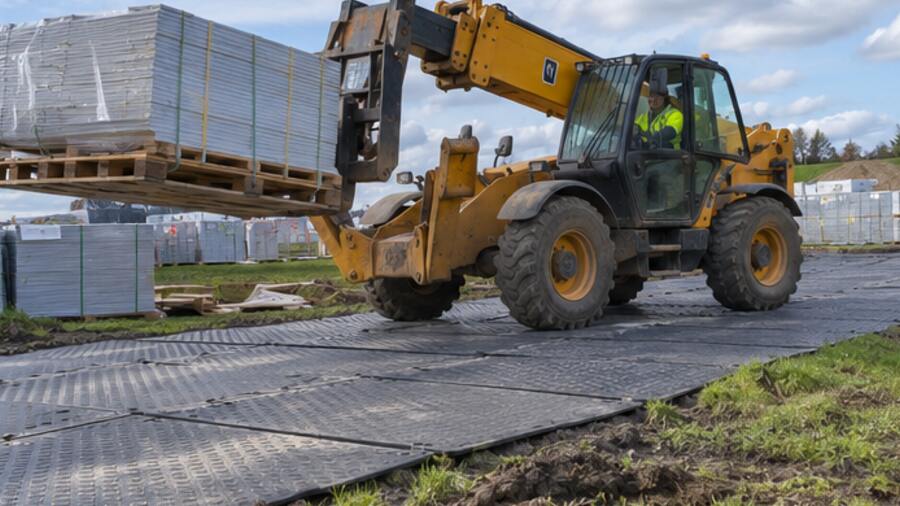
The sequence of laying would allow for the advance from the stable entrance to the area of operations. First, water and high differentials are processed, then the first plate is located; the subsequent plate is consistent in the direction of the texture and check if the seams form the steps. The ramp, turn and brake points shall increase the horizontal constraints or the width of the coverage. For this project, the key action could be “the immediate discontinuation of the slurry when it is found to be coming out of the seam” and the completion time and the results of the review could be recorded by a dedicated person.
Operating records include at least open hours, traffic through vehicles, unusual locations and disposal results. The first group of vehicles shall travel at a low speed to observe whether the plates are moving with the tyres; the second class shall then adjust the speed limits and frequency of the inspection to the records. Forklifts with frequent and rapid turnovers should check for surface wear and, if the crane changes the condition, re-check the retroactivity of the leg. Once maintenance is completed, access will be restored to the designated person.
In the case of a temporary parking area at a logistics park that would still need to be maintained during the construction of the warehouse, the site could be divided into five areas of entry, straight, turn, operation and recovery during the maintenance and repair phase. The entry point is responsible for vehicle reconciliation, maintaining continuous coverage of the straight-line segment, increasing the outer width of the turn-band, separate validation of the operating segment and completion of clean bundles in the recovery area. This simulation programme is used to illustrate the methodology and is not a client-specific performance; it helps project teams to synchronize the clean-up and classification of panels when they are evacuated and to keep records of the number of maintenances and the length of breaks.
Three products may be used in this category at the same time, but the boundaries of the use are clear: road-painted service vehicle routes, leg-past services are centrally supported, and carboard services are applied to bulk discharges. In particular, UHMWPE skateboards need to check the material particle size, water content rate, temperature, impact and car shape. No product could compensate for the error, and the configuration list should be deleted from the field mission.
It is best to complete small-scale technical confirmation before the next list. First, the expected delivery period and arrival sequence and complete field parameters are submitted, allowing the supplier to give specifications, quantities and packing suggestions; then the sample trail, connection holes, size differences and material documents are checked; and finally, the container type, destination port, discharge method and batch identification are identified. The supplier recommended that it be used only as an input and that the project party remain responsible for the stabilization of the ground load, traffic organization and lifting.
Need for further evaluation of the actual project?
Applications, sizes, quantities, site photographs or drawings and delivery destinations are sent, on which we can identify more suitable products and processing programmes.







