
The configuration of spare pavements in the temporary parking and loading areas of logistics parks cannot be answered with single product parameters. Project leaders need to view both traffic organization, ground support and maintenance capabilities; the back-up should be close to weak sections, turn areas and recovery points, and preserve fast-tracked connections. When semi-mounted vehicles, cold-chained vehicles, vans, forklifts and loading platform equipment enter the logistics park extension area, the outer side of the warehouse platform and the waiting area for peak vehicles, problems will arise earlier on the route, ramps, seams and waiting positions and should be separately marked on the drawings.
The project team could complete a joint pedal survey before the vehicle enters the field, focusing on high-water powdered backfills after the rain, drainage lows, ramps and available car space. The retroactivity of the legs of the vehicle ' s axial load, the exterior dimensions, the minimum convective radius and the equipment for the suspension was then collected. Continuous rainfall may change the state of the grass-roots level, so measurements need to be date- and weather-specific. All parameters should be consolidated in the same version of the road map and equipment list.
The selection is based on the calculation of the local pressure and the examination of whether the plate remains continuous at the grass-roots level. Road panels are suitable for making up the driveway, parking spaces and loading and unloading links, and can be accompanied, as necessary, by leg mats for the handling of the vehicle support points. The common thickness ranges from 15 mm to 30 mm, and this option can first assess 25 mm and then adjust it through trial preparation or project accounting. The so-called 160 to 200-ton carrier should have a clear test boundary and cannot be cited separately from the distance, temperature, payload distribution and safety factor.
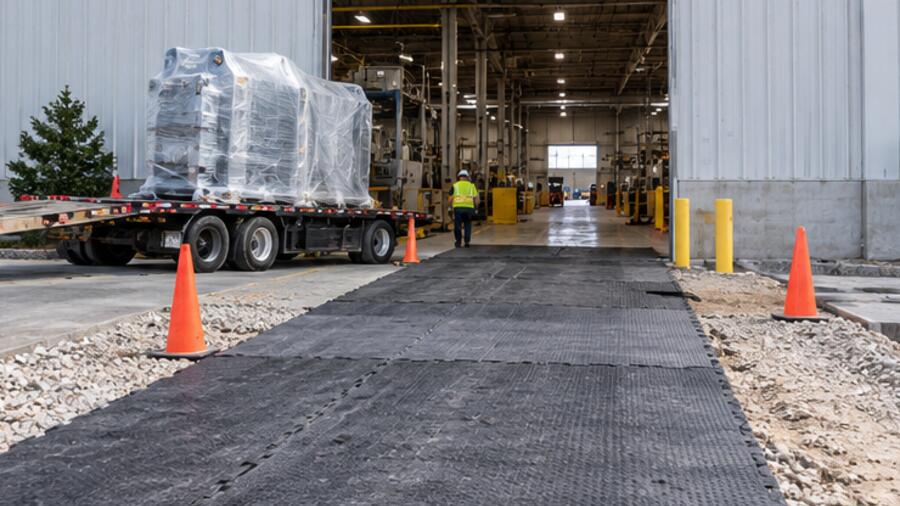
Pre-installation to remove sharp waste, loose rock and mobile mud, and to purge and level the ground. The plates were set up in the main direction and were sewd to avoid the deep path and to check the wells and legs. The turn and reverse areas are to be slightly wider and the connectors are to be locked as required. The “placement of a commanding officer to control a meeting and a back-up” should also be implemented at the site, and this requirement should be included in the pre-shift and traffic organization chart.
Operating records include at least open hours, traffic through vehicles, unusual locations and disposal results. The first group of vehicles shall travel at a low speed to observe whether the plates are moving with the tyres; the second class shall then adjust the speed limits and frequency of the inspection to the records. Forklifts with frequent and rapid turnovers should check for surface wear and, if the crane changes the condition, re-check the retroactivity of the leg. Once maintenance is completed, access will be restored to the designated person.
In the case of a temporary parking area at the logistics park, which is still subject to export during the construction of the warehouse, the site could be divided into five areas during the recovery phase of the evacuation site, straight ahead, turn, operate and recover. The entry point is responsible for vehicle reconciliation, maintaining continuous coverage of the straight-line segment, increasing the outer width of the turn-band, separate validation of the operating segment and completion of clean bundles in the recovery area. This simulation programme is used to describe the methodology and is not a client-specific performance; it can help the project team to maintain access without expanding permanent hardened areas and leave a record of the number of maintenances and the length of breaks.
Auxiliary equipment also affects the overall programme. A leg pad is required to accompany a vehicle, a forklift is required to focus on tyre contact, and a bulk vehicle may require a slab. The suitability of the UHMWPE liner depends on the work temperature, the chemical environment, the material impact and the car structure, and the manufacturer provides the installation requirements. Each product should be matched to specific equipment in the project form to avoid the use of the same parameter across uses.
The request for quotations must have a level of forklift doors and clear passages, otherwise it is likely that different vendors will have to calculate on different assumptions. The procurement staff shall also require the description of the effective size, weight, number of attachments, packing units, container load and delivery cycle of each plate. The evaluation will be based on technical conformity, installation efficiency and turnover. Where key payloads or ground data have not been confirmed, the quotations should be marked as preliminary and the review retained.
Need for further evaluation of the actual project?
Applications, sizes, quantities, site photographs or drawings and delivery destinations are sent, on which we can identify more suitable products and processing programmes.







