
The answer to how the temporary parking and loading areas at logistics parks compare different supply options should start with the operational route rather than with a fixed specification. The comparison should cover materials, structures, connections, effective area coverage, containerization and quality documents. The logistics park expansion area, the outside of the warehouse platform and the waiting areas for peak vehicles are usually accompanied by semi-mounted vehicles, cold-chain vehicles, vans, forklifts and loading platform equipment, with different pressures on tyres, axle loads and shifts. Vehicle parking, low-speed driving and overloading can easily result in road tracks, local downfalls and perimeter damage. The project team shall first delineate the main corridor, the waiting areas, the loading and unloading points and the emergency export, and then the boundary shall be confirmed jointly by the construction, logistics and security authorities.
The degree of completeness of the input conditions determines the quality of the subsequent selection. First, measuring the length and width of long-term parked vehicles to form a localized sink, then checking the maximum performance of semi-mounted vehicles, cold-chain vehicles, vans, forklifts and loading platform equipment. In addition to the weight, the pressure of the tyre, the form of the belt, the position of the brake, the possibility of in situ transfer and the frequency of passage shall be recorded. In case of damp salt fog, a ground review should be carried out; if the data cannot be confirmed, the unknown item should be classified as a restriction and not replaced by an empirical value.
Material parameters should serve the field rather than be propaganda figures. Road panels are suitable for making up the driveway, parking spaces and loading and unloading links, and can be accompanied, as necessary, by leg mats for the handling of the vehicle support points. The project compares 30 mm and the number of block weights, rigidity, laying efficiency and containers with the adjacent specifications, and cross-checks the links to the surface. 50-80 tonnes are only primary sifts; ground-based and support designs should be completed first when an underground hole, weak shoulder or hanger overload exists.
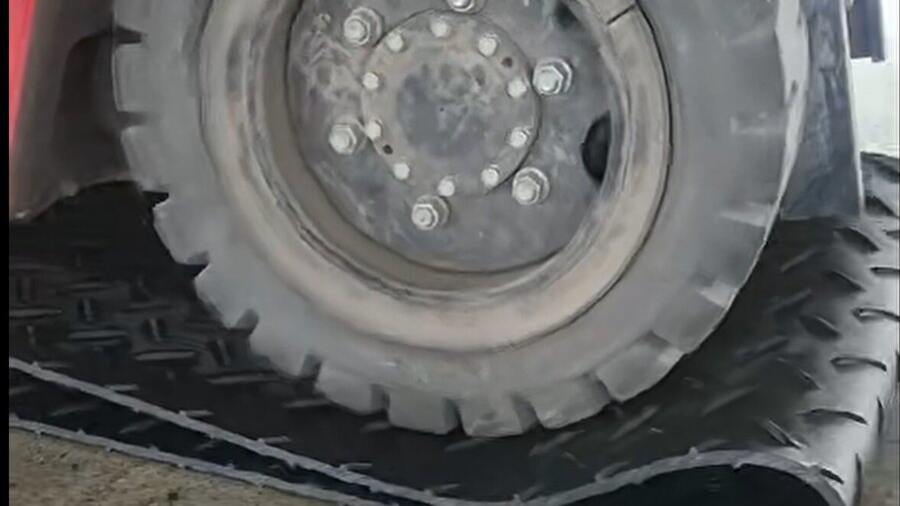
The fast-track installation still requires the retention of basic processes: drainage, debarment, peace-building, positioning, connection and trial passage. The plates remain continuous in line segments, leaving sufficient width at the intersections and outside areas; and they are to be removed from the rigid surface interface. Project leaders should arrange for “restricting speed and prohibiting the movement of vehicles in situ”, while specifying the conditions for decommissioning and preventing unusual leave to the next group during rush hours.
Operating records include at least open hours, traffic through vehicles, unusual locations and disposal results. The first group of vehicles shall travel at a low speed to observe whether the plates are moving with the tyres; the second class shall then adjust the speed limits and frequency of the inspection to the records. Forklifts with frequent and rapid turnovers should check for surface wear and, if the crane changes the condition, re-check the retroactivity of the leg. Once maintenance is completed, access will be restored to the designated person.
In the case of a temporary parking area at a logistics park, which would still need to be maintained during the construction of the warehouse, the site could be divided into five areas for entry, straight, turn, operation and recycling during the peak transport phase. The entry point is responsible for vehicle reconciliation, maintaining continuous coverage of the straight-line segment, increasing the outer width of the turn-band, separate validation of the operating segment and completion of clean bundles in the recovery area. This simulation programme is used to illustrate the methodology and is not a client-specific performance; it can help the project team to maintain a clear evacuation route for night maintenance, with a record of the number of maintenance and the length of interruption.
If the transport chain contains coal, ore, wet soil or food, self-release efficiency may be assessed as an independent subject. Car skateboards help to reduce the adhesiveness of certain materials, but prior to installation, the lining thickness, scalables, bolts or presses and tail door motion space should be confirmed. If there is no need for bulk discharges, there is no need to add the subparagraph; the procurement programme should be consistent with the use.
The procurement list should provide suppliers with a real picture of the work, in which indoor and outdoor temperatures and chemical contamination are data that need to be highlighted in this section. The remaining information includes vehicle and leg loads, ground photographs and sizes, projected number of vehicles, number of days of use, colour trails, destination port and desired period. A comparison of the quotations should be converted to a valid area coverage and complete connection system and not only a single block price; the acceptance and inspection criteria should also be included in the document before the next list.
Need for further evaluation of the actual project?
Applications, sizes, quantities, site photographs or drawings and delivery destinations are sent, on which we can identify more suitable products and processing programmes.







