
The answer to how industrial site retrofits choose the thickness of the pavement should start with the course of operation rather than with a fixed specification. The thickness should not be limited to the total weight of the vehicle, but must be combined with axle load, tyre contact, grass-roots support and the number of passes. The unstoppable retrofitting, upgrading of old plant areas, maintenance of the underground network and phased expansion projects usually include construction vehicles, material transporters, forklifts, excavators and temporary cranes, with different pressures on tyres, axle loads and diversions. Production and construction parallels the compression of the width of the route, and frequent changes in routes can lead to duplication of laying and disruption of material movement. The project team shall first delineate the main corridor, the waiting areas, the loading and unloading points and the emergency export, and then the boundary shall be confirmed jointly by the construction, logistics and security authorities.
The degree of completeness of the input conditions determines the quality of the subsequent selection. The length and width of the courtyards formed after repeated crushing were first measured, and the maximum performance of the construction vehicles, material transport vehicles, forklifts, excavators and temporary suspension equipment was checked. In addition to the weight, the pressure of the tyre, the form of the belt, the position of the brake, the possibility of in situ transfer and the frequency of passage shall be recorded. In case of high temperatures, a ground review should be carried out; if data cannot be confirmed, unknown items should be listed as a restriction rather than being replaced by empirical values.
Material parameters should serve the field rather than be propaganda figures. Reusable pavements facilitate relocation along the construction surface, and leg mats are used for equipment suspension and overhaul support. The project allows for a comparison of the 25 mm and the adjacent specifications of the single mass, rigidity, laying efficiency and number of containers, as well as a reconciliation of the links to the surface. Between 80 and 120 tonnes are only primary sifts; ground-based and support designs should be completed when underground holes, weak shoulder or suspension loads are overloaded.
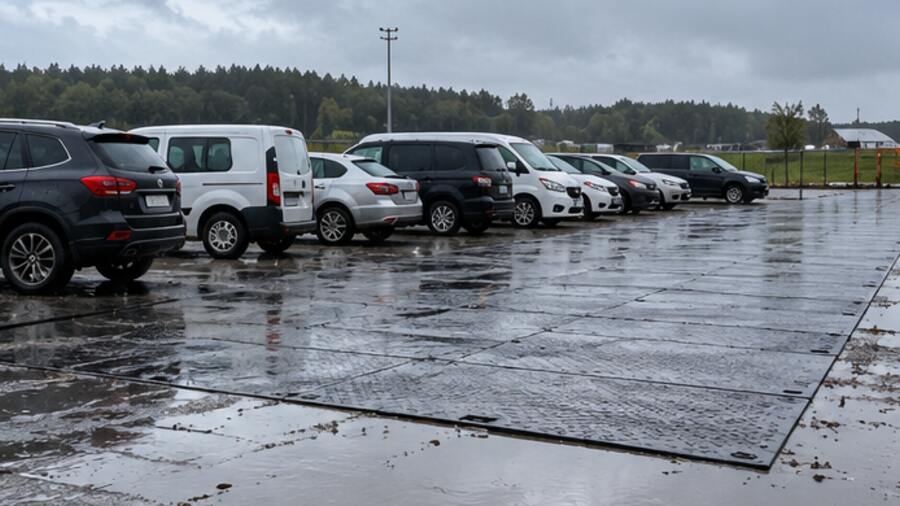
When the plates arrive at the site, the quantity, the connector and the crane are checked and the goods are discharged by route number. Upon completion of the grass-roots level, the vehicle entrance is prepared in sub-sections, and the level and edge support is checked at each stage of completion. The leg area of operation shall be separated from the area of passage. In the installation programme, add “recording of the number of vehicles passing through each shift” to allow field personnel to convert abstract requirements into actionable.
The day-to-day management will include vehicle behaviour in the inspection. Speed-limiting, prohibition of in-situ movement, fixed reverse routes and placement of commanders are often more effective than simply adding plates. The inspectors should touch or step on the suspicious seams, check the links and take photographs to locate them. Where there are repeated shifts, the width of the road, the turn radius and the grass-roots level should be re-evaluated, rather than the continuous consolidation of the same position.
In the case of a phased site retrofit that must maintain the plant ' s delivery capacity, the site could be divided into five areas during the installation phase, which would allow it to enter, go straight, turn, operate and recover. The entry point is responsible for vehicle reconciliation, maintaining continuous coverage of the straight-line segment, increasing the outer width of the turn-band, separate validation of the operating segment and completion of clean bundles in the recovery area. This simulation programme is used to illustrate the methodology and is not a client-specific performance; it can help the project team to separate the main wheel tracks of heavy vehicles from the people ' s lanes and leave a record of the number of maintenances and the length of breaks.
In the integrated site, different problems were solved by the pavement, leg mats and carboards. Vehicle traffic is supported by a continuous focus on the maximum retroactivity of the leg and the friction and adhesion of material from the surface of the vehicle. If MHMWPE skateboards are used, thermal stretches should be set aside and fixed systems checked; if relevant material is not available at the site, they should be removed from the list and the investment targeted.
The request for quotations must be in the form of packaging and handling equipment, otherwise it is likely that different suppliers will calculate on different assumptions. The procurement staff shall also require the description of the effective size, weight, number of attachments, packing units, container load and delivery cycle of each plate. The evaluation will be based on technical conformity, installation efficiency and turnover. Where key payloads or ground data have not been confirmed, the quotations should be marked as preliminary and the review retained.
Need for further evaluation of the actual project?
Applications, sizes, quantities, site photographs or drawings and delivery destinations are sent, on which we can identify more suitable products and processing programmes.







