
When dealing with turn brakes, the words “where to go, what to go, how many times a day” are written as verifiable conditions on the ground. The unstoppable retrofitting, upgrading of old plant areas, maintenance of the underground network and phased expansion projects often include construction vehicles, material transport vehicles, forklifts, excavators and temporary cranes, with only full tonnage to ignore the effects of tyre contact and low-speed turns. The more reliable conclusion is that in situ shifts, brakes and ramp start-ups will magnify the horizontal force, and should be broadened, connected and increased in frequency of patrols, followed by a decision on the combination of pavement, leg pads or local grass-roots processes.
The degree of completeness of the input conditions determines the quality of the subsequent selection. First, the length and width of the restricted loads above the ditches are measured, and then the maximum performance of the construction vehicles, material transporters, forklifts, excavators and temporary suspension equipment is checked. In addition to the weight, the pressure of the tyre, the form of the belt, the position of the brake, the possibility of in situ transfer and the frequency of passage shall be recorded. In case of continuous rainfall, a ground review should be carried out; if the data cannot be confirmed, the unknown item should be included as a restriction rather than replaced by an empirical value.
Where the route has both a mobile device and a fixed support point, the choice should be made between the pavement and the leg pad, respectively. Reusable pavements facilitate relocation along the construction surface, and leg mats are used for equipment suspension and overhaul support. The thickness can be screened from commonly used specifications such as 15, 20, 25 and 30 mm, and the 30 mm appearing in this section does not constitute a direct recommendation. For information ranging from 120 to 160 tons, the purchaser should also request a test method and give priority to the equipment description, construction programme and on-site validation.
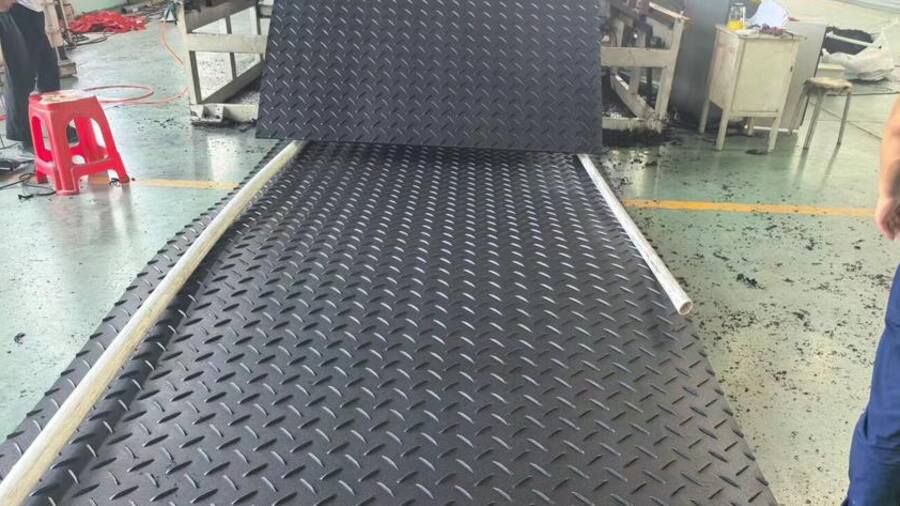
The sequence of laying would allow for the advance from the stable entrance to the area of operations. First, water and high differentials are processed, then the first plate is located; the subsequent plate is consistent in the direction of the texture and check if the seams form the steps. The ramp, turn and brake points shall increase the horizontal constraints or the width of the coverage. For this project, the key action could be “the immediate discontinuation of the slurry when it is found to be coming out of the seam” and the completion time and the results of the review could be recorded by a dedicated person.
Following the opening of access, the focus of the inspection was on the continued support under the plate. The first heavy vehicle passes by to check for high seams, peripheries, mudslides and planks; the shift is repeated after weather changes. The pressure of contact of the forklift ' s solid-heart wheel differs significantly from the concentrated static of the crane ' s legs, and anomalies should be detected first in isolation before being drained, evened or replaced, and the subsequent flow of the vehicle cannot continue to magnify the damage.
For a phased site retrofit that must maintain plant delivery capacity, the maintenance and overhaul phase could be established as an independent inspection node. On-site identification of vehicle lists and weather is followed by a check of drainage, connections and borders; if any conditions change, release is suspended and the road map updated. This scenario is used only to illustrate how the project is organized, with a focus on the softest 20 metres as the focus of the maintenance segment. It should also record the number of inputs, the time of laying, the time of stoppage, the location of maintenance and the condition of the ground after the evacuation site.
The bulk material project will also examine car car stickers, impact and wear. The UHMWPE car skateboard can improve offloading when materials, temperature and car structure are appropriate, but it is necessary to confirm fixation, thermal condensation, the end door gap and cleaning methods; it is not a substitute for the safe offloading procedure. If the project does not involve a self-loading vehicle, the budget should be focused on physical access and support points and not add irrelevant configurations to complete product portfolios.
It is best to complete small-scale technical confirmation before the next list. First, the container type and destination port and complete field parameters are submitted to the supplier for specification, quantity and packaging advice; then the sample trails, connections, dimensions and material documents are checked; and finally, the container type, destination port, discharge method and batch identification are identified. The supplier recommended that it be used only as an input and that the project party remain responsible for the stabilization of the ground load, traffic organization and lifting.
Need for further evaluation of the actual project?
Applications, sizes, quantities, site photographs or drawings and delivery destinations are sent, on which we can identify more suitable products and processing programmes.







