
In processing the cost of repairs, “where to go, what to go, how many times a day” is written as a verifiable on-site condition. The unstoppable retrofitting, upgrading of old plant areas, maintenance of the underground network and phased expansion projects often include construction vehicles, material transport vehicles, forklifts, excavators and temporary cranes, with only full tonnage to ignore the effects of tyre contact and low-speed turns. The more reliable conclusion is that the early protection of high-risk wheels and support points is usually more manageable than the after-action repair of coatings, grass-roots and drainage facilities, followed by a decision on the combination of pavement boards, leg pads or local grass-roots treatment.
The project team could complete a joint pedal before the vehicle enters the site, focusing on the hard-surfaced but empty floors, low-water drainage points, ramps and available car space. The retroactivity of the legs of the vehicle ' s axial load, the exterior dimensions, the minimum convective radius and the equipment for the suspension was then collected. Continuous rainfall may change the state of the grass-roots level, so measurements need to be date- and weather-specific. All parameters should be consolidated in the same version of the road map and equipment list.
Product selection should be differentiated by stress. Reusable pavements facilitate relocation along the construction surface, and leg mats are used for equipment suspension and overhaul support. 15, 20, 25 and 30 mm are in the common thickness range and 15 mm can only serve as a starting point for comparison for the project; if there are holes or sediments at the grass-roots level, the increase in thickness is not a substitute for the search for peace and reinforcement. The 160 to 200 tonnes in the product information should also be understood in conjunction with the test conditions, with the final specifications to be confirmed by the approved programme and field professionals.
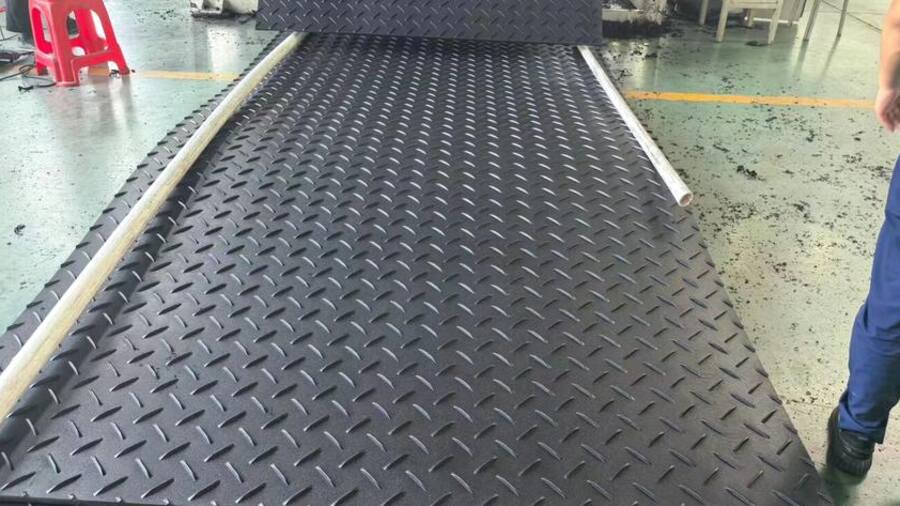
The construction staff should first seal the belts and confirm that no vehicles enter, then clear the floors and tablets. Do not leave the seams in the softest position, and do not let the edges remain open for long periods. Cleaning and installation of sandstones when the link is pierced, so that the connector is not fully in place. A low-speed test pass after a period of completion and the implementation of “an earlier re-routing based on weather forecasts” before the next segment becomes operational.
Operating records include at least open hours, traffic through vehicles, unusual locations and disposal results. The first group of vehicles shall travel at a low speed to observe whether the plates are moving with the tyres; the second class shall then adjust the speed limits and frequency of the inspection to the records. Forklifts with frequent and rapid turnovers should check for surface wear and, if the crane changes the condition, re-check the retroactivity of the leg. Once maintenance is completed, access will be restored to the designated person.
In a simulation plan for a phased site retrofit that must maintain the plant ' s delivery capacity, the maintenance and overhaul phase involves the zonal release of areas that have completed grass-roots processing and plate connectivity, with unaccepted areas remaining isolated. Each region designates a person responsible for the inspection and uses a number corresponding to the photograph. This example does not represent a specific project commitment, but allows the team to separate the temporary post from the main traffic route. If the records show repeated maintenance at the same location, they should be re-analysed back to the ground and transport organization.
Auxiliary equipment also affects the overall programme. A leg pad is required to accompany a vehicle, a forklift is required to focus on tyre contact, and a bulk vehicle may require a slab. The suitability of the UHMWPE liner depends on the work temperature, the chemical environment, the material impact and the car structure, and the manufacturer provides the installation requirements. Each product should be matched to specific equipment in the project form to avoid the use of the same parameter across uses.
The maximum gross vehicle weight and single axle load must be present in the request for quotations, otherwise it is likely that different vendors will calculate on different assumptions. The procurement staff shall also require the description of the effective size, weight, number of attachments, packing units, container load and delivery cycle of each plate. The evaluation will be based on technical conformity, installation efficiency and turnover. Where key payloads or ground data have not been confirmed, the quotations should be marked as preliminary and the review retained.
Need for further evaluation of the actual project?
Applications, sizes, quantities, site photographs or drawings and delivery destinations are sent, on which we can identify more suitable products and processing programmes.







