
In the case of demolition and recycling, the site should first determine whether the target is a continuous transport, a short-term suspension or a temporary stop during peak periods. The unstoppable retrofitting, upgrading of old plant areas, maintenance of the underground network and phased expansion projects involved the construction of vehicles, materials transporters, forklifts, excavators and temporary suspension equipment, while production and construction were accompanied by the compression of the width of the route and frequent changes in the route were also prone to duplication of laying and confusion in material movement. When targets, vehicles and vulnerable positions are matched, the scope is not too large or missing; the practical implementation principle is that recovery should be carried out in reverse from the end to the entrance, while cleaning, inspection, classification and binding are completed.
On-site measurements cover narrow slopes with insufficient convective radiuss for heavy vehicles, recording weak ranges, slopes, drainage directions and underground pipes. Changes in the water-bearing state and the car tracks should be observed before and after short and heavy rainfall. Mobile equipment will need to provide the whole vehicle with its own weight, full load weight, a single axle load, tyre size, turn radius and projected duration; the crane will also need to provide the maximum reversibility of the leg and leg extension. Data sources and measurement dates should also be recorded to avoid different versions.
Where the route has both a mobile device and a fixed support point, the choice should be made between the pavement and the leg pad, respectively. Reusable pavements facilitate relocation along the construction surface, and leg mats are used for equipment suspension and overhaul support. The thickness can be screened from commonly used specifications such as 15, 20, 25 and 30 mm, and the 30 mm appearing in this section does not constitute a direct recommendation. For information ranging from 120 to 160 tons, the purchaser should also request a test method and give priority to the equipment description, construction programme and on-site validation.
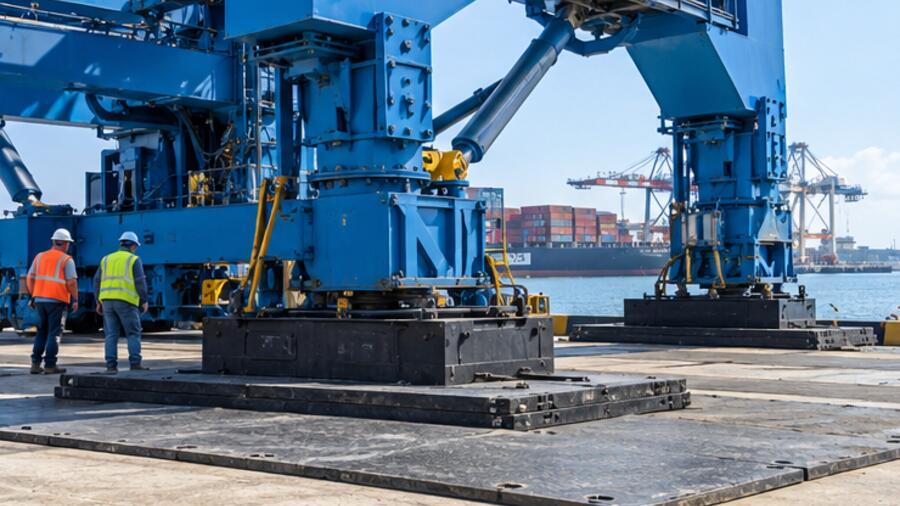
When the plates arrive at the site, the quantity, the connector and the crane are checked and the goods are discharged by route number. Upon completion of the grass-roots level, the vehicle entrance is prepared in sub-sections, and the level and edge support is checked at each stage of completion. The leg area of operation shall be separated from the area of passage. The inclusion of “restricting speed and prohibiting the movement of vehicles in situ” in the installation programme would allow field personnel to convert abstract requirements into actionable.
Operating records include at least open hours, traffic through vehicles, unusual locations and disposal results. The first group of vehicles shall travel at a low speed to observe whether the plates are moving with the tyres; the second class shall then adjust the speed limits and frequency of the inspection to the records. Forklifts with frequent and rapid turnovers should check for surface wear and, if the crane changes the condition, re-check the retroactivity of the leg. Once maintenance is completed, access will be restored to the designated person.
During the peak transport phase, in a simulation of a phased site retrofit that must maintain the plant ' s delivery capacity, a zonal release was introduced: the area that had completed the grass-roots processing and plate connection was opened and the unaccepted area remained isolated. Each region designates a person responsible for the inspection and uses a number corresponding to the photograph. This example does not represent a specific project commitment, but allows the team to recycle the plates to the next stage. If the records show repeated maintenance at the same location, they should be re-analysed back to the ground and transport organization.
In the integrated site, different problems were solved by the pavement, leg mats and carboards. Vehicle traffic is supported by a continuous focus on the maximum retroactivity of the leg and the friction and adhesion of material from the surface of the vehicle. If MHMWPE skateboards are used, thermal stretches should be set aside and fixed systems checked; if relevant material is not available at the site, they should be removed from the list and the investment targeted.
In order to obtain a comparable offer, the purchaser should harmonize the request for quotations, at least indicating the total length of the route, the net width and turn radius, the size of the route, the condition of the vehicle, the condition of the ground and the time of the project. Vendors are required to respond to material plates, sheeting, single weight, connection, packaging, containerization and quantity and quality documents. If the project is purchased on a containerized basis, the capability of the forklift or forklift on site or forklift is also confirmed. All safety-related selections are based on the equipment manual and the approval programme.
Need for further evaluation of the actual project?
Applications, sizes, quantities, site photographs or drawings and delivery destinations are sent, on which we can identify more suitable products and processing programmes.







