
The management of multi-equipment cross-operations for industrial site retrofitting cannot be answered with single-product parameters. Project leaders need to view the flow organization, ground support and maintenance capacity at the same time; forklifts, trucks and cranes should be routed and waiting areas should be made clear who has priority access. When construction vehicles, material transporters, forklifts, excavators and temporary cranes enter the uninterruptible retrofitting, upgrading of old plant areas, maintenance of the underground network and phased expansion projects, problems with turnovers, ramps, seams and waiting positions on routes may arise earlier than normal straight-line segments and should be individually marked on drawings.
On-site measurements cover the transition between grasslands and hardened surfaces and record weak ranges, slopes, drainage directions and underground pipes. The wet salt fog should be followed by a change in the water-bearing state and the car trail, respectively. Mobile equipment will need to provide the whole vehicle with its own weight, full load weight, a single axle load, tyre size, turn radius and projected duration; the crane will also need to provide the maximum reversibility of the leg and leg extension. Data sources and measurement dates should also be recorded to avoid different versions.
Material parameters should serve the field rather than be propaganda figures. Reusable pavements facilitate relocation along the construction surface, and leg mats are used for equipment suspension and overhaul support. The project allows for a comparison of the 25 mm and the adjacent specifications of the single mass, rigidity, laying efficiency and number of containers, as well as a reconciliation of the links to the surface. Between 80 and 120 tonnes are only primary sifts; ground-based and support designs should be completed when underground holes, weak shoulder or suspension loads are overloaded.
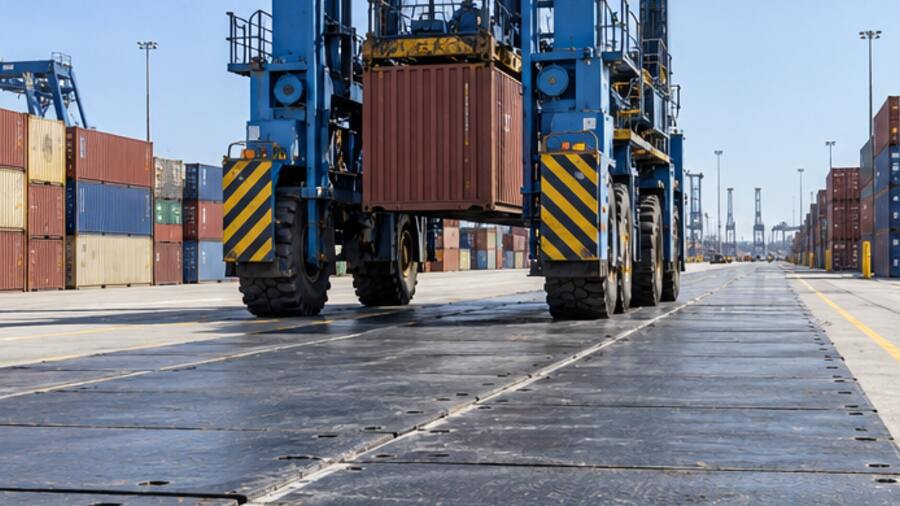
The construction staff should first seal the belts and confirm that no vehicles enter, then clear the floors and tablets. Do not leave the seams in the softest position, and do not let the edges remain open for long periods. Cleaning and installation of sandstones when the link is pierced, so that the connector is not fully in place. The following section will be opened only after completion of a period of low-speed trial traffic and implementation of a “one-way pass and check of the total vehicle weight at the entrance”.
Maintenance staff can divide the straight-line, turn-out, waiting areas and support points into different levels of inspection. The straight-line sections focus on the sutures and the tracks, turn around and look for lateral shifts, wait areas to see long-term static sinking, and support points to check whether the pads and the ground are sunk. Shorter check intervals after rain or when the traffic suddenly increases; any plate-side rise, loose connection or grass-roots plasma should trigger decommissioning.
Assuming that a phased site retrofit that must maintain the plant ' s delivery capacity is subject to an increase in traffic during the entry preparation phase, managers can first freeze route changes and then divide problems into four categories: ground, board, vehicle and movement control. Weak positions are reinforced, damage plates are replaced, vehicles are limited in speed, and one-way access is introduced for peak hours. The example does not correspond to the true customer, but shows how to maintain access without expanding the permanent sclerosis area and how to convert the on-site judgement into a reusable list for the next project.
Auxiliary equipment also affects the overall programme. A leg pad is required to accompany a vehicle, a forklift is required to focus on tyre contact, and a bulk vehicle may require a slab. The suitability of the UHMWPE liner depends on the work temperature, the chemical environment, the material impact and the car structure, and the manufacturer provides the installation requirements. Each product should be matched to specific equipment in the project form to avoid the use of the same parameter across uses.
It is best to complete small-scale technical confirmation before the next list. First, the maximum leg reaction and complete field parameters of the crane were submitted to the supplier for specification, quantity and packaging advice; then the sample trails, links, dimensions and material documentation were checked; and finally, the container type, destination port, method of discharge and batch identification were identified. The supplier recommended that it be used only as an input and that the project party remain responsible for the stabilization of the ground load, traffic organization and lifting.
Need for further evaluation of the actual project?
Applications, sizes, quantities, site photographs or drawings and delivery destinations are sent, on which we can identify more suitable products and processing programmes.







