
Night operations have a direct impact on the ability of vehicles to access the site as planned, in the context of uninterruptible rehabilitation, upgrading of old plant areas, maintenance of the underground network and phased expansion projects. The construction vehicles, material transporters, forklifts, excavators and temporary cranes, which are common on-site, vary in their dynamic wheel pressure, stationary bias and power. Production and construction parallels the compression of the width of the route, and frequent changes in routes can lead to duplication of laying and disruption of material movement. The programme should, therefore, first target routes and time windows that must be kept open, before arranging for materials and personnel to avoid temporary changes in rules of passage on the construction side.
On-site measurements are to cover the spill-off areas resulting from bulk contamination and record weak ranges, slopes, drainage directions and underground pipes. The water-bearing state and changes in the car tracks should be observed before and after the cryogenic freeze. Mobile equipment will need to provide the whole vehicle with its own weight, full load weight, a single axle load, tyre size, turn radius and projected duration; the crane will also need to provide the maximum reversibility of the leg and leg extension. Data sources and measurement dates should also be recorded to avoid different versions.
The selection is based on the calculation of the local pressure and the examination of whether the plate remains continuous at the grass-roots level. Reusable pavements facilitate relocation along the construction surface, and leg mats are used for equipment suspension and overhaul support. The common thickness ranges from 15 mm to 30 mm, and this option can first assess 20 mm and then adjust it through trial preparation or project accounting. The so-called 50-80-ton carrier should have a clear test boundary and cannot be cited separately from the distance, temperature, payload distribution and safety factor.
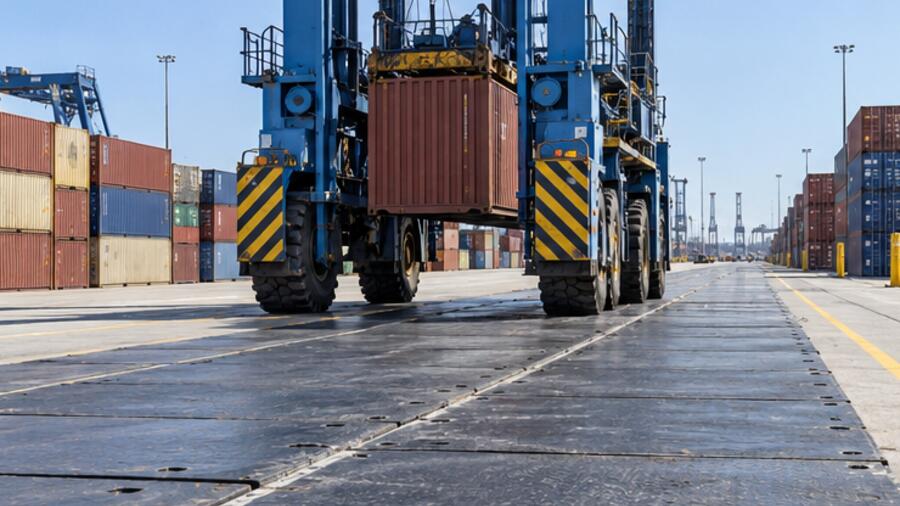
Pre-installation to remove sharp waste, loose rock and mobile mud, and to purge and level the ground. The plates were set up in the main direction and were sewd to avoid the deep path and to check the wells and legs. The turn and reverse areas are to be slightly wider and the connectors are to be locked as required. The site should also implement a “review of the original ground condition after the completion of the project” and include this requirement at the end of the shift and in the traffic organization chart.
Following the opening of access, the focus of the inspection was on the continued support under the plate. The first heavy vehicle passes by to check for high seams, peripheries, mudslides and planks; the shift is repeated after weather changes. The pressure of contact of the forklift ' s solid-heart wheel differs significantly from the concentrated static of the crane ' s legs, and anomalies should be detected first in isolation before being drained, evened or replaced, and the subsequent flow of the vehicle cannot continue to magnify the damage.
For a phased site retrofit that must maintain the plant ' s delivery capacity, the evacuation site recovery phase could be established as an independent inspection node. On-site identification of vehicle lists and weather is followed by a check of drainage, connections and borders; if any conditions change, release is suspended and the road map updated. This scenario is used only to illustrate how the project is organized, with an emphasis on making it possible for laying and recycling to be carried over in shifts. It should also record the number of inputs, the time of laying, the time of stoppage, the location of maintenance and the condition of the ground after the evacuation site.
If the transport chain contains coal, ore, wet soil or food, self-release efficiency may be assessed as an independent subject. Car skateboards help to reduce the adhesiveness of certain materials, but prior to installation, the lining thickness, scalables, bolts or presses and tail door motion space should be confirmed. If there is no need for bulk discharges, there is no need to add the subparagraph; the procurement programme should be consistent with the use.
Tyres or tracked sizes and quantities must be present in the request for quotations, or different suppliers are likely to calculate on different assumptions. The procurement staff shall also require the description of the effective size, weight, number of attachments, packing units, container load and delivery cycle of each plate. The evaluation will be based on technical conformity, installation efficiency and turnover. Where key payloads or ground data have not been confirmed, the quotations should be marked as preliminary and the review retained.
Need for further evaluation of the actual project?
Applications, sizes, quantities, site photographs or drawings and delivery destinations are sent, on which we can identify more suitable products and processing programmes.







