
For the width of the route, the site should first determine the target for access: whether it is a continuous transport, short-term suspension or a temporary stop during peak periods. The unstoppable retrofitting, upgrading of old plant areas, maintenance of the underground network and phased expansion projects involved the construction of vehicles, materials transporters, forklifts, excavators and temporary suspension equipment, while production and construction were accompanied by the compression of the width of the route and frequent changes in the route were also prone to duplication of laying and confusion in material movement. When targets, vehicles and vulnerable positions are matched, the scope is not too large or missing key points; the implementation principle is that the width should cover both the wheel, the rotation, car demand and the side safety residual.
The degree of completeness of the input conditions determines the quality of the subsequent selection. First, the length and width of the softened shoulder close to the drain are measured, and then the maximum performance of the construction vehicle, the material transport vehicle, the forklift, the excavator and the temporary suspension equipment is checked. In addition to the weight, the pressure of the tyre, the form of the belt, the position of the brake, the possibility of in situ transfer and the frequency of passage shall be recorded. Short and heavy rainfall should be supplemented by a ground review; if data cannot be confirmed, unknown items should be included as a limitation rather than replaced by empirical values.
The selection is based on the calculation of the local pressure and the examination of whether the plate remains continuous at the grass-roots level. Reusable pavements facilitate relocation along the construction surface, and leg mats are used for equipment suspension and overhaul support. The common thickness ranges from 15 mm to 30 mm, and this option can first assess 20 mm and then adjust it through trial preparation or project accounting. The so-called 50-80-ton carrier should have a clear test boundary and cannot be cited separately from the distance, temperature, payload distribution and safety factor.
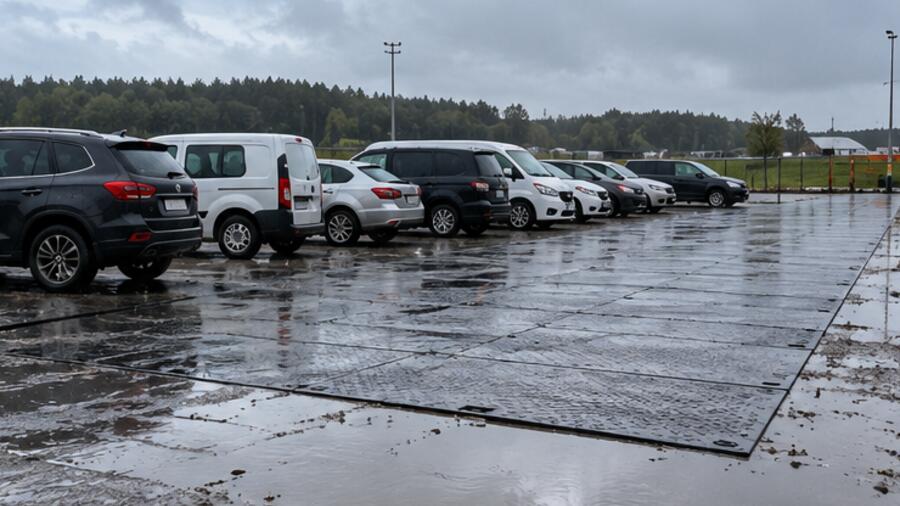
The construction staff should first seal the belts and confirm that no vehicles enter, then clear the floors and tablets. Do not leave the seams in the softest position, and do not let the edges remain open for long periods. Cleaning and installation of sandstones when the link is pierced, so that the connector is not fully in place. A low-speed test of access after a period of completion and the implementation of “place the spare parts near the weak zone” before opening the next section.
Temporary roads cannot be paved for long. Vehicle brakes, loading overloading and water stowing can gradually change the support under the plate, and surfaces may appear flat and may have created gaps. The site should be inspected before and after peak traffic, after short and heavy rainfall and when the route changes. In the event of a sinking, the ground and drainage should be checked before deciding whether to change or replace the panels, so as to avoid covering up the problem by filling the panels.
A reference scenario is a phased site retrofit that must maintain the plant ' s delivery capacity. During the peak transport phase, the project made a short-term test preparation to record the relocation and deposition of the first vehicle after its adoption, before gradually extending the route. The turn areas, parking areas and pick-up points are inspected separately and no result is used to replace the full condition. This is an example of a methodology rather than a statement of performance, and the intended management effect is to enable the receiving and inspection records to correspond to the site photographs and location maps; after completion, a comparison is also required between the original ground photographs, cleaning hours and the number of plates that can continue to be used.
Auxiliary equipment also affects the overall programme. A leg pad is required to accompany a vehicle, a forklift is required to focus on tyre contact, and a bulk vehicle may require a slab. The suitability of the UHMWPE liner depends on the work temperature, the chemical environment, the material impact and the car structure, and the manufacturer provides the installation requirements. Each product should be matched to specific equipment in the project form to avoid the use of the same parameter across uses.
The request for quotations shall provide, in addition to the total area, a back-up ratio and on-site maintenance conditions, with an indication of the country, duration, conditions of handling, packing and port of destination. Compared suppliers can check the documentation, size difference, surface routing, connector, piece weight, effective area coverage, cabinet list and batch retroactive. The whole container shall be purchased in advance to confirm the discharge equipment. The final programme, which involves the safety of the ground, assembly or operation of the airport, must be approved by the project professional.
Need for further evaluation of the actual project?
Applications, sizes, quantities, site photographs or drawings and delivery destinations are sent, on which we can identify more suitable products and processing programmes.







