
The answer to how industrial site retrofits develop acceptance standards should start with the course of operation, rather than with a fixed specification. Receiving and inspection involves checking the continuity of the route, the quality of the seams, the stability of the surface, the clarity of the border and the obstruction of drainage. The unstoppable retrofitting, upgrading of old plant areas, maintenance of the underground network and phased expansion projects usually include construction vehicles, material transporters, forklifts, excavators and temporary cranes, with different pressures on tyres, axle loads and diversions. Production and construction parallels the compression of the width of the route, and frequent changes in routes can lead to duplication of laying and disruption of material movement. The project team shall first delineate the main corridor, the waiting areas, the loading and unloading points and the emergency export, and then the boundary shall be confirmed jointly by the construction, logistics and security authorities.
The survey forms can be completed by the four columns of ground, equipment, route and time. The ground column indicates temporary intersections and adjacent drainage points shared between construction and production; the equipment column lists vehicle self-heaviness, cargo weights, axle numbers and tyre specifications; the route column takes a net width, slopes and turn radius; and the time column describes the high temperature storm and shift arrangements. If a crane is present, it should be based on the retroactivity of the leg in the manufacturer ' s worksheet, and it cannot be rated as a ground load.
Road-paving boards are responsible for spreading wheel pressure and leg mats for expanding static support areas, which cannot be replaced by one another. For this scenario, reusable pavements are easily moved along the construction surface, with a leg mat used for equipment suspension and overhaul support. 20 mm could be included as an option and compared with other thickness, subject to the simultaneous verification of plate size, connection structure, grass-roots rigidity and number of passages. The labelling of 50 to 80 tons of products does not mean that all the same vehicles are available on the ground, and ground conditions remain the determining factor.
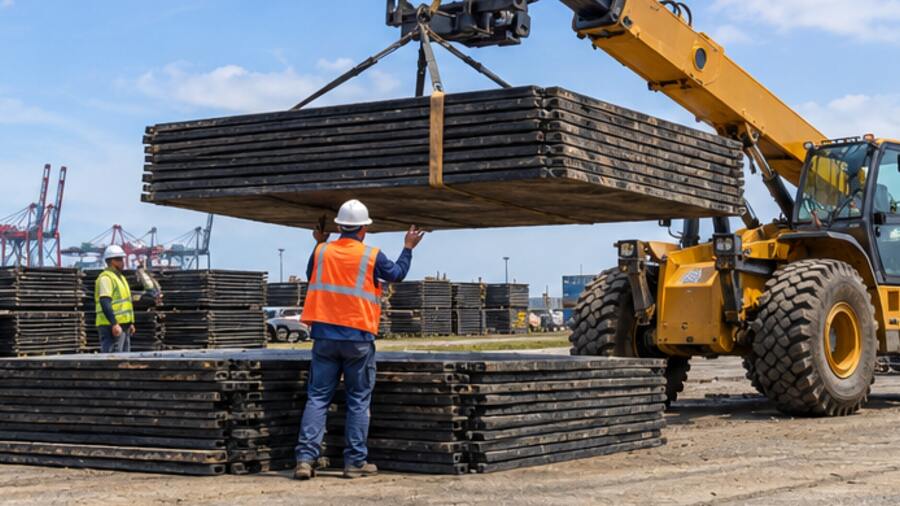
The construction staff should first seal the belts and confirm that no vehicles enter, then clear the floors and tablets. Do not leave the seams in the softest position, and do not let the edges remain open for long periods. Cleaning and installation of sandstones when the link is pierced, so that the connector is not fully in place. A low-speed test of access after a period of completion and the implementation of “pre-class confirmation of seams and connectors” before the next segment is opened.
Following the opening of access, the focus of the inspection was on the continued support under the plate. The first heavy vehicle passes by to check for high seams, peripheries, mudslides and planks; the shift is repeated after weather changes. The pressure of contact of the forklift ' s solid-heart wheel differs significantly from the concentrated static of the crane ' s legs, and anomalies should be detected first in isolation before being drained, evened or replaced, and the subsequent flow of the vehicle cannot continue to magnify the damage.
For a phased site retrofit that must maintain the plant ' s delivery capacity, the installation phase of the equipment could be established as an independent inspection node. On-site identification of vehicle lists and weather is followed by a check of drainage, connections and borders; if any conditions change, release is suspended and the road map updated. This scenario is used only to illustrate how the project is organized, with a focus on avoiding the sharing of a vague load assumption among different equipment. It should also record the number of inputs, the time of laying, the time of stoppage, the location of maintenance and the condition of the ground after the evacuation site.
Auxiliary equipment also affects the overall programme. A leg pad is required to accompany a vehicle, a forklift is required to focus on tyre contact, and a bulk vehicle may require a slab. The suitability of the UHMWPE liner depends on the work temperature, the chemical environment, the material impact and the car structure, and the manufacturer provides the installation requirements. Each product should be matched to specific equipment in the project form to avoid the use of the same parameter across uses.
In order to obtain a comparable offer, the purchaser should harmonize the request for quotations to at least indicate the colour of the sheet, the texture and custom holes, the size of the route, the condition of the vehicle, the condition of the ground and the time of the project. Vendors are required to respond to material plates, sheeting, single weight, connection, packaging, containerization and quantity and quality documents. If the project is purchased on a containerized basis, the capability of the forklift or forklift on site or forklift is also confirmed. All safety-related selections are based on the equipment manual and the approval programme.
Need for further evaluation of the actual project?
Applications, sizes, quantities, site photographs or drawings and delivery destinations are sent, on which we can identify more suitable products and processing programmes.







