
The manner in which the installation and vehicle movements are organized for industrial site retrofit cannot be answered with single-product parameters. Project leaders need to view the flow organization, ground support and maintenance capabilities at the same time; the installation area needs to be linked to the vehicle release plan to avoid connecting personnel to the plates in unseparated traffic. When construction vehicles, material transporters, forklifts, excavators and temporary cranes enter the uninterruptible retrofitting, upgrading of old plant areas, maintenance of the underground network and phased expansion projects, problems with turnovers, ramps, seams and waiting positions on routes may arise earlier than normal straight-line segments and should be individually marked on drawings.
The project team could complete a joint pedal before the vehicle enters the site, focusing on the mixed ground, drainage lows, ramps and available car space in a wet salt fog environment in the port area. The retroactivity of the legs of the vehicle ' s axial load, the exterior dimensions, the minimum convective radius and the equipment for the suspension was then collected. Moist salt mists may change the state of the grass-roots level, so measurements need to be date- and weather-specific. All parameters should be consolidated in the same version of the road map and equipment list.
The selection is based on the calculation of the local pressure and the examination of whether the plate remains continuous at the grass-roots level. Reusable pavements facilitate relocation along the construction surface, and leg mats are used for equipment suspension and overhaul support. The common thickness ranges from 15 mm to 30 mm, and this option can first assess 20 mm and then adjust it through trial preparation or project accounting. The so-called 50-80-ton carrier should have a clear test boundary and cannot be cited separately from the distance, temperature, payload distribution and safety factor.
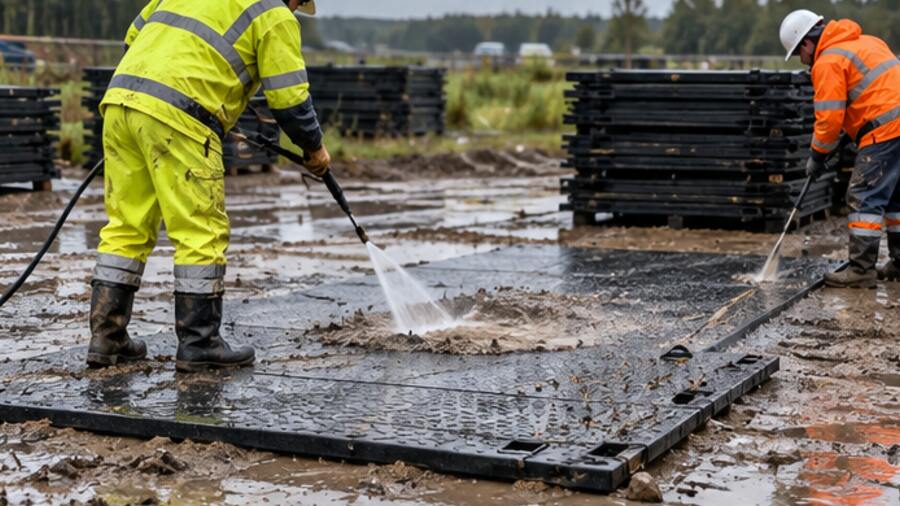
The sequence of laying would allow for the advance from the stable entrance to the area of operations. First, water and high differentials are processed, then the first plate is located; the subsequent plate is consistent in the direction of the texture and check if the seams form the steps. The ramp, turn and brake points shall increase the horizontal constraints or the width of the coverage. For this project, the “cleaning of bulk and sharp material before demolition” could be a key action, with a dedicated person recording the time of completion and the results of the re-examination.
The day-to-day management will include vehicle behaviour in the inspection. Speed-limiting, prohibition of in-situ movement, fixed reverse routes and placement of commanders are often more effective than simply adding plates. The inspectors should touch or step on the suspicious seams, check the links and take photographs to locate them. Where there are repeated shifts, the width of the road, the turn radius and the grass-roots level should be re-evaluated, rather than the continuous consolidation of the same position.
In the case of a phased site retrofit that must maintain the plant ' s delivery capacity, the site could be divided into five areas at the entrance preparation stage, straight, turning, operating and recycling. The entry point is responsible for vehicle reconciliation, maintaining continuous coverage of the straight-line segment, increasing the outer width of the turn-band, separate validation of the operating segment and completion of clean bundles in the recovery area. The simulation programme is used to illustrate the methodology and is not a client-specific performance; it can help the project team to reduce vehicle mud into the hardened area and leave a record of the number of maintenances and the length of breaks.
The bulk material project will also examine car car stickers, impact and wear. The UHMWPE car skateboard can improve offloading when materials, temperature and car structure are appropriate, but it is necessary to confirm fixation, thermal condensation, the end door gap and cleaning methods; it is not a substitute for the safe offloading procedure. If the project does not involve a self-loading vehicle, the budget should be focused on physical access and support points and not add irrelevant configurations to complete product portfolios.
In order to obtain a comparable offer, the purchaser should harmonize the request for quotations, at least specifying the needs for a sample or small-scale trial shop, the size of the route, the condition of the vehicle, the condition of the ground and the time of the project. Vendors are required to respond to material plates, sheeting, single weight, connection, packaging, containerization and quantity and quality documents. If the project is purchased on a containerized basis, the capability of the forklift or forklift on site or forklift is also confirmed. All safety-related selections are based on the equipment manual and the approval programme.
Need for further evaluation of the actual project?
Applications, sizes, quantities, site photographs or drawings and delivery destinations are sent, on which we can identify more suitable products and processing programmes.







