
For the back-up configuration, the site should first determine the goal of access: whether it is a continuous transport, short-term suspension or a temporary stop during peak periods. The unstoppable retrofitting, upgrading of old plant areas, maintenance of the underground network and phased expansion projects involved the construction of vehicles, materials transporters, forklifts, excavators and temporary suspension equipment, while production and construction were accompanied by the compression of the width of the route and frequent changes in the route were also prone to duplication of laying and confusion in material movement. When targets, vehicles and vulnerable locations are matched, the scope is not too large or missing critical points; the specific implementation principle is that the back-up should be in the vicinity of the weak sector, the turning area and the recovery point, and that a rapidly deployable connection is reserved.
The survey forms can be completed by the four columns of ground, equipment, route and time. Ground bars indicate areas and adjacent drains of the soil within the perimeter of the airport that are sensitive to the soil; equipment columns specify the vehicle ' s own weight, cargo weight, number of axes and tyre specifications; route bars take a clean width, slope and turn radius; and time bars describe short-term heavy rainfall and shift arrangements. If a crane is present, it should be based on the retroactivity of the leg in the manufacturer ' s worksheet, and it cannot be rated as a ground load.
Product selection should be differentiated by stress. Reusable pavements facilitate relocation along the construction surface, and leg mats are used for equipment suspension and overhaul support. 15, 20, 25 and 30 mm are in the common thickness range and 15 mm can only serve as a starting point for comparison for the project; if there are holes or sediments at the grass-roots level, the increase in thickness is not a substitute for the search for peace and reinforcement. The 160 to 200 tonnes in the product information should also be understood in conjunction with the test conditions, with the final specifications to be confirmed by the approved programme and field professionals.
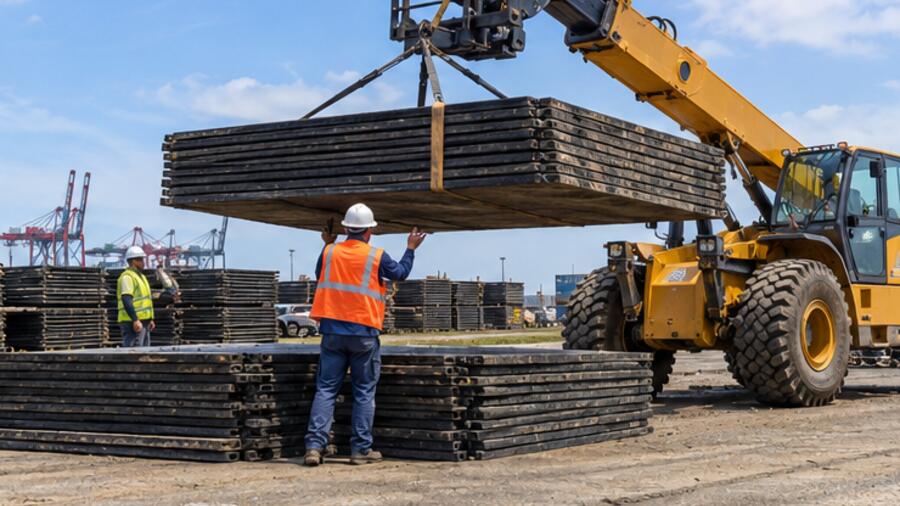
Pre-installation to remove sharp waste, loose rock and mobile mud, and to purge and level the ground. The plates were set up in the main direction and were sewd to avoid the deep path and to check the wells and legs. The turn and reverse areas are to be slightly wider and the connectors are to be locked as required. This requirement should also be included at the end of the shift and in the traffic organization chart.
The day-to-day management will include vehicle behaviour in the inspection. Speed-limiting, prohibition of in-situ movement, fixed reverse routes and placement of commanders are often more effective than simply adding plates. The inspectors should touch or step on the suspicious seams, check the links and take photographs to locate them. Where there are repeated shifts, the width of the road, the turn radius and the grass-roots level should be re-evaluated, rather than the continuous consolidation of the same position.
In the case of a phased site retrofit that must maintain the capacity of the plant to ship, the site could be divided into five areas during the peak transport phase, straight, turning, operating and recycling. The entry point is responsible for vehicle reconciliation, maintaining continuous coverage of the straight-line segment, increasing the outer width of the turn-band, separate validation of the operating segment and completion of clean bundles in the recovery area. The simulation programme is used to describe the methodology and is not a client-specific performance; it can help the project team to base the vendor ' s offer on uniform parameters and leave a record of the number and duration of maintenance.
If the transport chain contains coal, ore, wet soil or food, self-release efficiency may be assessed as an independent subject. Car skateboards help to reduce the adhesiveness of certain materials, but prior to installation, the lining thickness, scalables, bolts or presses and tail door motion space should be confirmed. If there is no need for bulk discharges, there is no need to add the subparagraph; the procurement programme should be consistent with the use.
It is best to complete small-scale technical confirmation before the next list. First, the method of connection and the need to lay tools and complete on-site parameters for suppliers to give specifications, quantities and packaging advice; then to check sample trails, connections, dimensions and material documents; and finally to confirm container type, destination port, discharge method and batch identification. The supplier recommended that it be used only as an input and that the project party remain responsible for the stabilization of the ground load, traffic organization and lifting.
Need for further evaluation of the actual project?
Applications, sizes, quantities, site photographs or drawings and delivery destinations are sent, on which we can identify more suitable products and processing programmes.







