
For vendor comparisons, “where to go, what to go, how many times a day” is written as a verifiable on-site condition. The unstoppable retrofitting, upgrading of old plant areas, maintenance of the underground network and phased expansion projects often include construction vehicles, material transport vehicles, forklifts, excavators and temporary cranes, with only full tonnage to ignore the effects of tyre contact and low-speed turns. The more reliable conclusion is that the material, structure, connector, effective area coverage, containerization and quality documentation should be covered by comparison, followed by a decision on the combination of pavement, leg pads or local grass-roots treatment.
In situ measurements cover backfill areas close to the building base and record weak ranges, slopes, drainage directions and underground pipes. Changes in the water-bearing state and the car tracks should be observed before and after consecutive rainfalls. Mobile equipment will need to provide the whole vehicle with its own weight, full load weight, a single axle load, tyre size, turn radius and projected duration; the crane will also need to provide the maximum reversibility of the leg and leg extension. Data sources and measurement dates should also be recorded to avoid different versions.
Road-paving boards are responsible for spreading wheel pressure and leg mats for expanding static support areas, which cannot be replaced by one another. For this scenario, reusable pavements are easily moved along the construction surface, with a leg mat used for equipment suspension and overhaul support. 20 mm could be included as an option and compared with other thickness, subject to the simultaneous verification of plate size, connection structure, grass-roots rigidity and number of passages. The labelling of 50 to 80 tons of products does not mean that all the same vehicles are available on the ground, and ground conditions remain the determining factor.
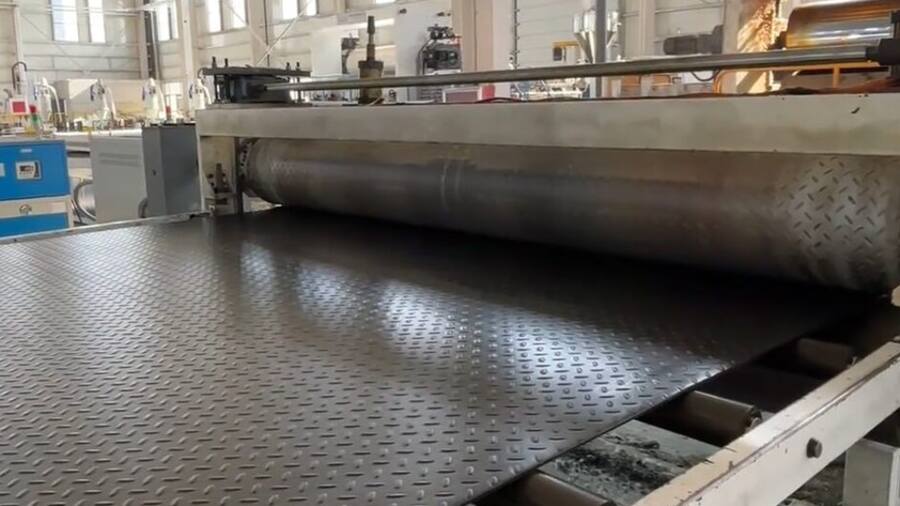
The fast-track installation still requires the retention of basic processes: drainage, debarment, peace-building, positioning, connection and trial passage. The plates remain continuous in line segments, leaving sufficient width at the intersections and outside areas; and they are to be removed from the rigid surface interface. The project manager should arrange for “the identification of people's accesses with a clear target” and should specify the conditions for deactivation, so as to prevent irregularity from being left to the next group during rush hours.
The day-to-day management will include vehicle behaviour in the inspection. Speed-limiting, prohibition of in-situ movement, fixed reverse routes and placement of commanders are often more effective than simply adding plates. The inspectors should touch or step on the suspicious seams, check the links and take photographs to locate them. Where there are repeated shifts, the width of the road, the turn radius and the grass-roots level should be re-evaluated, rather than the continuous consolidation of the same position.
In the case of a phased site retrofit that must maintain the plant ' s delivery capacity, the site could be divided into five areas at maintenance and overhaul. The entry point is responsible for vehicle reconciliation, maintaining continuous coverage of the straight-line segment, increasing the outer width of the turn-band, separate validation of the operating segment and completion of clean bundles in the recovery area. This simulation programme is used to describe the methodology and is not a client-specific performance; it can help the project team to position the problem sheets by number and leave a record of the number of maintenances and interruptions.
Three products may be used in this category at the same time, but the boundaries of the use are clear: road-painted service vehicle routes, leg-past services are centrally supported, and carboard services are applied to bulk discharges. In particular, UHMWPE skateboards need to check the material particle size, water content rate, temperature, impact and car shape. No product could compensate for the error, and the configuration list should be deleted from the field mission.
In addition to the total area, the request for quotations should provide the expected number and number of days per day, with an indication of the country, duration, conditions of handling, packing and port of destination. Compared suppliers can check the documentation, size difference, surface routing, connector, piece weight, effective area coverage, cabinet list and batch retroactive. The whole container shall be purchased in advance to confirm the discharge equipment. The final programme, which involves the safety of the ground, assembly or operation of the airport, must be approved by the project professional.
Need for further evaluation of the actual project?
Applications, sizes, quantities, site photographs or drawings and delivery destinations are sent, on which we can identify more suitable products and processing programmes.







