
For quantitative purposes, the site should first determine the target of access: whether it is a continuous transport, short-term suspension or a temporary stop during peak periods. The unstoppable retrofitting, upgrading of old plant areas, maintenance of the underground network and phased expansion projects involved the construction of vehicles, materials transporters, forklifts, excavators and temporary suspension equipment, while production and construction were accompanied by the compression of the width of the route and frequent changes in the route were also prone to duplication of laying and confusion in material movement. When targets, vehicles and weak positions are matched, the scope is not too large or missing; the implementation principle is to calculate the quantity by net area coverage, staggering, turn-widening, back-up ratio and turnaround batches.
The project team could complete a joint pedal before the vehicle enters the site, focusing on ramps, drains, ramps and available car space that are permanently flushed at the warehouse entrance. The retroactivity of the legs of the vehicle ' s axial load, the exterior dimensions, the minimum convective radius and the equipment for the suspension was then collected. Short and heavy rainfall can change the state of the grass-roots level, so measurements need to be date- and weather-specific. All parameters should be consolidated in the same version of the road map and equipment list.
Material parameters should serve the field rather than be propaganda figures. Reusable pavements facilitate relocation along the construction surface, and leg mats are used for equipment suspension and overhaul support. The project allows for a comparison of the 25 mm and the adjacent specifications of the single mass, rigidity, laying efficiency and number of containers, as well as a reconciliation of the links to the surface. Between 80 and 120 tonnes are only primary sifts; ground-based and support designs should be completed when underground holes, weak shoulder or suspension loads are overloaded.
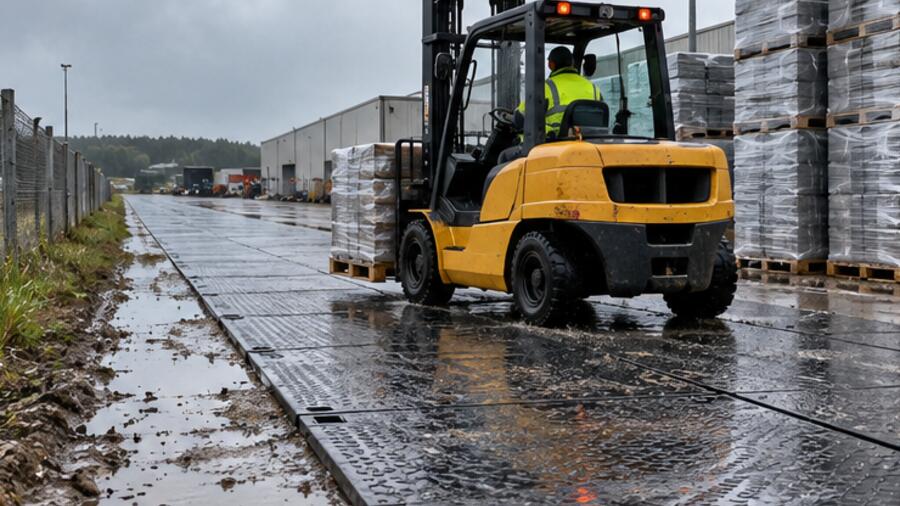
The fast-track installation still requires the retention of basic processes: drainage, debarment, peace-building, positioning, connection and trial passage. The plates remain continuous in line segments, leaving sufficient width at the intersections and outside areas; and they are to be removed from the rigid surface interface. Project leaders should arrange for “segregation of damaged plates”, while specifying the conditions for deactivation, to prevent irregularity from being left to the next group when working.
Following the opening of access, the focus of the inspection was on the continued support under the plate. The first heavy vehicle passes by to check for high seams, peripheries, mudslides and planks; the shift is repeated after weather changes. The pressure of contact of the forklift ' s solid-heart wheel differs significantly from the concentrated static of the crane ' s legs, and anomalies should be detected first in isolation before being drained, evened or replaced, and the subsequent flow of the vehicle cannot continue to magnify the damage.
For a phased site retrofit that must maintain plant delivery capacity, the peak transport phase could be established as an independent inspection node. On-site identification of vehicle lists and weather is followed by a check of drainage, connections and borders; if any conditions change, release is suspended and the road map updated. This scenario is used only to illustrate the way in which the project was organized, with a focus on maintaining a steady parking of vehicles while they are being handled. It should also record the number of inputs, the time of laying, the time of stoppage, the location of maintenance and the condition of the ground after the evacuation site.
Three products may be used in this category at the same time, but the boundaries of the use are clear: road-painted service vehicle routes, leg-past services are centrally supported, and carboard services are applied to bulk discharges. In particular, UHMWPE skateboards need to check the material particle size, water content rate, temperature, impact and car shape. No product could compensate for the error, and the configuration list should be deleted from the field mission.
The procurement list should provide vendors with a real picture of the situation, with the site manager and the security clearance process being the data that needs to be added to this section. The remaining information includes vehicle and leg loads, ground photographs and sizes, projected number of vehicles, number of days of use, colour trails, destination port and desired period. A comparison of the quotations should be converted to a valid area coverage and complete connection system and not only a single block price; the acceptance and inspection criteria should also be included in the document before the next list.
Need for further evaluation of the actual project?
Applications, sizes, quantities, site photographs or drawings and delivery destinations are sent, on which we can identify more suitable products and processing programmes.







