
How industrial site retrofits establish usage records cannot be answered with single-product parameters. Project leaders need to view the flow organization, ground support and maintenance capacity at the same time; and establish a numbering, location, pass volume, damage and maintenance record for each batch to facilitate turnover management. When construction vehicles, material transporters, forklifts, excavators and temporary cranes enter the uninterruptible retrofitting, upgrading of old plant areas, maintenance of the underground network and phased expansion projects, problems with turnovers, ramps, seams and waiting positions on routes may arise earlier than normal straight-line segments and should be individually marked on drawings.
The survey forms can be completed by the four columns of ground, equipment, route and time. The ground column indicates that the vehicle has been parked for a long period of time to form a partially sedentary parking belt and a nearby drainage vent; the equipment column lists the vehicle ' s own weight, cargo weight, number of axes and tyre specifications; the route column is taken with a clean width, slope and turn radius; and the time column describes the wet salt fog and the shift schedule. If a crane is present, it should be based on the retroactivity of the leg in the manufacturer ' s worksheet, and it cannot be rated as a ground load.
Where the route has both a mobile device and a fixed support point, the choice should be made between the pavement and the leg pad, respectively. Reusable pavements facilitate relocation along the construction surface, and leg mats are used for equipment suspension and overhaul support. The thickness can be screened from commonly used specifications such as 15, 20, 25 and 30 mm, and the 30 mm appearing in this section does not constitute a direct recommendation. For information ranging from 120 to 160 tons, the purchaser should also request a test method and give priority to the equipment description, construction programme and on-site validation.
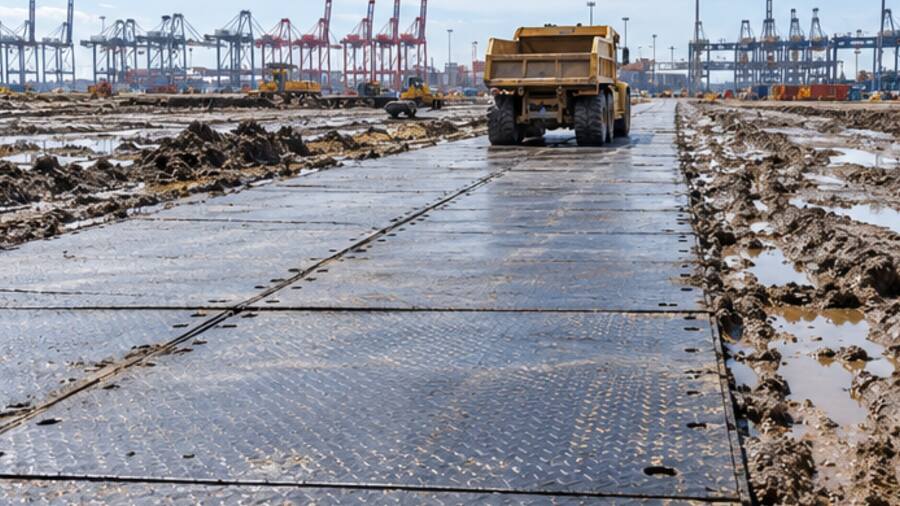
The fast-track installation still requires the retention of basic processes: drainage, debarment, peace-building, positioning, connection and trial passage. The plates remain continuous in line segments, leaving sufficient width at the intersections and outside areas; and they are to be removed from the rigid surface interface. Project leaders should arrange for “drain drainage before rain” and prepare cleaning tools, while specifying the conditions for decommissioning to prevent irregularity from being left to the next group during rush hours.
Temporary roads cannot be paved for long. Vehicle brakes, loading overloading and water stowing can gradually change the support under the plate, and surfaces may appear flat and may have created gaps. The site should be inspected before and after peak traffic, after damp salt fog and when the route is changed. In the event of a sinking, the ground and drainage should be checked before deciding whether to change or replace the panels, so as to avoid covering up the problem by filling the panels.
A reference scenario is a phased site retrofit that must maintain the plant ' s delivery capacity. The project involves short-term trial preparation during the start-up phase, recording the relocation and deposition of the first vehicle after its adoption, and a gradual extension of the route. The turn areas, parking areas and pick-up points are inspected separately and no result is used to replace the full condition. This is an example of a method rather than a statement of performance, and the expected management effect is to reduce the amount of time spent on cleaning car stickers; after completion, a comparison between the original ground photographs, cleaning hours and the number of plates that can be continued.
Three products may be used in this category at the same time, but the boundaries of the use are clear: road-painted service vehicle routes, leg-past services are centrally supported, and carboard services are applied to bulk discharges. In particular, UHMWPE skateboards need to check the material particle size, water content rate, temperature, impact and car shape. No product could compensate for the error, and the configuration list should be deleted from the field mission.
Indoor and outdoor temperatures and chemical contamination must be present in the request for quotations, otherwise different suppliers are likely to calculate on different assumptions. The procurement staff shall also require the description of the effective size, weight, number of attachments, packing units, container load and delivery cycle of each plate. The evaluation will be based on technical conformity, installation efficiency and turnover. Where key payloads or ground data have not been confirmed, the quotations should be marked as preliminary and the review retained.
Need for further evaluation of the actual project?
Applications, sizes, quantities, site photographs or drawings and delivery destinations are sent, on which we can identify more suitable products and processing programmes.







