
Drainage protection has a direct impact on the ability of vehicles to access their work as planned, in the context of uninterruptible rehabilitation, upgrading of old plant areas, maintenance of the underground network and phased expansion projects. The construction vehicles, material transporters, forklifts, excavators and temporary cranes, which are common on-site, vary in their dynamic wheel pressure, stationary bias and power. Production and construction parallels the compression of the width of the route, and frequent changes in routes can lead to duplication of laying and disruption of material movement. The programme should, therefore, first target routes and time windows that must be kept open, before arranging for materials and personnel to avoid temporary changes in rules of passage on the construction side.
The project team could complete a joint pedal before the vehicle enters the site, focusing on loose grass-roots, drainage lows, ramps and available car space after the winter freeze. The retroactivity of the legs of the vehicle ' s axial load, the exterior dimensions, the minimum convective radius and the equipment for the suspension was then collected. Low-temperature freezing may change the state at the grass-roots level, so measurement results need to be date- and weather-specific. All parameters should be consolidated in the same version of the road map and equipment list.
Road-paving boards are responsible for spreading wheel pressure and leg mats for expanding static support areas, which cannot be replaced by one another. For this scenario, reusable pavements are easily moved along the construction surface, with a leg mat used for equipment suspension and overhaul support. 15 mm could be included as an option and compared with other thickness, provided that the size of the plate, the connection structure, the base level and the number of passages were verified. The labelling of 160 to 200 tons of products does not mean that all the same vehicles are available on the ground, and ground conditions remain the determining factor.
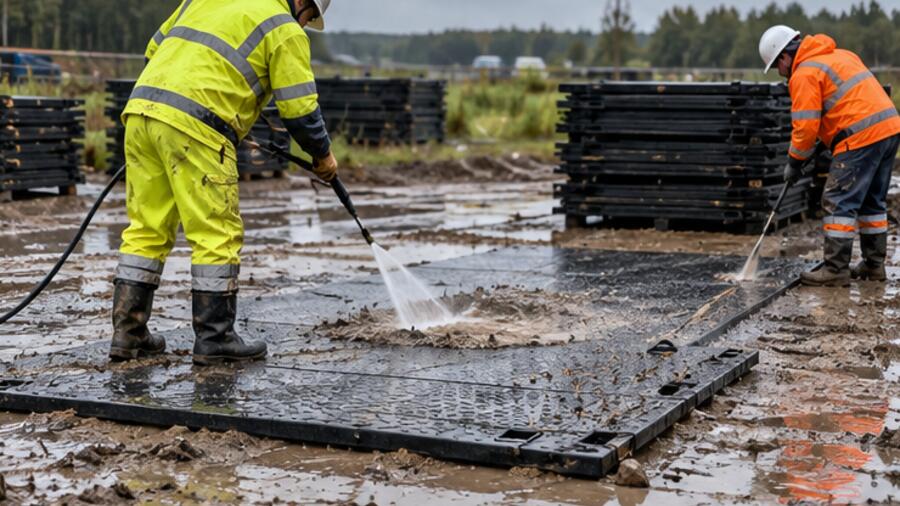
When the plates arrive at the site, the quantity, the connector and the crane are checked and the goods are discharged by route number. Upon completion of the grass-roots level, the vehicle entrance is prepared in sub-sections, and the level and edge support is checked at each stage of completion. The leg area of operation shall be separated from the area of passage. The inclusion in the installation programme of the phrase “the protection of panel lines using soft and clean tools” would allow field personnel to convert abstract requirements into actionable.
Temporary roads cannot be paved for long. Vehicle brakes, loading overloading and water stowing can gradually change the support under the plate, and surfaces may appear flat and may have created gaps. The site should be checked before and after peak traffic, after cryogenic freezing and when the route changes. In the event of a sinking, the ground and drainage should be checked before deciding whether to change or replace the panels, so as to avoid covering up the problem by filling the panels.
A reference scenario is a phased site retrofit that must maintain the plant ' s delivery capacity. The project involves short-term trial preparation during the recovery phase of the evacuation site, recording the relocation and deposition of the first vehicle after its adoption, and a gradual extension of the route. The turn areas, parking areas and pick-up points are inspected separately and no result is used to replace the full condition. This is an example of a methodology rather than a statement of performance, and the expected management effect is to incorporate the shoulder of the original repeater into the continuous coverage; after completion, it is also necessary to compare the original ground photographs, cleaning hours and the number of plates that can be continued.
In the integrated site, different problems were solved by the pavement, leg mats and carboards. Vehicle traffic is supported by a continuous focus on the maximum retroactivity of the leg and the friction and adhesion of material from the surface of the vehicle. If MHMWPE skateboards are used, thermal stretches should be set aside and fixed systems checked; if relevant material is not available at the site, they should be removed from the list and the investment targeted.
It is best to complete small-scale technical confirmation before the next list. First, quality documents, batch retroactive and acceptance methods and complete field parameters were submitted, allowing suppliers to give specifications, quantities and packing suggestions; then the sample trails, connections, dimensions and material documents were checked; and finally the container type, destination port, discharge method and batch identification were confirmed. The supplier recommended that it be used only as an input and that the project party remain responsible for the stabilization of the ground load, traffic organization and lifting.
Need for further evaluation of the actual project?
Applications, sizes, quantities, site photographs or drawings and delivery destinations are sent, on which we can identify more suitable products and processing programmes.







