
For a prior survey, the site should first determine whether the target is a continuous transport, a short-term suspension or a peak stop. Port machine overhauls, production equipment in place, electrical installation of the warehouse and replacement of airfield facilities involving car hanging, tracked lifting aids, cranes, pumps and hydraulic support equipment, while retrogressive legs are concentrated and may vary with the angle of the crane arm, with the potential to reduce the stability of the ground hole, slope distance and eccentric receptivity. When targets, vehicles and vulnerable positions are matched, the scope is not too large or missing critical points; the practical implementation principle is to complete the records of the route, load, ground and operational beats, and to determine the quantity and sequence of the plates.
On-site measurements cover the mixed ground in the humid salt mist of the port area, recording weak ranges, slopes, discharge directions and underground pipes. The wet salt fog should be followed by a change in the water-bearing state and the car trail, respectively. Mobile equipment will need to provide the whole vehicle with its own weight, full load weight, a single axle load, tyre size, turn radius and projected duration; the crane will also need to provide the maximum reversibility of the leg and leg extension. Data sources and measurement dates should also be recorded to avoid different versions.
Where the route has both a mobile device and a fixed support point, the choice should be made between the pavement and the leg pad, respectively. The size and thickness of the leg pads must be determined on the basis of the maximum retroactivity of the leg, the permitted ground-based load and the material performance of the mattress. The thickness can be screened from commonly used specifications such as 15, 20, 25, 30 mm, and the 20 mm appearing in this article does not constitute a direct recommendation. For information ranging from 120 to 160 tons, the purchaser should also request a test method and give priority to the equipment description, construction programme and on-site validation.
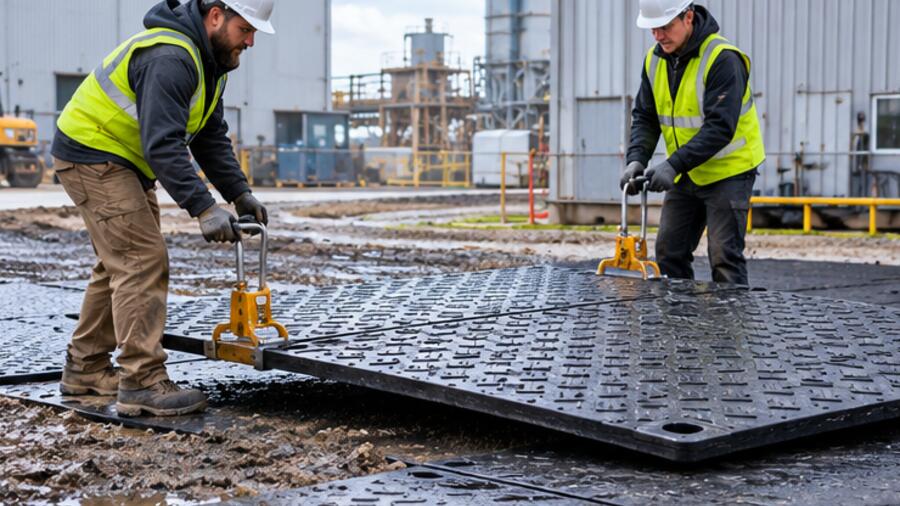
When the plates arrive at the site, the quantity, the connector and the crane are checked and the goods are discharged by route number. Upon completion of the grass-roots level, the vehicle entrance is prepared in sub-sections, and the level and edge support is checked at each stage of completion. The leg area of operation shall be separated from the area of passage. The inclusion in the installation programme of the "Sensitization of people's corridors with a clear target" will allow field personnel to convert abstract requirements into actionable actions.
The day-to-day management will include vehicle behaviour in the inspection. Speed-limiting, prohibition of in-situ movement, fixed reverse routes and placement of commanders are often more effective than simply adding plates. The inspectors should touch or step on the suspicious seams, check the links and take photographs to locate them. Where there are repeated shifts, the width of the road, the turn radius and the grass-roots level should be re-evaluated, rather than the continuous consolidation of the same position.
An independent inspection node could be established for the maintenance and repair phase for a large equipment suspension mission performed on a limited industrial site. On-site identification of vehicle lists and weather is followed by a check of drainage, connections and borders; if any conditions change, release is suspended and the road map updated. This scenario was used only to illustrate how the project was organized, with an emphasis on enabling receiving and inspection records to correspond to site photographs and location maps. It should also record the number of inputs, the time of laying, the time of stoppage, the location of maintenance and the condition of the ground after the evacuation site.
The bulk material project will also examine car car stickers, impact and wear. The UHMWPE car skateboard can improve offloading when materials, temperature and car structure are appropriate, but it is necessary to confirm fixation, thermal condensation, the end door gap and cleaning methods; it is not a substitute for the safe offloading procedure. If the project does not involve a self-loading vehicle, the budget should be focused on physical access and support points and not add irrelevant configurations to complete product portfolios.
It is best to complete small-scale technical confirmation before the next list. First, the sample or small-scale trial shop needs and complete field parameters are submitted, allowing the supplier to give specifications, quantities and packaging advice; then the sample textures, connections, dimensions and material documents are checked; and finally the container type, destination port, discharge method and batch identification are identified. The supplier recommended that it be used only as an input and that the project party remain responsible for the stabilization of the ground load, traffic organization and lifting.
Need for further evaluation of the actual project?
Applications, sizes, quantities, site photographs or drawings and delivery destinations are sent, on which we can identify more suitable products and processing programmes.







